
Preventive Maintenance KPI: Complete Guide to Tracking Maintenance Performance
2026-05-15
Tracking the right preventive maintenance KPI helps you spot problems early, reduce breakdowns, and keep your equipment running longer. When you use clear maintenance performance metrics, it becomes easier to plan maintenance, avoid unexpected downtime, and control costs. With AntMyERP Preventive Maintenance Software, you can automate tracking, improve asset performance, and make better day-to-day decisions without manual effort.
Why Preventive Maintenance KPI Matters
Many companies perform maintenance regularly but still face machine failures.
The reason is simple, they are not tracking performance.
Without proper maintenance KPI, you cannot understand:
- Whether maintenance is effective
- Why machines fail repeatedly
- Where time and cost are wasted
Using a centralized system Preventive Maintenance Software helps automate maintenance scheduling, track activities, and ensure no task is missed.
For businesses managing multiple service operations, a complete Field Service Management Software provides better control over service workflows and performance.
Different industries follow different maintenance practices. For example, you can check preventive maintenance checklists for the food industry to understand how maintenance is handled in food processing environments.
What is a Preventive Maintenance KPI?
A preventive maintenance KPI is a measurable value that shows how well your maintenance process is working.
It helps you:
- Track maintenance efficiency
- Reduce machine downtime
- Improve equipment reliability
- Optimize maintenance scheduling
Why Preventive Maintenance KPI is Important for Maintenance Performance
(PDF) Essential and New Maintenance KPIs Explained that preventive maintenance KPIs help find the root cause of problems and improve maintenance planning. They make equipment last longer, reduce failures, and keep maintenance aligned with overall business goals.
1. Planned Maintenance Percentage (PMP)
Shows how much maintenance is planned vs unplanned.
2. Mean Time Between Failures (MTBF)
Measures equipment reliability over time.
3. Mean Time to Repair (MTTR)
Shows how quickly issues are resolved.
4. Equipment Downtime
Critical for maintenance downtime tracking and productivity analysis.
5. Preventive Maintenance Compliance
Ensures all scheduled tasks are completed on time.
6. Work Order Completion Rate
Improves efficiency in work order management.
7. Maintenance Cost per Asset
Supports better asset lifecycle management decisions.
Top Maintenance KPI Examples for Preventive Maintenance
Many teams struggle with how to measure preventive maintenance effectiveness.
Step 1: Define Goals
- Reduce breakdowns
- Improve asset performance
- Lower costs
Step 2: Select KPIs
Use:
- MTTR
- MTBF
- Downtime
- Compliance
Step 3: Track Data
Manual tracking often leads to errors.
Using Preventive Maintenance Software helps automatically generate maintenance schedules, assign engineers, and track performance in real time.
Step 4: Analyze Trends
Check:
- Frequent failures
- Repair delays
- Cost increases
Step 5: Take Action
Improve:
- Maintenance scheduling
- Resource allocation
- Technician productivity
Similarly, industries like telecom require structured maintenance routines. You can refer to this preventive maintenance checklist for the telecom industry to see real-world maintenance planning.
Preventive Maintenance Performance Tracking Using Maintenance KPIs
1. Use a Maintenance Management System
A structured system Service Management Software helps:
- Track KPIs automatically
- Manage work orders
- Schedule maintenance
2. Automate Maintenance Scheduling
Automation ensures:
- No missed maintenance
- Better planning
AntMyERP Preventive Maintenance Software can auto-generate preventive maintenance tasks based on time or usage.
3. Monitor Equipment Performance
Track:
- Equipment reliability
- Failure patterns
- Repair time
For example, in manufacturing, following a proper CNC machine preventive maintenance checklist helps improve equipment reliability and reduce breakdowns.
4. Use Real-Time Data
Real-time insights help reduce downtime and improve decisions.
Maintenance KPI Examples List
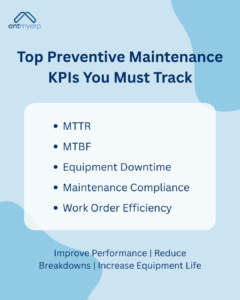
Here is a quick maintenance KPI examples list:
- Planned Maintenance Percentage
- Preventive Maintenance Compliance
- MTTR
- MTBF
- Equipment Downtime
- Work Order Completion Rate
- Maintenance Cost per Asset
- Schedule Compliance
How to Measure Preventive Maintenance Effectiveness Using KPIs
If you are wondering how to track maintenance performance, follow this:
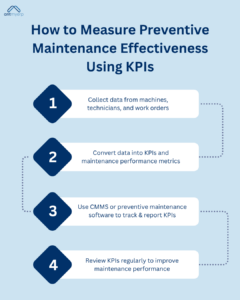
Step 1: Collect Data
From machines, technicians, and work orders
Step 2: Use KPIs
Convert data into meaningful maintenance performance metrics
Step 3: Use CMMS Software
Preventive Maintenance Software helps centralize data, generate reports, and track KPIs efficiently.
Step 4: Review Regularly
Weekly or monthly reviews improve performance continuously.
Equipment Maintenance Performance Indicators
Important equipment maintenance performance indicators include:
- Equipment reliability
- Failure frequency
- Repair time
- Maintenance cost
- Downtime
These directly impact asset performance.
In healthcare, maintenance becomes even more critical. A well-defined medical equipment preventive maintenance checklist ensures safety and compliance.
Reduce Machine Breakdowns Using Maintenance KPIs
You can reduce machine breakdowns using maintenance KPIs by:
- Tracking MTBF to predict failures
- Improving MTTR for faster repairs
- Monitoring compliance to avoid missed maintenance
- Using downtime data to identify issues
This results in:
- Fewer breakdowns
- Better productivity
- Lower operational costs
Maintenance Downtime Tracking: Why It Matters
Maintenance downtime tracking helps:
- Identify problem equipment
- Improve maintenance planning
- Reduce production loss
There are two types:
- Planned downtime
- Unplanned downtime
Goal: minimize unplanned downtime.
For safety systems, regular checks are essential. This fire alarm system maintenance checklist shows how routine maintenance can prevent failures and ensure reliability.
Role of Preventive Maintenance Software
Managing KPIs manually is difficult. Preventive Maintenance Software helps:
- Automate scheduling
- Track KPIs in real time
- Manage work orders
- Improve equipment reliability
For complete service operations, businesses can also use Service Management Software to manage end-to-end workflows.
In sectors like infrastructure preventive elevator maintenance software help automate maintenance tasks and improve service efficiency.
Benefits of Using a Maintenance Management System
A modern system helps:
- Centralize maintenance data
- Improve planning
- Increase uptime
- Reduce machine downtime
- Enable better decisions
Common Mistakes in Maintenance KPI Tracking
1. Tracking Too Many KPIs
Focus on what matters
2. Not Analyzing Data
Insights are more important than data collection
3. Skipping Preventive Maintenance
Leads to frequent failures
4. Using Manual Systems
Creates inefficiencies
Final Thoughts
Tracking the right preventive maintenance KPI is essential for modern businesses.
Without KPIs:
- Maintenance becomes reactive
- Costs increase
- Equipment reliability decreases
With the right maintenance performance metrics and AntMyERP Preventive Maintenance Software, you can:
- Improve asset performance
- Reduce downtime
- Increase reliability
- Optimize maintenance operations
Quick Recap
- Preventive maintenance KPI measures maintenance effectiveness
- Use MTTR, MTBF, and downtime metrics
- Track everything using a maintenance system
- Automate with preventive maintenance software