
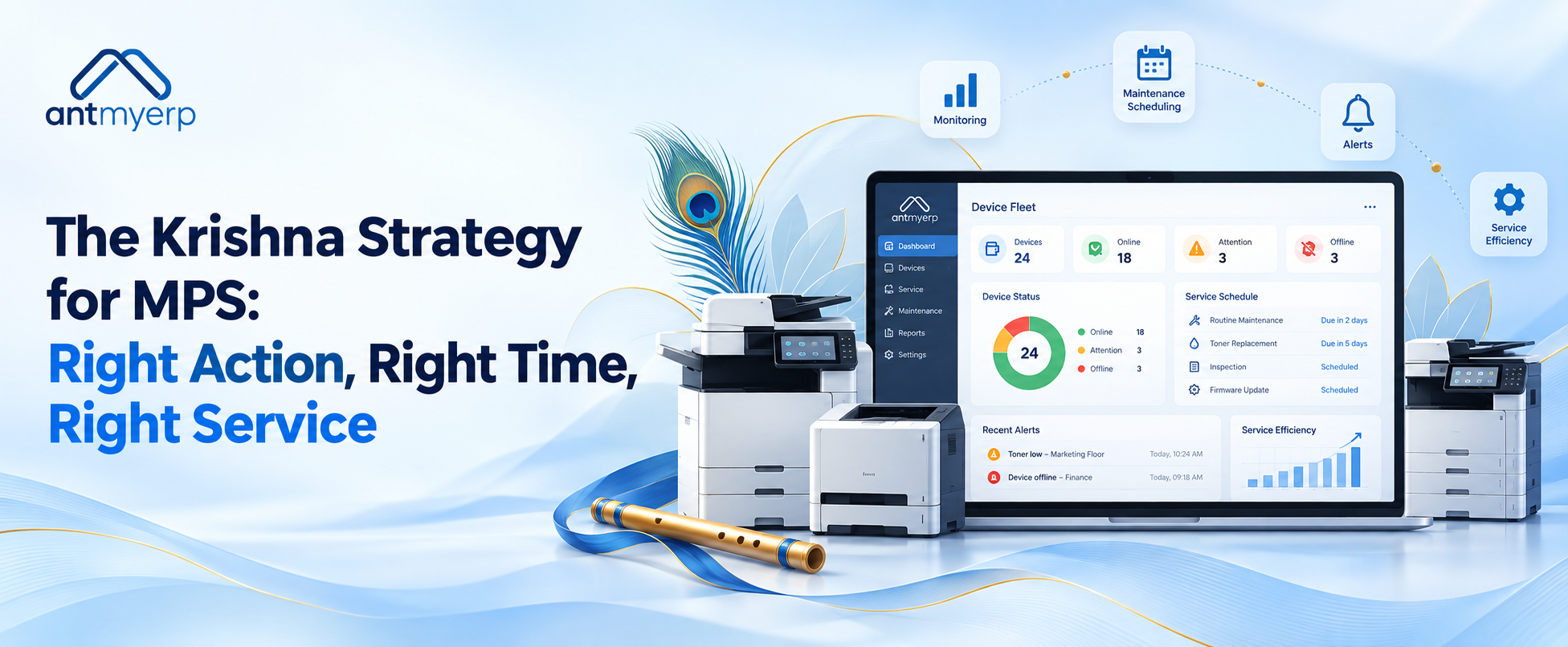
The Krishna Strategy for MPS: Right Action, Right Time, Right Service
2026-09-08
Managing Managed Print Services is not just about printers, toner, and service tickets. It is about knowing what needs attention, when it needs attention, and how to deliver the right service. MPS software helps MPS providers bring customer data, printer records, service requests, technicians, meter readings, consumables, and billing into one connected system.
What Can Krishna Teach Us About MPS?
The teachings of Lord Krishna focus on performing the right action with discipline, awareness, and purpose.This idea also applies to Managed Print Services.
MPS providers manage many printers, customers, contracts, service requests, toner requirements, and technicians every day. As the number of devices grows, manual processes can make it difficult to know what needs attention first.A customer may be waiting for a technician. Another printer may be close to its maintenance schedule. A third customer may need toner soon.
The challenge is not only doing the work. It is doing the right work at the right time.
MPS software helps service teams turn this approach into everyday operations. It gives them better visibility into daily activities so they can prioritize tasks, respond faster, and deliver more consistent service.
Right Action: Know What Needs Attention
In MPS operations, every device does not require the same action. One printer may need preventive maintenance. Another may have a recurring problem. A third may simply need a meter reading.
Without centralized information, teams may depend on spreadsheets, emails, phone calls, and manual reminders. This can create delays and missed follow-ups.
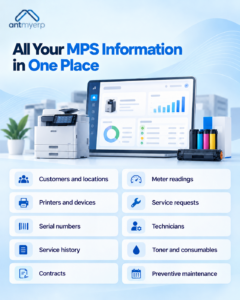
MPS software brings important information together in one place. Teams can maintain records for:
- Customers and locations
- Printers and devices
- Serial numbers
- Service history
- Contracts
- Meter readings
- Service requests
- Technicians
- Toner and consumables
- Preventive maintenance
With this information available, teams can understand the situation before deciding what to do.
For example, a technician can review previous service records before visiting a printer. A service manager can identify devices with repeated problems. A team can also check whether a required spare part is available before scheduling a visit.
The result is simple: better information leads to better action.
Right Time: Do Not Wait for the Next Complaint
Timing matters in MPS.A printer problem may appear small today but become a serious issue if it remains unresolved. Likewise, delaying preventive maintenance can increase the possibility of unexpected breakdowns.
MPS providers therefore need to monitor activities such as:
- Service deadlines
- SLA commitments
- Preventive maintenance
- Meter-reading schedules
- Toner requirements
- Contract renewals
- Technician assignments
MPS software can help teams organize these activities and reduce dependence on manual reminders.Instead of waiting for a customer to report a problem, service teams can identify upcoming maintenance requirements and plan ahead.
This creates a shift from reactive service to proactive service.
The goal is not to respond faster only after something goes wrong.But to reduce the chances of the problem happening in the first place.
Right Service: Every Customer Is Different
Not every MPS customer has the same requirements.An enterprise customer may have hundreds of printers across different locations. A small business may have only a few devices.
Some customers may have strict SLA requirements. Others may need regular toner delivery or scheduled maintenance.
Because of this, MPS providers need customer-specific information.With MPS software, teams can view details such as:
- Customer contracts
- Device information
- Service history
- Open tickets
- SLA requirements
- Meter readings
- Consumable usage
- Previous repairs
This helps teams understand the customer before taking action.When service teams have the right information, they can provide a more consistent customer experience.
Stop Treating Every Printer Problem as an Emergency
Imagine an MPS provider managing 1,000 devices.Five printers report problems on the same day. Should all five receive the same priority?
Not necessarily. One printer may support a critical business process. Another may have a minor issue. A third may already have a technician assigned.Without proper visibility, teams may simply handle requests in the order they arrive.
MPS software can help teams organize service requests based on factors such as priority, SLA, customer, location, technician availability, and device history.
This helps managers decide what should happen first.The result is a more organized service operation.
From Reactive MPS to Proactive MPS
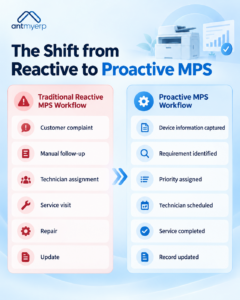
A traditional MPS workflow:
- Customer complaint
- Manual follow-up
- Technician assignment
- Service visit
- Repair
- Update
A proactive MPS workflow:
- Device information captured
- Requirement identified
- Priority assigned
- Technician scheduled
- Service completed
- Record updated
Why the difference matters:
- Preventive maintenance can be planned before a breakdown occurs.
- Service tickets can be assigned based on technician availability.
- Consumables can be tracked to reduce unnecessary delays.
- Customer service teams get better visibility into pending work.
- Service teams can address potential issues before they become major problems.
MPS software helps organize these activities in one workflow, making it easier for teams to move from reactive service to proactive MPS management.
The Right Technician for the Right Job
A service ticket is only the beginning.The next question is: Who should handle it? Sending the wrong technician can increase travel time and delay resolution.
Before assigning a job, service managers may need to consider:
- Technician availability
- Location
- Current workload
- Required skills
- Device type
- Spare part availability
- SLA priority
A connected MPS and field service workflow can give managers better visibility when making these decisions.For MPS providers, this means moving closer to the principle of:
Right technician. Right job. Right time.
AntMyERP helps businesses manage service operations, technicians, service requests, preventive maintenance, and related field activities through a centralized platform.
Meter Readings: Small Data, Important Decisions
Meter readings are an important part of MPS operations.They can support billing, usage tracking, contract management, and service planning.
However, manually collecting and organizing meter readings can become difficult when an MPS provider manages a large number of devices.MPS software can help organize meter information and connect it with customer and device records.
This creates a useful flow:
- Data: Printer usage, service history, toner levels, maintenance schedules
- Insight: Identify devices needing attention
- Decision: Prioritize the right task
- Action: Schedule service, maintenance, or toner delivery
Instead of treating meter readings as only a billing activity, MPS providers can use the information to better understand device usage and customer requirements.
The Krishna Strategy Means Building Better Processes
One of the most useful lessons from Krishna’s teachings is the importance of performing one’s duty with focus and discipline.For MPS providers, this means creating processes that do not depend completely on individual memory.
A service manager should not have to remember every upcoming maintenance task.A technician should not need to search through emails to understand a customer’s printer history.
The finance team should not have to chase different people for meter information.A centralized MPS system can help organize these workflows.
Automation does not replace people.Instead, it helps people spend less time searching for information and more time solving customer problems.
How AntMyERP Supports MPS Operations
MPS providers need to manage more than printers.They need to manage the complete service journey. AntMyERP’s Managed Print Services solution helps connect important MPS activities such as device management, service requests, meter readings, consumables, technicians, and service operations.
This creates a connected flow:
- Customer
- Device
- Contract
- Meter Reading
- Service
- Technician
- Consumable
- Billing
When these processes work together, teams gain better operational visibility.They can identify what needs attention, prioritize the work, assign the right resources, and keep customer records updated.That is the practical meaning of the Krishna strategy for MPS.
Right Action. Right Time. Right Service.
The future of Managed Print Services is not simply about managing more printers. It is about managing service more intelligently.
MPS providers need to know what is happening across their devices, customers, technicians, contracts, and service requests.
They also need to act before small problems become major ones.
MPS software can help make this possible by connecting information, people, and processes in one system.
The principle is simple:
Right action means knowing what needs to be done.Right time means acting before delays become problems.Right service means giving each customer the support they actually need.
For growing MPS providers, this approach can create more organized operations, better service visibility, and stronger customer relationships. In the end, the Krishna strategy for MPS is not about doing everything.
It is about doing the right thing, at the right time, for the right customer.