
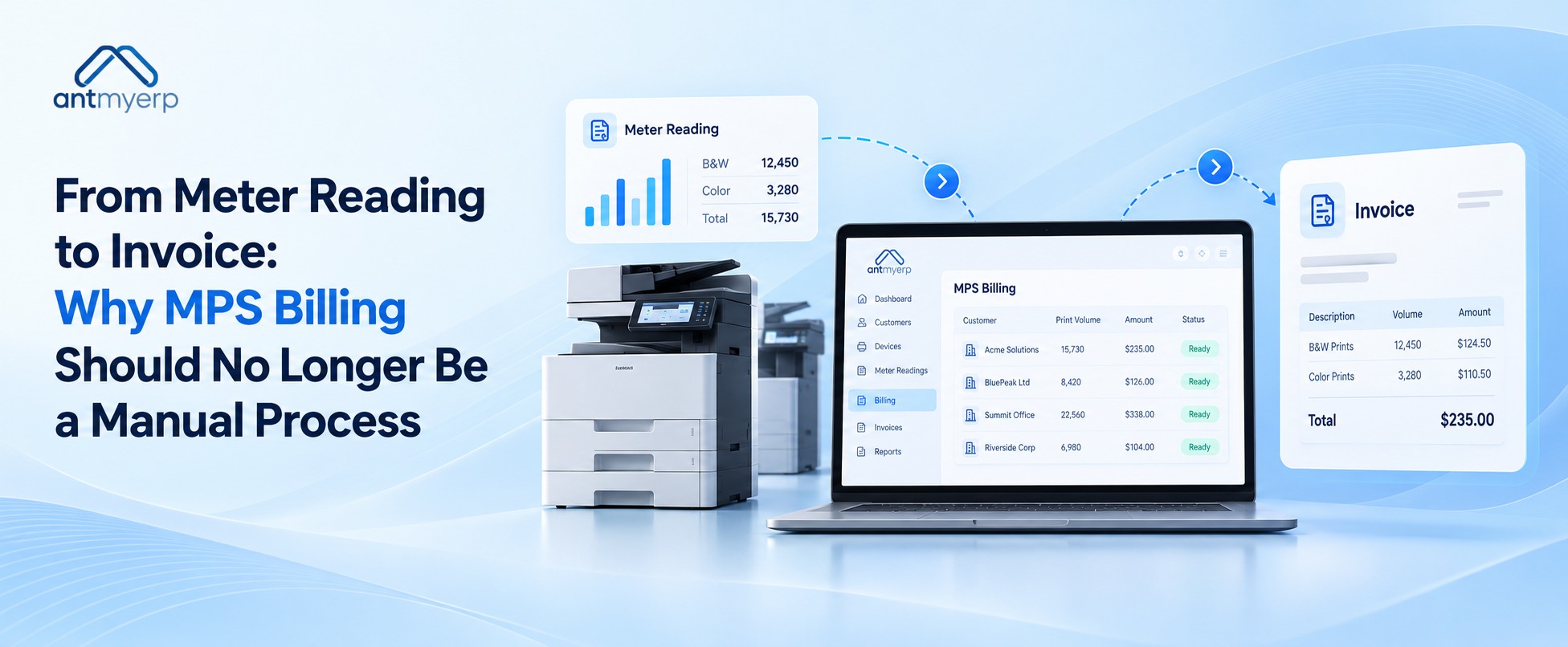
From Meter Reading to Invoice: Why MPS Billing Should No Longer Be a Manual Process
2026-09-14
Managing printer meter readings manually can slow down the entire billing process for Managed Print Services providers. Printer meter reading software helps businesses collect meter data, track usage, calculate billing, and generate invoices with less manual work. By connecting meter readings with MPS billing, providers can reduce errors, speed up invoicing, and improve cash flow.
Managed Print Services providers deal with large amounts of printer data every day. They need to track printer usage, collect meter readings, calculate customer charges, manage service contracts, and generate invoices.
When these tasks are handled manually, the billing process can become slow and complicated.
A missing meter reading, incorrect page count, or spreadsheet error can affect the final invoice. This can lead to billing disputes, delayed payments, and unnecessary administrative work.
That is why businesses need printer meter reading software that can help connect meter data with the billing process.
Instead of manually moving information from printers to spreadsheets and then from spreadsheets to invoices, MPS providers can automate the journey from meter reading to invoice.
For businesses managing a complete printer fleet, a centralized Managed Print Services solution can also help connect different operational processes.
Why Manual Meter Reading Creates Billing Problems
Manual meter reading may seem manageable when a business handles only a few printers.
However, the process becomes more difficult as the number of customers and devices increases.
Employees may need to:
- Collect printer meter readings manually
- Contact customers for usage information
- Enter readings into spreadsheets
- Compare current and previous meter readings
- Calculate page usage
- Apply contract rates
- Prepare invoices manually
Each step creates another opportunity for mistakes. For example, an incorrect meter reading can result in incorrect usage calculations. Incorrect usage can then affect the customer’s invoice. The problem is not only accuracy.
Manual processes also take time. Teams may spend hours collecting and checking data before they can start billing customers. Here automated meter reading can make a major difference.
From Meter Reading to Invoice: Understanding the MPS Billing Process
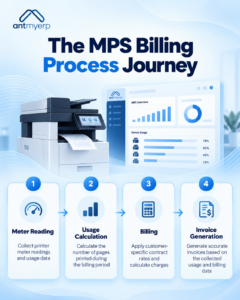
The MPS billing process usually follows a simple journey:
- Meter Reading: Collect printer meter readings and usage data.
- Usage Calculation: Calculate the number of pages printed during the billing period.
- Billing: Apply customer-specific contract rates and calculate charges.
- Invoice Generation: Generate accurate invoices based on the collected usage and billing data.
However, when each stage is managed separately, the process becomes slow. A connected system can make the workflow much easier.
Collecting Printer Meter Readings
The first step is collecting accurate printer meter readings.
Meter readings provide important information about printer usage. They can show the number of pages printed or copied during a specific period.
Traditionally, MPS providers may collect this information manually.
However, printer meter reading software can help businesses organize and manage meter data in one system.
This reduces dependence on spreadsheets and manual data entry.
Businesses managing multiple printer devices can also benefit from dedicated printer service management software.
Tracking Customer Usage
After collecting meter readings, the business needs to calculate actual usage.
For example, the system can compare the current meter reading with the previous reading.
This helps determine:
- Total pages printed
- Black and white page usage
- Color page usage
- Device usage during the billing period
This information becomes important for usage-based billing. Instead of estimating customer usage, MPS providers can use actual meter data to calculate charges.
Calculating MPS Billing
Once usage data is available, the next step is billing.
Different customers may have different service agreements.
Some contracts may include:
- Cost-per-page billing
- Monthly minimum charges
- Fixed service charges
- Separate rates for color printing
- Separate rates for black and white printing
Calculating these charges manually can become difficult when managing multiple customers.
An MPS billing software solution can help connect customer contracts, meter readings, and billing information.
This makes the billing process more organized and consistent.
For businesses managing service agreements and recurring customer services, AMC management software can help organize contract-related operations.
Generating Customer Invoices
The final step is invoice generation.
With a manual process, employees may need to transfer billing information into an invoicing system.
This creates additional work.
It also increases the risk of errors.
With MPS invoice automation, businesses can move billing information toward invoice generation more efficiently.
As a result, invoices can be prepared faster and with better accuracy.
The Biggest Problems With Manual MPS Billing
Manual billing affects more than just the finance team. It can impact customer experience, operations, and cash flow.
1. Incorrect Meter Readings
Manual data collection can lead to incorrect entries.
Even a small mistake can affect usage calculations.
This may result in an incorrect invoice.
2. Too Much Spreadsheet Work
Many MPS providers depend on spreadsheets to manage meter readings and billing data.
While spreadsheets can be useful, they become difficult to manage when the business grows.
Teams may have multiple files for different customers, contracts, and billing periods.
This makes information harder to track.
3. Delayed Invoice Generation
When teams need to collect, verify, and calculate information manually, invoices can take longer to generate.
Delayed invoices can also delay customer payments.
4. Billing Disputes
Customers expect clear and accurate invoices.
If the invoice does not match their actual printer usage, they may question the charges.
Accurate printer meter readings can help businesses provide better billing transparency.
5. Higher Administrative Work
Employees should not have to spend large amounts of time copying numbers between systems.
Automation can reduce repetitive work and allow teams to focus on more important tasks.
How Printer Meter Reading Software Automates the Process
A printer meter reading software solution helps bring important usage information into a more organized workflow.
Instead of treating meter readings as isolated data, businesses can use them as part of the complete billing process.
The workflow can look like this:
Step 1: Collect Meter Data
The business collects and records printer meter readings.
Step 2: Calculate Usage
The system compares readings to identify actual printer usage during the billing period.
Step 3: Apply Customer Contract Rates
Usage information can be connected with customer-specific pricing and service agreements.
Step 4: Prepare Billing Information
The required billing data is organized based on actual usage.
Step 5: Generate Invoices
The business can use the billing information to support faster and more accurate invoice generation.
This connected approach helps reduce the gap between operational data and financial processes.
Why Meter Readings Should Be Connected to Billing
Meter readings are not just technical information. For an MPS provider, they are also billing data. Every meter reading can provide information about customer usage. When this data remains disconnected from billing systems, employees need to manually transfer information.
Meter readings are not just technical information. For an MPS provider, they are also billing data. According to Quocirca, printer data and analytics can help MPS providers gain valuable business insights. Every meter reading can provide information about customer usage. When this data remains disconnected from billing systems, employees need to manually transfer information.
A meter reading and billing software solution helps connect these processes.
This creates a smoother workflow between:
- Printer usage
- Customer contracts
- Billing calculations
- Invoice generation
As a result, businesses can reduce manual steps. They can also improve billing consistency.
Benefits of Automated MPS Billing with Printer meter reading software
Automating the journey from meter reading to invoice can provide several benefits.
Improved Billing Accuracy
When businesses reduce manual data entry, they can reduce the risk of human errors.
Accurate meter data supports more accurate billing.
Faster Invoice Generation
Automation can reduce the time required to prepare invoices.
Instead of waiting for employees to manually calculate usage, businesses can streamline the process.
Reduced Administrative Work
Teams no longer need to spend as much time moving information between spreadsheets and systems.
This can improve overall productivity.
For companies managing service teams alongside printer operations, field service management software can help organize service requests, technicians, and field activities.
Better Cash Flow
Faster invoicing can help businesses send bills on time.
Timely invoices can support faster payment cycles and better cash flow.
Better Customer Transparency
Customers can better understand charges when invoices are based on clear usage information.
This can help reduce billing-related questions and disputes.
Printer Downtime Is More Expensive Than You Think
Manual MPS Billing vs Automated MPS Billing
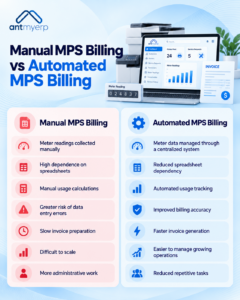
Manual MPS billing requires teams to collect meter readings, calculate printer usage, and prepare invoices manually. This often increases dependence on spreadsheets, creates more administrative work, and raises the risk of data entry errors. As the number of printers and customers grows, managing the billing process manually can become more difficult and time-consuming.
Automated MPS billing creates a more connected process by managing meter data, tracking usage, and supporting faster invoice generation through a centralized system. It helps reduce repetitive tasks, improve billing accuracy, and make it easier for Managed Print Services providers to manage growing operations.
As an MPS business grows, the difference between these two approaches becomes even more important.
How MPS Billing Software Supports Growing Print Businesses
Growth brings more customers. More customers bring more printers, contracts, meter readings, and invoices.
A process that works for 20 devices may not work efficiently for 500 devices. This is why growing providers need a connected system.
Managed print services billing software can help businesses organize operational and billing information in one workflow.
Instead of managing every stage separately, businesses can create a more connected process.
This can be especially useful for companies managing:
- Large printer fleets
- Multiple customer locations
- Different service contracts
- Cost-per-page agreements
- Regular billing cycles
Automation does not simply save time. It can also help businesses build a process that is easier to scale.
Learn more about how data is shaping the future of Managed Print Services.
How AntMyERP Helps Streamline MPS Operations
Managing Managed Print Services involves much more than tracking printers.
Businesses also need to manage customers, service requests, technicians, printer assets, consumables, meter readings, and billing-related information.
AntMyERP helps businesses bring important operational processes into a centralized system.
For MPS providers, connecting printer information with service and operational workflows can help reduce dependence on disconnected spreadsheets and manual processes.
The Managed Print Services software solution can support businesses that need better visibility into printer-related operations.
MPS providers can also use service management software to organize service requests and customer service activities.
A connected platform helps businesses manage information more efficiently across different stages of their operations.
The Future of MPS Billing Is Connected and Automated
The future of Managed Print Services is becoming increasingly data-driven.
Printer data can help businesses make better operational decisions.
However, data creates the most value when it is connected to the right business processes.
Meter readings should not remain isolated inside spreadsheets.
They should support usage tracking, billing calculations, and invoice generation.
A printer meter reading software solution can help businesses create a smoother journey from printer usage to customer billing.
For MPS providers, this means less manual work, better billing accuracy, faster invoices, and a more scalable operation.
The goal is simple.
Collect accurate meter data once and use that information throughout the billing workflow.
From meter reading to invoice, the process should no longer depend on manual data entry.
It should be connected, accurate, and ready to support business growth.