
Preventive Maintenance Checklist for Power Equipment Industry
2026-05-31
This blog covers a preventive maintenance checklist for generators, transformers, UPS systems, motors, compressors, and other power equipment. Regular inspections help maintenance teams find small problems early and avoid sudden equipment breakdowns.
Why Small Equipment Problems Become Big Failures
In factories, machines run all day, so maintenance checks are sometimes delayed.At first, the problem does not look big.A generator starts a little late. A motor gets a little hot. The compressor pressure becomes low slowly.But since the machine is still working, people ignore it.
After some time, the same small issue can stop the machine suddenly and work gets delayed. That is why an electrical equipment maintenance checklist and regular maintenance is important.
Common Problems Maintenance Teams Face
Many companies still use paper records or spreadsheets to manage maintenance work. This becomes difficult when there are many machines to handle. Teams often struggle with:
- Missed inspections
- Delayed servicing
- Incomplete records
- Repeated equipment problems
- Confusion between teams
- Sudden downtime
When maintenance history is not properly tracked, it becomes harder to know which machine needs attention first.
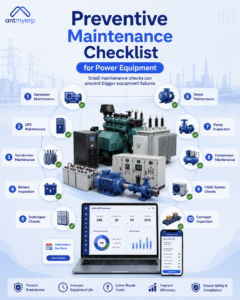
Preventive Maintenance Checklist for Power Equipment (Electrical equipment)
Generator Maintenance Checklist
Generators are mostly used during power cuts or emergency situations. But many generator problems start much earlier. Sometimes teams notice battery weakness, overheating, or fuel leakage but delay inspection because the generator is still working.
During routine maintenance, technicians usually check:
- Fuel level and fuel leakage
- Battery condition
- Engine oil and coolant level
- Belts and hoses
- Cooling airflow
- Unusual noise or vibration
- Generator startup performance
In many facilities, weak batteries and overheating are common reasons for generator failure.
UPS Maintenance Checklist
UPS systems help provide backup power during electricity failure. Most of the time, they stay in the background, so problems are not noticed quickly.Many businesses only discover UPS issues during a sudden power cut.
Maintenance teams usually inspect:
- Battery health
- Charging condition
- Warning alarms
- Backup timing
- Cooling fans
- Loose electrical connections
Old batteries are one of the most common UPS problems.
Transformer Maintenance Checklist
Transformers work continuously, so small problems slowly grow over time if inspections are delayed.Oil leakage, rising temperature, or damaged insulation can later affect the whole system. Routine transformer checks usually include:
- Transformer oil condition
- Leakage inspection
- Temperature monitoring
- Insulation testing
- Cooling fan inspection
- Electrical connection checks
Maintenance teams also watch for overheating or unusual humming sounds.
Battery Maintenance Checklist
Industrial batteries support backup systems and emergency equipment.Many battery issues stay hidden until the power fails.Technicians usually inspect:
- Battery voltage
- Terminal corrosion
- Charging cycles
- Electrolyte level
- Battery cleanliness
- Backup performance
Corrosion and weak charging are common battery problems in older systems.
Switchgear Maintenance Checklist
Switchgear protects equipment from overload and electrical faults.If maintenance is delayed, even small issues inside switchgear panels can become dangerous. Routine inspection usually includes:
- Circuit breaker checks
- Fuse inspection
- Relay testing
- Loose wire inspection
- Grounding checks
- Panel cleaning
Dust buildup and loose connections are common issues found during maintenance.
Motor Maintenance Checklist
Motors are used in many industrial machines, so they face continuous load every day.Over time, teams may notice vibration, overheating, or reduced performance. Routine motor inspection usually includes:
- Bearing lubrication
- Alignment checks
- Vibration monitoring
- Temperature checks
- Fan cleaning
- Wiring inspection
Poor lubrication is one of the biggest reasons behind motor failure.
Pump Maintenance Checklist
Pumps help move liquids through industrial systems.Small pump problems often start with leakage or pressure loss. Maintenance teams usually inspect:
- Seals and gaskets
- Pressure level
- Flow performance
- Lubrication condition
- Leakage around joints
- Vibration and noise
Seal leakage and reduced flow are common pump problems.
Compressor Maintenance Checklist
Compressors provide compressed air for industrial operations.When maintenance gets delayed, compressors slowly lose efficiency. Routine compressor checks usually include:
- Air filter inspection
- Oil level checks
- Pressure monitoring
- Hose leakage inspection
- Cooling system checks
- Moisture drainage
Air leakage is a common issue in older compressor systems.
HVAC Maintenance Checklist
HVAC systems help control airflow and temperature inside facilities.When HVAC maintenance is ignored, cooling performance starts dropping slowly.
Maintenance teams usually inspect:
- Air filters
- Ducts and airflow
- Thermostat condition
- Refrigerant levels
- Electrical components
- Cooling performance
Dirty filters and poor airflow are common HVAC problems.
Conveyor Maintenance Checklist
Conveyors move materials from one place to another inside industrial facilities. Even small conveyor problems can slow down operations. Routine conveyor inspection usually includes:
- Belt condition
- Roller inspection
- Alignment checks
- Motor performance
- Lubrication of moving parts
- Vibration and noise monitoring
Belt misalignment and roller wear are common conveyor issues.
Why More Companies Are Focusing on Regular equipment maintenance
Today, most factories cannot afford machine stoppages, even for a short time. One breakdown is enough to delay production and increase costs quickly.
As per ITPro, unplanned downtime is not just a technical issue but a major business cost, as it leads to lost revenue, productivity loss, and long-term operational impact for organizations.
Many companies are ready to follow from the “wait until it fails” approach.Their teams now check equipment regularly and fix small issues, before it turns into bigger breakdowns.
Why Manual Maintenance Tracking Creates Problems
Many maintenance teams still manage inspections using paper records or spreadsheets. After some time, this creates problems like:
- Missed maintenance dates
- Incomplete inspection records
- Difficulty tracking machine history
- Delayed technician updates
- Poor visibility across equipment
As the number of machines increases, manual tracking becomes harder to manage.
How Preventive Maintenance Software Helps
Many companies now use preventive maintenance software to organize maintenance work better.
AntMyERP’s Preventive maintenance software help teams:
- Schedule inspections automatically
- Track service history
- Manage work orders
- Assign technician tasks
- Receive maintenance reminders
- Monitor equipment records in one place
This helps maintenance teams stay more organized and reduce unexpected downtime.
Industries Where Preventive Maintenance Is Important
Preventive maintenance is useful in many industries, including:
- Power plants
- Manufacturing
- Oil and gas
- Healthcare facilities
- Construction equipment companies
- Data centers
These industries depend on machines running properly every day.
Final Thought: Small Maintenance Delays Can Become Expensive Problems
Most equipment failures do not happen suddenly. In many cases, small warning signs were already there earlier.Regular inspections help maintenance teams find problems before they become serious.Preventive maintenance electrical equipment checklist helps companies improve equipment reliability, reduce downtime, and keep operations running smoothly. Read more on:
To explore more service modules and see how they work, talk to our experts.