
The Importance of CMMS Software in the Power Equipment Sector
2026-10-14
Power equipment plays a critical role in electricity generation, transmission, distribution, and industrial operations. From generators and transformers to turbines and electrical control systems, these assets must remain reliable to support daily operations. However, unexpected breakdowns, delayed repairs, and poor maintenance planning can lead to costly downtime.
CMMS software for power equipment helps maintenance teams organize service schedules, track equipment history, manage spare parts, and monitor maintenance activities from one centralized system. Instead of relying on spreadsheets or paper records, teams can use maintenance data to plan work more effectively and identify potential issues before they cause major disruptions.
As power systems become more complex, a structured maintenance process is essential for improving equipment reliability, controlling costs, and extending asset life.
What Is CMMS Software for Power Equipment?
A computerized maintenance management system (CMMS) is software that helps organizations plan, schedule, track, and manage maintenance activities. In the power equipment sector, it supports the upkeep of electrical and mechanical assets used in power plants, substations, industrial facilities, and other energy-related operations.
CMMS software for power equipment centralizes maintenance records, work orders, inspection schedules, spare parts information, and equipment service history. This gives maintenance managers a clearer view of asset conditions and upcoming maintenance requirements.
For example, a power plant maintenance team can use a CMMS to schedule generator inspections, assign repair tasks, record maintenance findings, and track the replacement of worn components. As a result, technicians can follow a more consistent maintenance process.
Depending on its capabilities and integrations, a CMMS may also support condition monitoring and predictive maintenance workflows. However, predictive insights usually require suitable sensor data, monitoring tools, or other connected systems.
Why Is Maintenance Important in the Power Equipment Sector?
Power equipment often operates under demanding conditions. Continuous operation, high temperatures, vibration, electrical loads, and environmental exposure can contribute to wear and unexpected failures.
Without proper maintenance planning, even a minor fault can affect equipment availability and disrupt connected operations.
Here are some common maintenance challenges in the power equipment sector.
1. Unexpected Equipment Breakdowns
Equipment failures can interrupt power generation or affect the performance of electrical systems. Emergency repairs may also require additional labor, replacement components, and urgent service arrangements.
A CMMS helps teams maintain service schedules, record recurring faults, and prioritize maintenance tasks. These records make it easier to identify equipment that requires closer attention.
2. Unplanned Downtime
Unplanned downtime can affect production targets, operational costs, and service reliability. When maintenance teams do not have clear visibility into equipment conditions or pending work, they may struggle to respond quickly.
Maintenance software helps teams organize work orders, assign responsibilities, and track repair progress. Consequently, teams can coordinate maintenance activities more effectively and reduce avoidable delays.
3. Poor Spare Parts Availability
Repairs can take longer when essential components are unavailable. On the other hand, holding excessive inventory increases storage costs and ties up working capital.
Spare parts management features help teams track stock levels, monitor parts usage, and identify replenishment requirements. This improves visibility into the components needed for routine maintenance and emergency repairs.
4. Incomplete Maintenance Records
Paper-based records and disconnected spreadsheets can make it difficult to understand an asset’s maintenance history. Teams may also lose important information when technicians change roles or service responsibilities shift.
A centralized CMMS stores maintenance records, inspection results, repair details, and work order history. Therefore, authorized employees can access relevant information when planning future maintenance.
5. Limited Maintenance Visibility
Maintenance managers need accurate information about open work orders, overdue inspections, recurring faults, and maintenance costs. Without a consolidated view, prioritizing tasks becomes more difficult.
A CMMS dashboard can bring key maintenance information together, helping managers review workloads, identify bottlenecks, and make better-informed decisions.
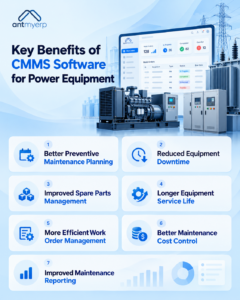
Key Benefits of CMMS Software for Power Equipment
Implementing the right maintenance system can help power equipment operators improve maintenance planning and asset management.
1. Better Preventive Maintenance Planning
Preventive maintenance involves inspecting, servicing, and replacing components at planned intervals to reduce the risk of unexpected failures.
Preventive maintenance software for power equipment helps teams schedule recurring inspections and service tasks based on time, usage, or other supported maintenance triggers.
For example, maintenance teams can schedule regular inspections for generators, lubrication checks for rotating machinery, and routine testing of selected electrical equipment. The system can also help track upcoming and overdue tasks.
As a result, teams can follow planned maintenance routines instead of relying only on breakdown-based repairs.
2. Reduced Equipment Downtime
Equipment downtime can affect productivity, maintenance budgets, and operational reliability. Although a CMMS cannot prevent every failure, it helps teams manage maintenance work more systematically.
Technicians can receive assigned work orders, review fault descriptions, record repair findings, and update task status. Maintenance managers can then monitor progress and identify unresolved issues.
Over time, maintenance history can reveal recurring problems that deserve further investigation. Addressing these issues may help reduce avoidable downtime.
3. Improved Spare Parts Management
Power equipment maintenance often depends on having the correct components available when needed. Missing parts can delay repairs, while excess stock can increase inventory expenses.
A CMMS with inventory management capabilities helps teams monitor spare parts availability, track consumption, and maintain records of parts used during repairs.
This supports better coordination between maintenance and inventory teams. It can also help organizations plan replenishment around maintenance schedules and equipment requirements.
4. Longer Equipment Service Life
Regular inspections and timely repairs can help identify wear before it develops into a more serious problem. This is especially important for high-value assets such as generators, transformers, turbines, and industrial electrical systems.
A CMMS maintains service histories that help technicians understand previous faults, component replacements, and inspection findings.
These records support maintenance decisions throughout the asset lifecycle. They also help managers evaluate whether an asset needs continued maintenance, refurbishment, or replacement.
5. More Efficient Work Order Management
Unclear instructions, delayed approvals, and poor task coordination can slow down maintenance work.
With CMMS software, teams can create work orders, assign technicians, set priorities, record labor, and track task completion. Managers can also review outstanding jobs and identify work that needs immediate attention.
A more organized workflow helps maintenance teams coordinate responsibilities and maintain better records of completed work.
6. Better Maintenance Cost Control
Frequent emergency repairs, excessive spare parts purchases, and repeated equipment failures can increase maintenance expenses.
A CMMS helps organizations record maintenance activities, parts consumption, labor details, and repair history. Managers can use these records to review spending patterns and identify assets that require frequent repairs.
Although cost savings depend on the equipment, maintenance strategy, and implementation, better records provide a stronger basis for maintenance budgeting.
7. Improved Maintenance Reporting
Maintenance teams need reliable data to evaluate performance and plan future work. A CMMS can provide reports on completed tasks, overdue work orders, equipment failures, and maintenance activity.
Depending on the system, managers may also track indicators such as mean time to repair (MTTR), mean time between failures (MTBF), preventive maintenance compliance, and maintenance costs.
These insights help teams assess performance and identify opportunities to improve maintenance practices.
Essential Features of Power Equipment Maintenance Software
When evaluating power equipment maintenance software, organizations should look for features that match their asset types, maintenance processes, and operational requirements.
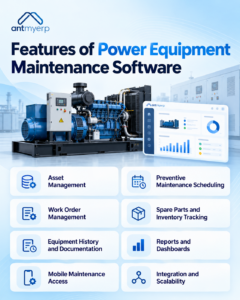
Asset Management
Asset management features maintain records of equipment details, locations, specifications, service histories, and maintenance requirements.
These records help teams identify assets, review previous repairs, and organize maintenance activities throughout the asset lifecycle.
Preventive Maintenance Scheduling
Maintenance scheduling tools help teams plan inspections and servicing at defined intervals. Automated reminders and recurring work orders can reduce the risk of missed maintenance activities.
Organizations should check whether the software supports calendar-based, meter-based, or condition-based triggers relevant to their equipment.
Work Order Management
Work order management supports task creation, assignment, prioritization, progress tracking, and completion records. It helps technicians and managers maintain a shared view of maintenance activities.
Spare Parts and Inventory Tracking
Inventory features help teams track spare parts, stock movements, usage, and replenishment needs. Integration between maintenance tasks and inventory records can improve visibility into the materials required for repairs.
Equipment History and Documentation
Centralized records can include inspection reports, maintenance logs, equipment manuals, fault details, and replacement histories.
Easy access to these documents helps technicians prepare for service tasks and make informed maintenance decisions.
Reports and Dashboards
Dashboards provide a consolidated view of maintenance performance. Teams can use reports to monitor open work orders, overdue preventive maintenance, recurring faults, and equipment repair trends.
Mobile Maintenance Access
Mobile access allows technicians to view assigned tasks, review equipment information, and update work orders while working in the field or at remote facilities, subject to the software’s supported capabilities.
Integration and Scalability
Some organizations may need to connect their CMMS with ERP, inventory, procurement, or equipment monitoring systems. Before selecting a solution, check its integration options, data requirements, access controls, and ability to support additional assets or locations.
CMMS vs. Predictive Maintenance for Power Equipment
Preventive and predictive maintenance serve related but different purposes.
Preventive maintenance follows a planned schedule, while predictive maintenance uses equipment condition data and analytical methods to estimate when maintenance may be needed.
For example, a preventive maintenance plan may schedule a generator inspection every three months. A predictive maintenance approach may use vibration, temperature, or other condition data to identify signs of developing faults.
A CMMS provides the work management and maintenance recordkeeping needed to support these activities. When connected to suitable monitoring systems, it may also help teams convert condition alerts into maintenance work orders.
However, a CMMS does not automatically provide predictive maintenance simply because it stores equipment records. Organizations need the appropriate monitoring technology, data quality, integrations, and analytical capabilities to support predictive workflows.
Combining planned maintenance with condition-based insights can help teams prioritize work more effectively.
How to Choose the Right CMMS for Power Equipment
Selecting a maintenance system requires more than comparing feature lists. Organizations should evaluate how well the software fits their equipment, maintenance procedures, and reporting needs.
Consider these factors before making a decision:
- Equipment coverage: Confirm that the system can maintain records for your generators, transformers, turbines, electrical panels, or other relevant assets.
- Maintenance scheduling: Check whether it supports the preventive maintenance schedules and triggers your team uses.
- Work order flexibility: Evaluate how easily users can create, assign, prioritize, and close maintenance tasks.
- Inventory capabilities: Confirm that spare parts tracking and replenishment workflows meet your requirements.
- Reporting: Look for reports that support maintenance planning, performance monitoring, and cost analysis.
- Mobile usability: Ensure technicians can access and update relevant information at the worksite.
- Integration requirements: Identify any connections needed with ERP, procurement, monitoring, or other operational systems.
- Ease of implementation: Consider data migration, user training, configuration, and ongoing support.
- Scalability: Choose a solution that can accommodate additional equipment, facilities, and maintenance teams as operations grow.
It is also useful to map your current maintenance process before evaluating software. This helps you identify the problems the system needs to solve and avoid paying for features your team does not require.
How AntMyERP Can Support Maintenance Operations
Power equipment maintenance involves more than scheduling inspections. Teams also need to manage assets, coordinate service tasks, track spare parts, and maintain reliable records.
AntMyERP offers business software capabilities for service and asset-related operations. Depending on the modules selected and the organization’s requirements, businesses can evaluate how these capabilities fit their maintenance workflows.
When assessing AntMyERP or any other solution, consider whether it supports your required preventive maintenance schedules, work order processes, asset records, inventory tracking, and reporting needs.
The right configuration should help your team centralize maintenance information, improve task coordination, and make better use of equipment service history.
Looking to improve your maintenance management process? Explore AntMyERP’s AMC Management Software to understand how structured maintenance and service management can support your operations, and discuss your specific requirements with the team.
Conclusion
Reliable power equipment depends on consistent maintenance planning, accurate records, and timely repairs. When teams rely on disconnected spreadsheets or reactive maintenance alone, they may struggle to identify recurring faults, coordinate service work, and manage spare parts effectively.
CMMS software for power equipment provides a structured way to organize maintenance schedules, work orders, asset histories, and inventory information. With the right processes and implementation, it can help maintenance teams improve visibility, support equipment reliability, and make better-informed decisions throughout the asset lifecycle.
Evaluate your current maintenance challenges, identify the capabilities your team needs, and choose a system that supports your long-term operational goals.