
How India’s Cooling Action Plan Will Impact HVAC Companies, Dealers, and Service Teams
2026-07-24
India’s Cooling Action Plan (ICAP) is reshaping the future of the HVAC industry. As cooling demand rises due to urbanization, heatwaves, and economic growth, HVAC companies will face increasing installation requests, larger AMC portfolios, technician shortages, and higher customer expectations. Businesses that invest in digital tools such as HVAC Service Management Software can improve operational, enhance customer service, and support India’s sustainable cooling goals.
India’s Cooling Industry Is Entering a New Era
India is getting hotter every year. Longer summers, frequent heatwaves, rapid urbanization, and increasing disposable incomes are driving record demand for air conditioners and commercial cooling systems. From residential apartments and office buildings to hospitals, factories, shopping malls, and data centers, cooling has become a necessity rather than a luxury.
According to the International Energy Agency (IEA), space cooling is one of the fastest-growing uses of electricity globally, and demand is expected to increase significantly over the coming decades. To prepare for this future while reducing environmental impact, the Government of India introduced the India Cooling Action Plan (ICAP) , the world’s first comprehensive national cooling strategy.
For HVAC manufacturers, contractors, dealers, distributors, and service providers, ICAP is more than an environmental policy. It is a roadmap that will shape business operations, workforce development, energy efficiency, and customer service over the next decade.
What Is the India Cooling Action Plan (ICAP)?
The India Cooling Action Plan (ICAP) is a long-term national strategy launched by the Government of India to address the country’s growing cooling needs while reducing environmental impact. It provides a framework for sustainable cooling across residential, commercial, transportation, refrigeration, and cold chain sectors.
Unlike traditional environmental policies, ICAP focuses on balancing economic growth with climate responsibility. It encourages the adoption of energy-efficient technologies, environmentally friendly refrigerants, skilled workforce development, and better cooling infrastructure.
According to the Ministry of Environment, Forest and Climate Change (MoEFCC), the plan aims to improve access to cooling while reducing cooling demand, refrigerant requirements, and energy consumption over time.
Why Was the India Cooling Action Plan Introduced?
India is expected to become one of the world’s largest cooling markets. Rising temperatures, expanding cities, growing middle-class incomes, and increased demand for thermal comfort are accelerating the adoption of cooling systems across industries.
Without proper planning, this rapid growth could lead to:
- Higher electricity consumption
- Increased greenhouse gas emissions
- Greater pressure on the power grid
- Rising operating costs
- Shortage of skilled HVAC professionals
- Increased demand for maintenance and repair services
The India Cooling Action Plan addresses these challenges by promoting sustainable cooling solutions that support both economic development and environmental protection.

The Five Major Goals of ICAP
The India Cooling Action Plan focuses on several long-term objectives that will directly influence the HVAC industry.
1. Reduce Cooling Demand
The plan encourages better building design, insulation, passive cooling techniques, and efficient cooling systems to reduce overall energy consumption.
2. Improve Energy Efficiency
Energy-efficient air conditioning systems consume less electricity, reduce operating costs, and help lower carbon emissions. Organizations are encouraged to adopt high-efficiency equipment and improve maintenance practices.
3. Promote Environmentally Friendly Refrigerants
ICAP supports the gradual transition toward refrigerants with lower Global Warming Potential (GWP), helping India meet its environmental commitments while improving long-term sustainability.
4. Develop Skilled HVAC Professionals
One of the biggest challenges facing the HVAC industry is the shortage of trained technicians. ICAP emphasizes workforce development, technician certification, and skill enhancement to improve service quality across the country.
5. Strengthen Cold Chain and Cooling Infrastructure
Beyond air conditioning, the plan also supports improvements in refrigeration, cold storage, food processing, healthcare, pharmaceuticals, and agricultural supply chains.
Why This Matters for HVAC Companies Today
The India Cooling Action Plan is creating new opportunities for HVAC businesses—but it also raises the bar for operational efficiency.
As demand for cooling systems increases, HVAC companies will need to:
- Install more equipment in less time.
- Respond to service requests faster.
- Manage a growing number of AMC contracts.
- Ensure technicians have the right skills and spare parts.
- Deliver better customer experiences through faster and more transparent service.
Businesses that continue relying on spreadsheets, paper job cards, or manual scheduling may struggle to keep pace with this growth. Digital service management will become a competitive advantage rather than an optional investment.
How India’s Cooling Action Plan Will Impact HVAC Companies
India’s Cooling Action Plan (ICAP) is not just about reducing environmental impact, it will also reshape how HVAC businesses manage installations, maintenance, customer service, and field operations. As cooling demand grows, companies that modernize their processes will be better equipped to handle higher workloads and changing customer expectations.
1. Preventive Maintenance Will Become a Business Priority
Energy-efficient HVAC systems require regular servicing to perform at their best. Dirty filters, refrigerant leaks, worn-out components, or poorly maintained equipment can increase energy consumption and reduce system lifespan.
As ICAP promotes sustainable and energy-efficient cooling, preventive maintenance will become more important for:
- Residential air conditioning
- Commercial HVAC systems
- Industrial cooling equipment
- Hospitals and healthcare facilities
- Data centers
- Cold storage and food processing
For HVAC companies, this means shifting from reactive repairs to planned maintenance programs.
What this means for businesses
- More scheduled maintenance visits
- Higher demand for Annual Maintenance Contracts (AMCs)
- Better customer retention through proactive service
- Reduced emergency breakdowns
2. Annual Maintenance Contracts (AMCs) Will Grow Rapidly
As more air conditioning systems are installed across India, the installed equipment base will continue to expand. Every new installation creates a long-term opportunity for maintenance and after-sales support.
Instead of waiting for equipment failures, many businesses and homeowners are choosing AMC plans that include:
- Regular inspections
- Cleaning and servicing
- Filter replacement
- Performance checks
- Priority support
- Reduced repair costs
Managing hundreds or thousands of AMC customers manually can become challenging. Missed visits, delayed renewals, and poor service tracking often lead to customer dissatisfaction.
AMC Management Software helps businesses automate maintenance schedules, send reminders, and maintain complete service histories.
3. Technician Shortages Will Become a Bigger Challenge
One of the key objectives of the India Cooling Action Plan is to strengthen India’s HVAC workforce through skill development and technician training. However, the demand for skilled technicians is expected to grow faster than the available workforce.
This creates operational challenges such as:
- Longer customer wait times
- Delayed installations
- Missed maintenance visits
- Increased overtime costs
- Lower first-time fix rates
HVAC companies that improve technician productivity through better scheduling, mobile access to work orders, and real-time communication will have a competitive advantage.
4. Customers Will Expect Faster and More Transparent Service
Today’s customers expect more than just a repair—they expect a seamless service experience.
They want to know:
- When the technician will arrive
- Service progress in real time
- Warranty status
- Parts replaced
- Digital service reports
- Easy payment options
Companies that provide real-time updates and digital communication are more likely to build customer trust and encourage repeat business.
5. Spare Parts and Inventory Management Will Become Critical
As service requests increase, managing spare parts efficiently becomes essential.
Technicians need quick access to components such as:
- Compressors
- Capacitors
- Condenser coils
- Evaporator coils
- Thermostats
- Fan motors
- Refrigerants
- Filters
Without proper inventory visibility, businesses may experience:
- Delayed repairs
- Repeat technician visits
- Lost revenue
- Poor customer satisfaction
Inventory management software helps ensure the right parts are available at the right time, reducing downtime and improving first-time fix rates.
How India’s Cooling Action Plan Will Impact HVAC Dealers
HVAC dealers are no longer just product sellers; they play a vital role in installation, warranty management, customer education, and after-sales support.
As cooling demand rises, dealers can expect:
- Increased sales of energy-efficient HVAC systems
- More installation requests
- Higher warranty registrations
- Greater demand for preventive maintenance plans
- Increased coordination with field service teams
Dealers that offer complete lifecycle support from product selection to ongoing maintenance can strengthen customer relationships and generate recurring revenue.
How Service Teams Need to Prepare
Field service teams will be at the forefront of India’s growing cooling demand. To keep pace, they will need better tools, streamlined workflows, and real-time visibility into daily operations.
Why Manual Service Management Is No Longer Enough
Many HVAC businesses still rely on spreadsheets, phone calls, WhatsApp messages, and paper job cards to manage field operations.
While these methods may work for small teams, they become increasingly difficult to manage as the business grows.
Common challenges include:
- Missed customer appointments
- Duplicate work orders
- Delayed technician assignments
- Lost service history
- Difficulty tracking AMC renewals
- Inaccurate inventory records
- Slow billing and invoicing
As service volumes increase under the India Cooling Action Plan, manual processes can limit growth and reduce customer satisfaction.
Read more about Why India’s Rising AC Demand Is Creating Operational Challenges for HVAC Companies
How HVAC Service Management Software Supports ICAP Goals
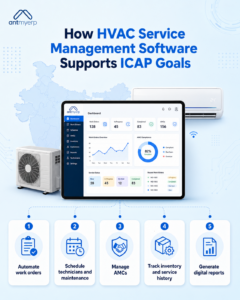
To meet the growing demand for installations, preventive maintenance, and after-sales service, HVAC businesses need digital solutions that improve efficiency across the entire service lifecycle HVAC Service Management Software helps businesses to:
- Automate work order creation and assignment
- Schedule preventive maintenance visits
- Manage Annual Maintenance Contracts (AMCs)
- Dispatch technicians based on availability and location
- Track service history and warranties
- Monitor spare parts inventory
- Generate digital service reports
- Improve customer communication with real-time updates
- Analyze service performance through dashboards and reports
For businesses experiencing rapid growth, these capabilities reduce manual effort, improve operational visibility, and support better customer experiences.
How AntMyERP Helps HVAC Businesses Scale
As HVAC companies adapt to the changing demands driven by India’s Cooling Action Plan, having an integrated service management platform becomes increasingly valuable.
AntMyERP HVAC Service Management Software helps businesses:
- Automate service requests and work orders
- Plan preventive maintenance schedules
- Manage Annual Maintenance Contracts (AMCs)
- Optimize technician scheduling and dispatch
- Track spare parts inventory across locations
- Capture digital service reports through a mobile app
- Monitor service performance using real-time dashboards
Instead of managing multiple spreadsheets and disconnected tools, businesses can centralize their operations, improve response times, and deliver a consistent customer experience.
Future Outlook
India’s Cooling Action Plan (ICAP) is expected to increase demand for energy-efficient HVAC systems, preventive maintenance, and skilled service teams. As cooling needs grow across residential, commercial, and industrial sectors, HVAC companies will need faster service, better technician management, and improved operational efficiency.
To stay competitive, businesses should adopt HVAC Service Management Software to automate work orders, AMC management, technician scheduling, and inventory tracking. Digital service operations will help HVAC companies deliver faster, more reliable customer service while supporting India’s long-term sustainable cooling goals.
Key Takeaways
- India’s Cooling Action Plan (ICAP) is driving the shift toward sustainable and energy-efficient cooling.
- HVAC companies should prepare for increased installations, AMC contracts, and service requests.
- Skilled technicians and preventive maintenance will become critical for business growth.
- HVAC dealers can create new revenue opportunities through installation, maintenance, and after-sales support.
- HVAC Service Management Software helps automate work orders, technician scheduling, AMC management, and inventory tracking to improve service efficiency.
As India’s cooling demand continues to grow, now is the time to modernize your service operations. Explore how AntMyERP HVAC Service Management Software can help your business scale