
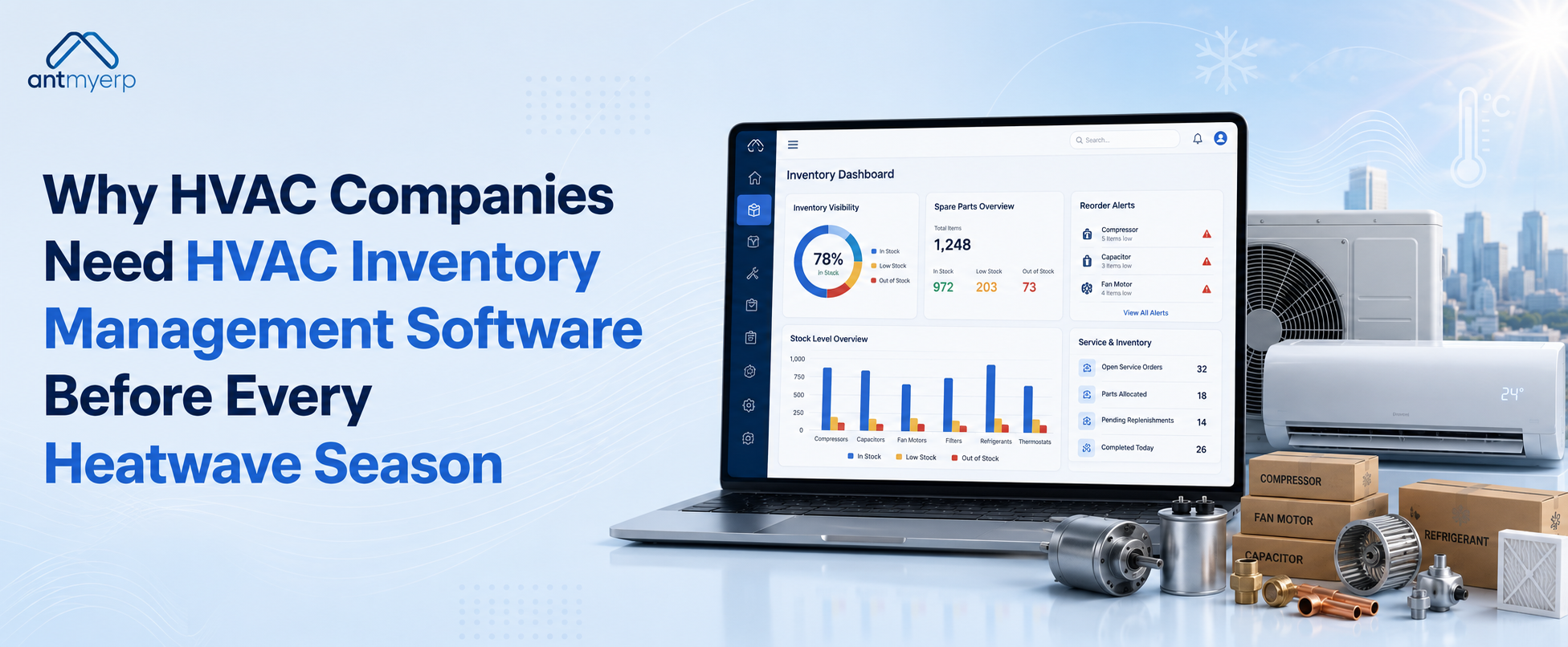
Why HVAC Companies Need HVAC Inventory Management Software Before Every Heatwave Season
2026-08-01
HVAC inventory management software integrated with HVAC field service management software gives service teams complete visibility into stock levels across warehouses, technician vans, and branch locations. It helps businesses streamline dispatch, work orders, preventive maintenance, procurement, and inventory to improve first-time fix rates and customer satisfaction.
Every heatwave season brings a surge in HVAC service requests. While many businesses prepare by hiring technicians and stocking additional spare parts, they often overlook one critical factor: real-time inventory visibility.
Without knowing where compressors, motors, capacitors, filters, and other essential parts are located, technicians spend valuable time searching for inventory instead of repairing equipment. This leads to delayed service, repeat visits, emergency purchases, and unhappy customers.
Summer Is the Busiest Season for HVAC Businesses
For HVAC companies, summer is both an opportunity and a challenge. As temperatures rise, air conditioners, chillers, refrigeration units, and ventilation systems operate continuously, increasing the likelihood of equipment failures.
Residential customers expect same-day AC repairs. Commercial buildings cannot afford cooling downtime. Hospitals, data centers, hotels, retail stores, manufacturing plants, and office complexes rely on uninterrupted HVAC systems to keep operations running.
During this period, service requests often increase significantly. Dispatch teams work around the clock, technicians manage packed schedules, and warehouses experience rapid movement of spare parts.
Despite this preparation, many HVAC companies still struggle to complete repairs on the first visit not because of technician shortages, but because the required spare parts are unavailable or cannot be located quickly.
Why Inventory Becomes the Biggest Challenge During Heatwaves
When service demand increases, inventory moves much faster than usual.
Compressors, capacitors, blower motors, filters, contactors, thermostats, refrigerant valves, sensors, and fan motors are issued daily from multiple warehouses and technician vans.
Without a centralized inventory system, businesses often rely on spreadsheets, phone calls, or WhatsApp messages to confirm stock availability.
This creates several operational problems:
- Technicians arrive without the required spare parts.
- Warehouse teams cannot identify available stock quickly.
- Different branches unknowingly purchase the same inventory.
- Emergency procurement increases operational costs.
- Critical spare parts go out of stock during peak demand.
- Customers experience longer equipment downtime.
These delays directly affect customer satisfaction, technician productivity, and revenue.
The Real Cost of Poor Inventory Visibility
Inventory problems affect much more than warehouse operations.
When technicians cannot access the right spare parts, every department feels the impact.
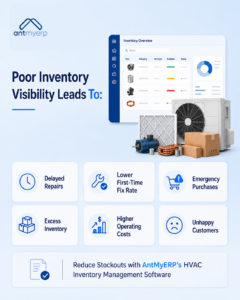
Delayed Service Resolution
A technician reaches the customer site only to discover that the required compressor or capacitor is unavailable. The visit must be rescheduled, increasing travel costs and delaying repairs.
Lower First-Time Fix Rate
Customers expect technicians to solve the issue during the first visit. Missing spare parts result in repeat visits, reducing technician productivity and increasing operational expenses.
Emergency Purchases
Without accurate stock visibility, companies often purchase spare parts urgently at higher prices to meet customer commitments.
Excess Inventory
Ironically, many businesses face stock shortages while simultaneously carrying excess inventory of slow-moving parts. This ties up working capital and increases storage costs.
Customer Dissatisfaction
For commercial customers, even a few hours of HVAC downtime can affect business operations. Delayed repairs reduce trust and increase the likelihood of losing long-term maintenance contracts.
What Is HVAC Inventory Management Software?
When integrated with HVAC field service management software, inventory becomes part of the entire service workflow. Dispatchers can assign technicians based on both spare part availability and technician skills, while field teams receive real-time inventory information before visiting customer sites.
Instead of manually tracking inventory, businesses gain real-time visibility into every spare part, making it easier to plan service operations and respond quickly during high-demand seasons.
Inventory Management solution allows companies to:
- Track spare parts across multiple warehouses.
- Monitor inventory movement in real time.
- View stock availability before assigning work orders.
- Manage technician van inventory.
- Receive low-stock alerts.
- Automate purchase requests.
- Maintain accurate inventory records.
- Reduce stock shortages and overstocking.
When inventory data is connected with service operations, dispatch teams can assign technicians confidently, knowing the required parts are already available.

Why Real-Time Stock Visibility Matters
Real-time inventory visibility means every department has access to the same inventory information at the same time.Instead of calling different warehouses or checking spreadsheets, service managers can instantly see:
- Available stock
- Reserved inventory
- Parts already allocated to work orders
- Inventory available in technician vehicles
- Incoming purchase orders
- Warehouse transfers
- Low-stock alerts
- Spare part movement history
This level of visibility helps businesses make faster decisions, especially during emergency service situations.
Common HVAC Spare Parts That Need Accurate Tracking
During the summer season, certain spare parts move much faster than others.
These include:
- Compressors
- Capacitors
- Fan motors
- Blower motors
- Contactors
- Thermostats
- Expansion valves
- Refrigerant gas
- Copper tubing
- Condenser coils
- Evaporator coils
- Filters
- PCB boards
- Relays
- Sensors
- Bearings
- Belts
- Electrical connectors
Tracking these parts manually becomes increasingly difficult as service requests increase.
How Better Inventory Visibility Improves First-Time Fix Rates
One of the most important performance indicators for HVAC service businesses is the First-Time Fix Rate (FTFR) , the percentage of service requests resolved during the first technician visit.
When technicians have access to the right spare parts before reaching the customer site, they are more likely to complete repairs immediately.
This results in:
- Fewer repeat visits
- Faster service completion
- Lower fuel and travel costs
- Higher technician productivity
- Better customer satisfaction
- Improved service profitability
Conversely, poor inventory visibility forces technicians to return later with the required parts, increasing both operational costs and customer frustration.
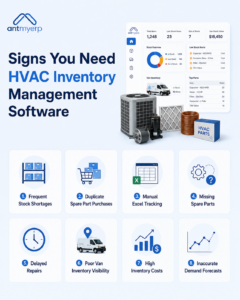
Signs Your HVAC Business Needs Better Inventory Management
If your business experiences any of the following issues, it may be time to replace manual inventory tracking with a digital solution:
- Frequent stock shortages during summer.
- Duplicate purchases across warehouses.
- Technicians calling stores to confirm stock availability.
- Manual Excel sheets used for inventory management.
- Difficulty locating spare parts.
- High inventory carrying costs.
- Delayed preventive maintenance visits.
- Poor visibility into technician van inventory.
- Increasing customer complaints about delayed repairs.
- Difficulty forecasting spare part requirements for seasonal demand.
These challenges not only reduce operational efficiency but also limit your ability to scale service operations during peak seasons.
How HVAC Inventory Management Software Helps Businesses Stay Ready for Every Heatwave
Preparing for the summer rush isn’t just about stocking more spare parts. It’s about ensuring the right part reaches the right technician at the right time.
HVAC inventory management software connects inventory, field service, procurement, dispatch, preventive maintenance, and customer service into a single platform. This gives every department access to accurate, real-time information, helping teams work faster and make better decisions.
Here’s how it makes a difference.

1. Centralized Inventory Across Multiple Locations
Many HVAC companies operate from multiple warehouses, regional branches, or service centers. Without a centralized system, each location maintains its own inventory records, making it difficult to know where parts are available.
A centralized inventory platform provides a single view of stock across all locations, enabling teams to transfer parts quickly instead of purchasing them again.
2. Real-Time Technician Van Inventory
Technicians often carry frequently used spare parts in their service vehicles. However, these inventories are rarely updated in real time when managed manually. By using a Technician Mobile App, field technicians can update spare parts consumption, request additional inventory, and sync stock information directly from the customer site. HVAC inventory management software automatically tracks technician van stock after every service call, giving dispatchers real-time visibility into both technician availability and spare parts before assigning new work orders.
3. Automated Low-Stock Alerts
Running out of high-demand spare parts during summer can delay dozens of service requests.
Automated alerts notify warehouse and procurement teams when inventory reaches predefined minimum levels, allowing replenishment before stockouts occur.
4. Faster Warehouse Transfers
If one branch runs out of a compressor while another has excess inventory, the software can help initiate a transfer instead of creating a new purchase order. This reduces procurement costs and improves inventory utilization.
5. Better Demand Forecasting
Historical service data helps businesses identify seasonal trends and forecast which spare parts are likely to move faster during summer.
Instead of relying on assumptions, inventory planning becomes data-driven.
Prepare Your Inventory Before the Next Heatwave
Waiting until temperatures rise is already too late.HVAC companies should begin preparing several weeks before the peak season starts. Businesses should also schedule preventive servicing using Preventive Maintenance Software to reduce emergency breakdowns during peak summer. A practical pre-season checklist includes:
- Review previous summer’s service requests.
- Identify fast-moving spare parts.
- Replenish critical inventory.
- Remove obsolete or slow-moving stock.
- Verify technician van inventory.
- Enable barcode or QR code tracking.
- Set minimum stock levels for critical parts.
- Schedule preventive maintenance for AMC customers.
- Train warehouse teams on inventory processes.
- Monitor inventory turnover through dashboards.
Businesses that prepare early are better equipped to handle seasonal demand without disrupting service operations.
How AntMyERP Helps HVAC Companies Manage Inventory More Efficiently
AntMyERP’s HVAC Inventory Management Software and HVAC Field Service Management Software help businesses gain complete visibility into spare parts while connecting inventory with service operations. It helps businesses gain complete visibility into spare parts while connecting inventory with service operations.
Using a single platform, HVAC companies can:
- Track spare parts across multiple warehouses in real time.
- Manage serialized and non-serialized inventory.
- Monitor technician van inventory.
- Reserve inventory automatically for assigned work orders.
- Generate purchase requests when stock reaches minimum levels.
- Track inventory movement using barcode or QR code scanning.
- Schedule preventive maintenance for AMC customers.
- Dispatch technicians based on skills, location, and availability.
- Manage work orders from request to closure.
- Generate reports on inventory consumption, stock valuation, and service performance.
Instead of switching between spreadsheets, emails, and disconnected software, every department works from one centralized system.This improves inventory accuracy, reduces delays, and helps technicians complete more jobs during the busiest months of the year.
Benefits of HVAC Inventory Management Software
Reduces Stock Shortages
Real-time inventory tracking shows current stock levels. Low-stock alerts help businesses reorder spare parts before they run out.
Prevents Duplicate Purchases
A centralized inventory system shows stock across all locations. This prevents buying the same spare part twice.
Minimizes Repair Delays
Technicians can check spare part availability before visiting the customer. This speeds up repairs and reduces waiting time.
Improves First-Time Fix Rates
Technicians arrive with the right spare parts. More service requests are resolved in the first visit.
Optimizes Inventory Costs
The software tracks inventory usage and demand. This reduces excess stock and avoids unnecessary spending.
Replaces Manual Inventory Tracking
The software replaces spreadsheets with digital inventory records. This improves accuracy and reduces manual errors.
Speeds Up Procurement
Automatic low-stock alerts trigger timely purchase requests. This keeps critical spare parts available during peak seasons.
Improves Business Visibility
Real-time dashboards show inventory levels and stock movement. Managers can make faster and better business decisions.
Why Inventory Visibility Will Be a Competitive Advantage
Customer expectations continue to rise. Businesses expect same-day service, residential customers want faster repairs, and service teams are under pressure to resolve issues on the first visit.
Companies that continue relying on manual inventory tracking may struggle with delayed repairs, higher operational costs, and dissatisfied customers.
In contrast, businesses that invest in connected inventory management gain better control over stock, improve technician productivity, reduce emergency purchases, and deliver faster service.
Inventory visibility is no longer just a warehouse function it has become a key driver of customer experience and business growth.
Key Takeaways
- Real-time inventory visibility helps HVAC companies avoid stock shortages during peak summer demand.
- HVAC inventory management software improves first-time fix rates by ensuring technicians have the right spare parts.
- Centralized inventory tracking reduces duplicate purchases and excess inventory costs.
- Automated stock alerts and procurement prevent emergency part shortages.
- HVAC stock management software helps in inventory planning and leads to faster service, higher customer satisfaction, and improved technician productivity.
- Integrating inventory, field service, dispatch, and preventive maintenance on one platform streamlines HVAC operations.
- As heatwaves increase, investing in HVAC inventory management software is essential for scalable and reliable service delivery.