
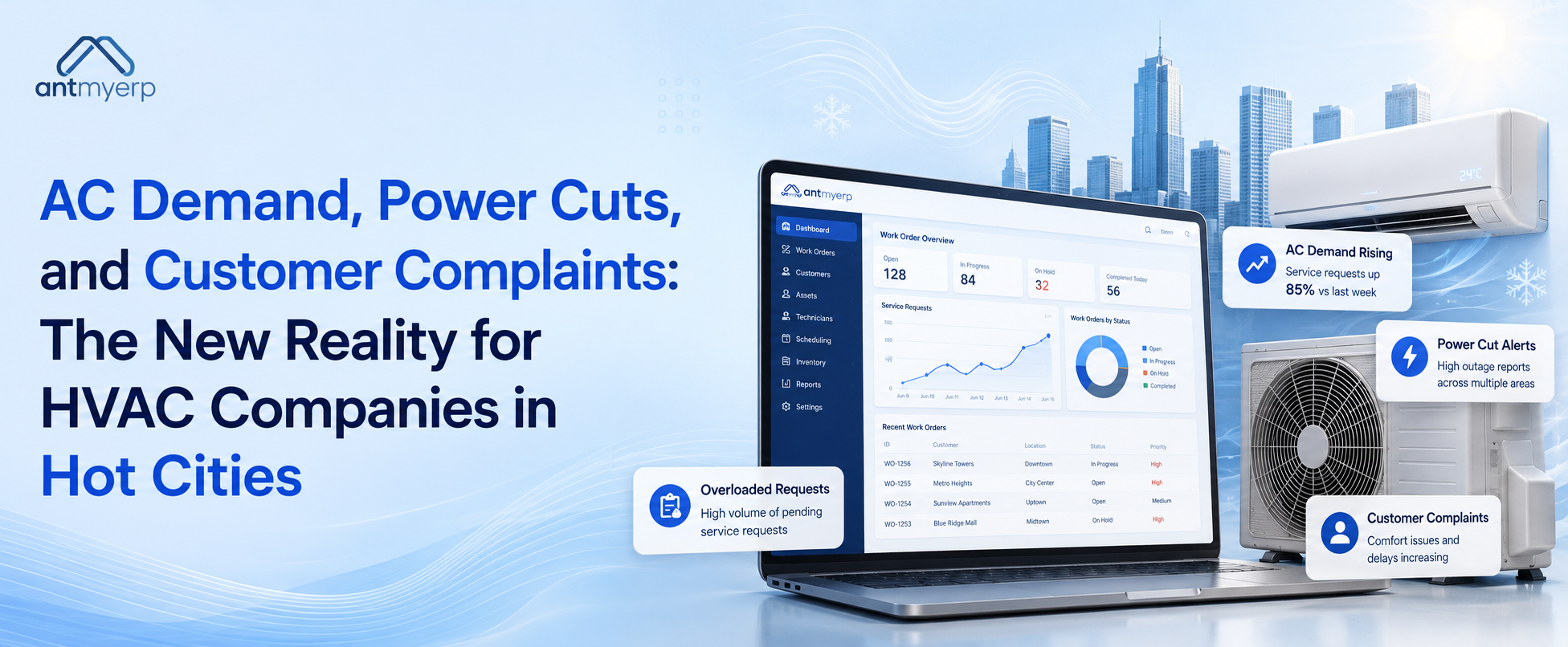
AC Demand, Power Cuts, and Customer Complaints: The New Reality for HVAC Companies in Hot Cities
2026-07-31
Hotter summers, frequent power cuts, and rising air conditioner installations are creating a surge in HVAC service requests. Customers now expect faster repairs, preventive maintenance, and real-time service updates. Manual scheduling and spreadsheets make it difficult for HVAC companies to keep up with this growing demand. Field service software for HVAC helps automate technician scheduling, work orders, preventive maintenance, inventory tracking, and customer communication, enabling businesses to improve response times, increase first-time fix rates, and deliver better customer service.
AC Demand, Power Cuts, and Customer Complaints: The New Reality for HVAC Companies in Hot Cities
Every summer seems hotter than the last. Rising temperatures, expanding cities, and increasing air conditioner installations are driving unprecedented demand for HVAC services. At the same time, frequent power cuts and voltage fluctuations are causing more equipment failures, resulting in a sharp increase in emergency repair requests.
According to IMARC Group, the India HVAC market was valued at USD 13.56 billion in 2025 and is expected to reach USD 49.02 billion by 2034, driven by rapid urbanization, commercial construction, and growing demand for cooling solutions.
For HVAC service businesses, this growth presents both an opportunity and a challenge. More installations create more Annual Maintenance Contracts (AMCs), preventive maintenance visits, and repair jobs. However, managing this increasing workload manually often leads to delayed service, missed maintenance visits, scheduling conflicts, and unhappy customers.
This is why many businesses are investing in field service software for HVAC to automate technician dispatch, work order management, preventive maintenance, and customer communication from one centralized platform.
Why AC Demand Is Growing Faster Than Ever
Several factors are contributing to the growing demand for HVAC installation, maintenance, and repair services.
Rising Urban Temperatures
Cities experience higher temperatures than surrounding rural areas due to the Urban Heat Island Effect. Roads, buildings, and concrete surfaces absorb and retain heat, increasing the need for air conditioning in residential, commercial, and industrial buildings.
More Air Conditioner Installations
Air conditioners are no longer limited to offices and shopping malls. Apartments, hospitals, schools, hotels, warehouses, manufacturing facilities, and retail stores increasingly rely on HVAC systems to maintain comfortable indoor environments.
Every new HVAC installation also creates long-term service opportunities, including:
- Preventive maintenance
- Annual Maintenance Contracts (AMCs)
- Warranty services
- Emergency repairs
- Spare parts replacement
- Equipment inspections
As the installed base grows, HVAC companies must manage a larger volume of service requests without compromising customer experience.
How Power Cuts Increase HVAC Service Requests
Power outages are more than just an inconvenience. They can significantly impact the performance and lifespan of HVAC equipment.
Common problems caused by voltage fluctuations and power interruptions include:
- Compressor failures
- Capacitor damage
- Printed Circuit Board (PCB) failures
- Refrigerant system issues
- Thermostat malfunctions
- Electrical component damage
When power is restored after an outage, sudden voltage spikes can place additional stress on HVAC systems, resulting in a surge of repair requests. During peak summer, HVAC businesses often receive hundreds of service calls within a short period, making it difficult to respond quickly using manual processes.
Customer Expectations Have Changed
Modern customers expect more than just a technician visit. They want fast, transparent, and professional service from the moment they raise a complaint.
Today’s HVAC customers expect:
- Same-day or next-day service
- Real-time technician updates
- Digital work orders and service reports
- Instant quotations and invoices
- AMC renewal reminders
- Preventive maintenance to reduce unexpected breakdowns
Businesses that fail to provide these services risk losing customers to competitors that offer faster response times and better communication.
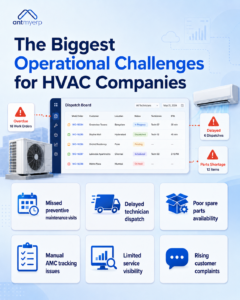
The Biggest Operational Challenges for HVAC Companies
As service requests continue to increase, manual service management becomes difficult to scale.
Missed Preventive Maintenance Visits
Preventive maintenance plays a critical role in reducing unexpected equipment failures. However, when schedules are managed using spreadsheets or paper records, service visits are often delayed or forgotten.Missed maintenance visits increase emergency breakdowns, reduce equipment efficiency, and negatively impact AMC renewal rates.
Businesses using Preventive Maintenance Software can automatically schedule recurring service visits, helping reduce emergency breakdowns and improve equipment reliability.
Inefficient Technician Dispatch
Manual technician scheduling often results in:
- Longer travel times
- Delayed customer response
- Uneven workload distribution
- Higher fuel and operational costs
Without visibility into technician availability, businesses struggle to assign the right technician to the right job at the right time.
Poor Spare Parts Visibility
Technicians arriving without the required spare parts is one of the biggest causes of repeat service visits.
Without centralized inventory tracking, businesses face:
- Stock shortages
- Delayed repairs
- Increased operational costs
- Lower first-time fix rates
Manual AMC Management
Managing hundreds or even thousands of Annual Maintenance Contracts manually becomes increasingly difficult as a business grows.
Common challenges include:
- Missed renewal dates
- Missed preventive maintenance visits
- Delayed invoicing
- Incomplete service records
- Customer dissatisfaction
These issues not only affect revenue but also damage long-term customer relationships.As the number of contracts grows, AMC Management Software helps automate contract renewals, preventive maintenance scheduling, billing, and customer communication.
Limited Service Visibility
Many service managers struggle to answer basic operational questions, such as:
- Which technician is available?
- Which service requests are high priority?
- Which AMC contracts are due for renewal?
- Which HVAC assets have repeated failures?
- Which customers require immediate attention?
Without centralized service data, managers are forced to make reactive decisions instead of proactively planning operations.
Why HVAC Companies Need Field Service Software During Peak Summer
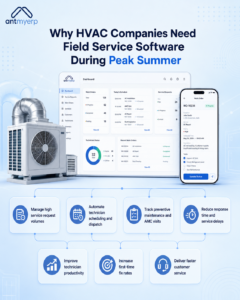
Peak summer is the busiest season for HVAC businesses. Emergency breakdowns, preventive maintenance visits, AMC renewals, and installation requests often occur at the same time. Managing these activities through spreadsheets, phone calls, and paper job cards can quickly overwhelm service teams.
Field service software for HVAC provides a centralized platform to manage the entire service lifecycle. From creating work orders and assigning technicians to tracking inventory and generating invoices, every process is connected in one system. Recent changes such as GST cuts on air conditioners can further increase AC demand, creating additional pressure on HVAC sales and service teams to manage enquiries, installations, and service requests efficiently.
With the right solution, HVAC businesses can:
- Automate technician scheduling and dispatch
- Manage preventive maintenance and AMC visits
- Track service requests in real time
- Improve technician productivity
- Monitor spare parts inventory
- Reduce response times
- Increase first-time fix rates
- Deliver faster and more reliable customer service
Instead of reacting to service emergencies, businesses can proactively manage operations, improve customer satisfaction, and prepare for future growth.
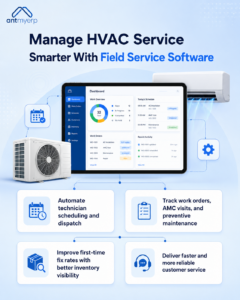
How Field Service Software for HVAC Solves These Challenges
As HVAC businesses grow, managing service operations with spreadsheets, phone calls, and manual records becomes increasingly difficult. A centralized field service software for HVAC helps automate the complete service lifecycle, allowing businesses to deliver faster, more reliable, and more profitable service.
1. Smart Technician Scheduling and HVAC Dispatch Software
Assigning the right technician to the right job is essential during peak summer when service requests are at their highest.
HVAC service software automatically assigns work orders based on:
- Technician availability
- Skill set and certifications
- Current workload
- Service location
- Job priority
This reduces travel time, improves response speed, and helps increase technician productivity.
2. Preventive Maintenance and AMC Management
Preventive maintenance is one of the most effective ways to reduce emergency breakdowns and improve equipment performance.
HVAC maintenance software automates:
- Preventive maintenance schedules
- AMC service visits
- Renewal reminders
- Service notifications
- Recurring work orders
This helps businesses improve customer retention while increasing AMC renewal rates.
3. HVAC Work Order Software
Creating and tracking work orders manually often results in delays and missing information.
With HVAC work order software, service teams can:
- Create work orders instantly
- Assign technicians digitally
- Track job progress
- Upload photos
- Capture customer signatures
- Generate digital service reports
Managers can monitor every service request from creation to completion through a centralized dashboard.
4. Mobile HVAC Technician Software
Modern technicians need access to customer information while working on-site.
A mobile HVAC technician software solution enables technicians to:
- Receive work orders instantly
- View customer and equipment history
- Update job status in real time
- Record service notes
- Capture images
- Generate digital job cards
- Close jobs from the customer’s location
This improves communication between office staff, technicians, and customers while reducing paperwork.Using a Technician Mobile App, field engineers can receive work orders, update job status, capture customer signatures, and generate digital service reports directly from the customer site.
5. Spare Parts and Inventory Management
Technicians cannot complete repairs without the right spare parts.Field service software helps businesses:
- Track spare parts across warehouses and service vehicles
- Monitor inventory levels
- Reduce stock shortages
- Prevent unnecessary purchases
- Improve first-time fix rates
Better inventory visibility ensures technicians arrive prepared, reducing repeat visits and improving customer satisfaction.
6. Complete HVAC Asset Management
Every HVAC system has its own maintenance history, warranty details, and repair records. With centralized HVAC asset management, businesses can track:
- Installation dates
- Service history
- Warranty information
- Previous repairs
- Equipment performance
- Replacement recommendations
Having complete equipment records enables technicians to diagnose problems faster and deliver better service.With Asset Management Software, businesses can maintain complete equipment history, warranty records, and maintenance schedules for every HVAC asset.
7. Automated Billing and Service Reporting
Manual invoicing often causes delays and billing errors.
A modern field service management software automatically generates:
- Quotations
- Invoices
- AMC bills
- Service reports
- Payment records
This reduces administrative work while improving billing accuracy and cash flow.
How AntMyERP Helps HVAC Companies Scale Service Operations
As service demand continues to grow, HVAC businesses need a single platform to manage technicians, customers, inventory, contracts, and billing efficiently. AntMyERP Field Service Software for HVAC helps businesses streamline every stage of the service lifecycle through one centralized platform.
With AntMyERP, HVAC companies can:
- Manage Annual Maintenance Contracts (AMCs)
- Automate preventive maintenance scheduling
- Create and assign work orders instantly
- Optimize technician scheduling and dispatch
- Track field technicians in real time
- Manage customer complaints efficiently
- Maintain complete HVAC asset history
- Track spare parts inventory
- Generate quotations, invoices, and service reports
- Improve first-time fix rates
- Increase AMC renewal rates
- Manage multiple branches from a single dashboard
Instead of switching between spreadsheets, paper records, and disconnected systems, service teams can access customer details, equipment history, technician schedules, inventory, and billing information from one platform. This enables faster response times, better operational visibility, and improved customer satisfaction.
Preparing for the Next Heatwave Starts Today
Climate trends indicate that hotter summers, increasing AC installations, and higher service demand will continue in the coming years. HVAC companies that rely on manual scheduling, paper job cards, and disconnected systems may struggle to keep pace with growing customer expectations.
Investing in field service software for HVAC enables businesses to automate routine operations, improve technician productivity, reduce emergency breakdowns, and deliver exceptional customer service.
As competition continues to increase, companies that embrace automation will be better positioned to improve operational efficiency, strengthen customer relationships, and scale their service business profitably.
The future of HVAC service is no longer just about repairing equipment, it’s about building a connected, data-driven, and customer-focused service operation.