
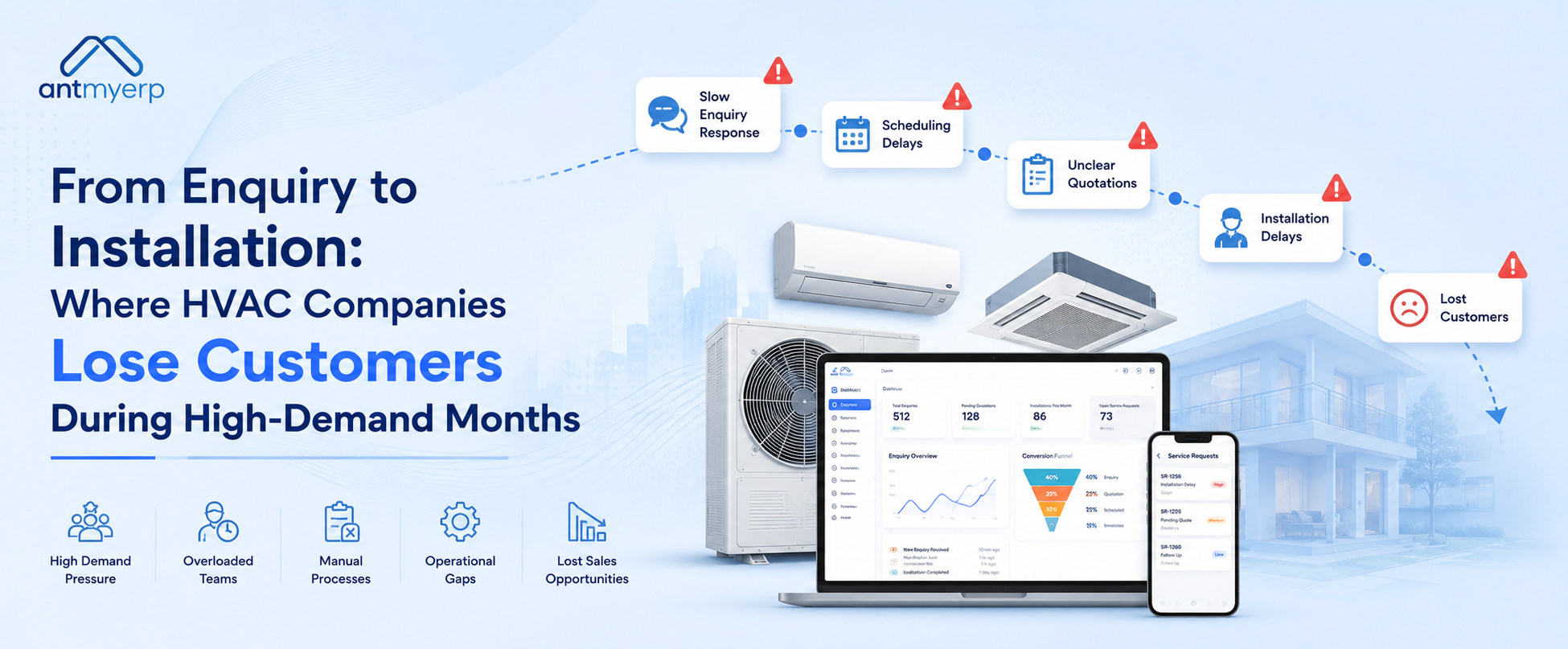
From Enquiry to Installation: Where HVAC Companies Lose Customers During High-Demand Months
2026-07-17
IThe summer season brings more enquiries for HVAC businesses, but it also exposes weaknesses in day-to-day operations. Many companies lose customers before an installation is completed because of slow responses, missed follow-ups, delayed site visits, poor communication, and manual scheduling. By improving the entire enquiry-to-installation process with HVAC field service software, businesses can convert more leads, complete installations faster, and deliver a better customer experience.
More Enquiries Don’t Always Mean More Installations
Summer is the busiest season for HVAC businesses. As temperatures rise, customers start looking for AC installations, repairs, replacements, and preventive maintenance services. Phone calls increase, website enquiries multiply, and sales teams receive more requests than usual.
Many business owners assume that more enquiries will automatically result in more revenue. Unfortunately, that isn’t always true.During high-demand months, HVAC companies often lose customers before the installation even begins. Some customers never receive a callback. Others wait too long for a quotation or a site visit. Some become frustrated because they don’t know the status of their request.
In many cases, customers don’t leave because your prices are too high or your technicians lack experience. They leave because another company responds faster and provides a smoother customer experience.
The journey from the first enquiry to the final installation is just as important as the quality of the installation itself.
Understanding the HVAC Customer Journey
Every HVAC customer follows a similar journey before an installation is completed.It usually begins when a customer calls your office, fills out a website form, sends a WhatsApp message, or contacts your sales team through social media.
After that, the business typically:
- Responds to the enquiry
- Understands the customer’s requirements
- Schedules a site visit
- Inspects the location
- Shares a quotation
- Confirms the order
- Schedules the installation
- Assigns technicians
- Completes the installation
- Provides after-sales support
Every step matters. If customers experience delays or confusion at any stage, they may decide to hire another HVAC company instead.
Why HVAC Companies Lose Customers During High-Demand Months
1. Slow Response to Customer Enquiries
Today’s customers expect quick responses.
Whether they contact your company through a phone call, email, website form, or WhatsApp, they want confirmation that someone has received their request.
If your team takes several hours or even an entire day to respond, the customer has probably already contacted multiple HVAC providers.The company that responds first often has the highest chance of winning the business.
A delayed response can result in a lost opportunity before the sales conversation even begins.
2. Missed Follow-Ups
Not every customer makes an immediate decision.Some customers compare quotations, discuss options with family members, or wait for budget approval.
Without a structured follow-up process, these potential customers are easily forgotten.Sales teams become busy handling new enquiries while older leads receive no further communication.
A simple reminder or follow-up call could have converted those enquiries into completed installations.
3. Delayed Site Visits
Before preparing an accurate quotation, many HVAC companies need to inspect the installation site.
During summer, technician schedules become extremely busy.
When scheduling is managed through phone calls, notebooks, Excel sheets, or WhatsApp messages, appointments can easily be delayed or missed.
Customers who wait several days for a site visit often choose another company that can visit sooner.Delays often become worse when companies are also dealing with the HVAC technician shortage, making efficient scheduling even more important.
4. Slow Quotation Approval
Customers expect quotations quickly after a site inspection.However, some HVAC businesses still prepare estimates manually.Technicians send handwritten notes to the office, sales teams create quotations later, and approvals take additional time.
By the time the quotation reaches the customer, another HVAC company may have already completed the sale.Fast quotations improve customer confidence and help businesses close deals before competitors.
5. Poor Customer Communication
One of the biggest frustrations for customers is not knowing what is happening.
They often ask questions such as:
- Has my enquiry been received?
- When will the technician visit?
- Has my quotation been approved?
- What day is my installation scheduled?
- Will the technician arrive on time?
If customers repeatedly need to call your office for updates, their confidence starts to decline. Regular communication builds trust throughout the installation process.
6. Manual Scheduling Creates Confusion
During busy months, dispatch teams handle dozens of installation appointments every day.Without proper scheduling tools, common problems include:
- Double-booked technicians
- Wrong technician assignments
- Long travel distances
- Missed appointments
- Last-minute schedule changes
These issues affect both customer satisfaction and technician productivity.
7. Inventory and Equipment Delays
Sometimes the installation cannot proceed because the required equipment or spare parts are unavailable.Without visibility into inventory, businesses may schedule installations before confirming product availability.
Customers who experience repeated delays may cancel the order altogether.Proper inventory planning helps avoid unnecessary rescheduling and improves customer confidence.
Common Warning Signs That Your HVAC Business Is Losing Customers
Your business may have operational challenges if you regularly experience:
- Plenty of enquiries but fewer completed installations
- Customers requesting multiple status updates
- High quotation rejection rates
- Frequent appointment cancellations
- Missed follow-up calls
- Delayed installations
- Negative customer reviews about communication
- Declining customer retention
These issues often point to problems in the process rather than the quality of your service.
How HVAC Field Service Software Improves the Customer Journey
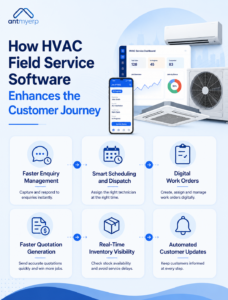
Managing every stage of the customer journey manually becomes difficult during peak season. HVAC field service software brings enquiry management, scheduling, dispatch, work orders, quotations, inventory, invoicing, and customer communication together in one centralized system.
Instead of switching between spreadsheets, WhatsApp conversations, paper forms, and multiple software tools, your team works from one platform. This reduces errors, improves coordination across departments, and helps businesses respond to customer enquiries faster.
If you’re exploring software solutions, check out our guide on Best Field Service Software for HVAC to Save Costs and Improve Business to learn how the right solution can streamline operations and improve customer service.
Faster Enquiry Management
Every enquiry is automatically recorded and assigned to the right team member.Sales teams can track enquiry status, schedule follow-ups, and monitor lead progress without relying on handwritten notes or spreadsheets. No customer enquiry gets overlooked.
Better Scheduling and Dispatch
Modern scheduling tools help dispatchers assign technicians based on availability, location, workload, and required skills. This reduces travel time, improves daily planning, and allows more installations to be completed.
Mobile Work Orders
Instead of carrying paperwork, technicians receive digital work orders on their mobile devices. These work orders include customer information, installation details, equipment specifications, service history, and job checklists.
Having complete information before arriving at the site helps technicians complete work more efficiently.
Faster Quotation Generation
After the site inspection, quotations can be created immediately using predefined pricing and templates. Customers receive estimates much faster, reducing the chance of losing business to competitors.
Better Inventory Visibility
Installation teams can verify equipment availability before confirming appointment dates.This minimizes delays caused by unavailable products or missing spare parts.Accurate inventory management software helps HVAC companies ensure the right equipment is available before scheduling installations.
Automated Customer Updates
Customers appreciate knowing what is happening.Automated notifications can keep them informed about:
- Appointment confirmation
- Technician arrival
- Installation schedule
- Job completion
- Service reports
Keeping customers informed throughout the process builds confidence and improves the overall experience.
Best Practices to Convert More HVAC Enquiries into Installations
If you want to improve customer conversion during peak seasons, focus on strengthening every stage of the customer journey.
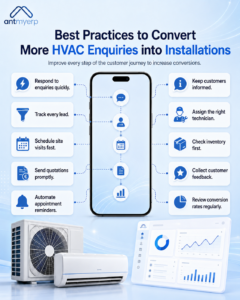
Consider these best practices:
- Respond to every enquiry as quickly as possible.
- Track every lead in one centralized system.
- Schedule site visits without unnecessary delays.
- Share quotations on the same day whenever possible.
- Send appointment reminders automatically.
- Keep customers informed throughout the installation process.
- Assign technicians based on availability and location.
- Check inventory before confirming installation dates.
- Collect customer feedback after every completed installation.
- Regularly review your enquiry-to-installation conversion rate.
Small improvements at each stage can lead to significant increases in completed installations.
Why Improving the Process Matters More Than Generating More Leads
Many HVAC companies focus heavily on generating more enquiries through Google Ads, SEO, social media, and referrals. However, if your internal process isn’t efficient, bringing in more leads simply creates more opportunities to lose customers.
Before increasing your marketing budget, review how your business handles enquiries, scheduling, quotations, installations, and customer communication.
Improving operational efficiency often delivers a better return on investment than generating additional leads. A well-organized HVAC CRM helps sales teams track enquiries, follow up with prospects, and improve lead conversion throughout the sales process.
Why Choose AntMyERP for HVAC Service Management?
If your HVAC business struggles with missed follow-ups, delayed scheduling, manual dispatch, or poor visibility into installation progress, the right software can simplify your operations.
HVAC Field Service Management Software helps businesses:
- Capture and track every customer enquiry
- Schedule site visits efficiently
- Assign technicians based on availability and skills
- Create digital work orders
- Generate quotations faster
- Track inventory in real time
- Send automated customer updates
- Monitor installation progress from one dashboard
- Improve enquiry-to-installation conversion rates
Whether you manage residential, commercial, or industrial HVAC projects, AntMyERP helps your team stay organized while delivering a better customer experience.
Conclusion
During peak season, HVAC companies compete on more than just price or service quality. Customers also expect quick responses, clear communication, and a smooth installation process.
Every delay from the first enquiry to the final installation can lead to a lost customer. Slow follow-ups, manual scheduling, poor coordination, and inventory issues make it easier for customers to choose another provider.
HVAC field service software helps streamline the entire process. It speeds up response times, improves scheduling, keeps teams connected, and helps complete more installations with fewer delays.
The most successful HVAC companies aren’t always the ones with the most enquiries. They’re the ones that turn more enquiries into happy, long-term customers.