
Warranty management systems for HVAC companies
2026-07-06
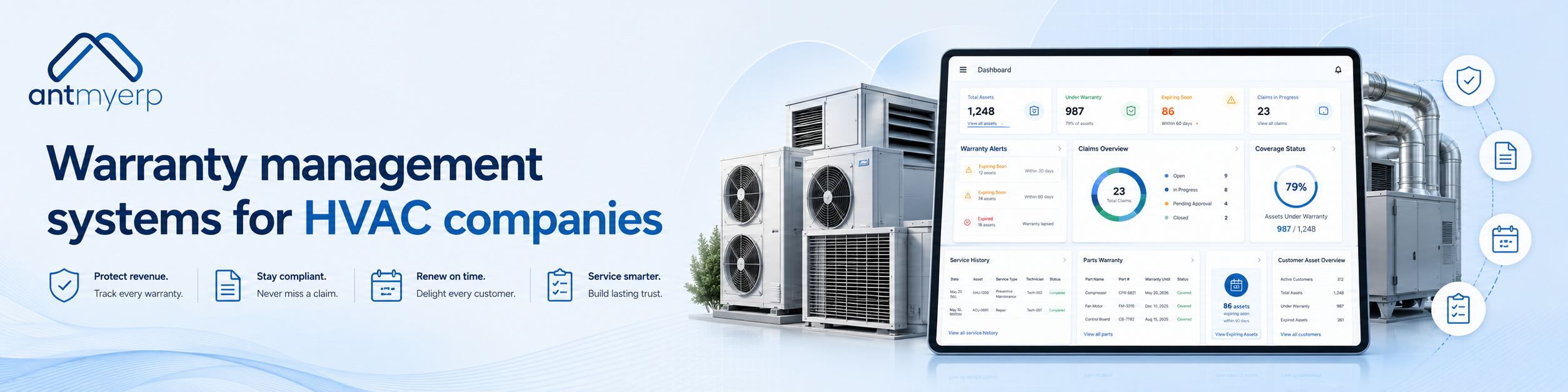
Warranty Management Systems help HVAC companies track equipment warranties, manage warranty claims, handle spare parts returns, and maintain complete service history in one centralized system. It reduces manual work, prevents warranty leakage, and improves service speed through automation and system integration.
What Are Warranty Management Systems?
Warranty Management Systems are software solutions that help HVAC companies manage and track warranties for equipment, spare parts, and services in a centralized digital platform.
Instead of using spreadsheets or manual records, HVAC businesses can store all warranty data in one system and access it anytime.AntMyERP’s HVAC Field Service Management Software is built specifically for service businesses operating in the HVAC industry.
In HVAC businesses, these systems manage:
- HVAC equipment warranties (compressors, chillers, AHUs)
- Spare parts warranties
- Service warranties
- AMC-related warranties
Key functions include:
- Warranty registration
- Warranty tracking
- Digital warranty records
- Warranty expiration alerts
- Warranty claim management
Why HVAC Companies Need Warranty Management Systems
HVAC businesses deal with complex equipment, multiple vendors, and long service lifecycles.
Manual warranty tracking often leads to errors and financial losses.
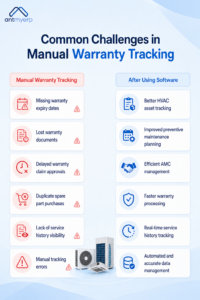
Common challenges include:
- Missing warranty expiry dates
- Lost warranty documents
- Delayed warranty claim approvals
- Duplicate spare part purchases
- Lack of service history visibility
- Manual tracking errors
Business improvements after using software:
- Better HVAC asset tracking
- Improved preventive maintenance planning
- Efficient AMC management
- Faster warranty processing
Comparison: Manual Tracking vs Warranty Management System
Manual warranty tracking is usually done using Excel sheets or paper-based records, which makes the process less organized and harder to manage as the business grows. In contrast, a warranty management system provides a centralized digital platform where all warranty data is stored and easily accessible.
Manual systems have a higher chance of human errors because data is entered and updated manually. On the other hand, a warranty management system ensures automated and accurate tracking of all warranty details.
In manual tracking, there are no automatic expiry alerts, which often leads to missed warranty deadlines. However, a warranty management system sends automated notifications before warranty expiry, helping businesses take timely action.
Claim processing is usually slow in manual systems because it involves multiple steps and paperwork. With a warranty management system, warranty claim approval becomes faster due to automation and streamlined workflows.
Manual tracking also provides poor visibility of assets, making it difficult to track equipment status and history. In contrast, a warranty management system offers complete asset lifecycle visibility, allowing HVAC companies to track equipment from installation to replacement.
How Do HVAC Firms Manage Warranty Claims for Equipment?
HVAC companies follow a structured process to manage warranty claims efficiently.
Step-by-step process:
- Equipment is installed at customer site
- Warranty details are recorded in the system
- Issue is reported by customer or technician
- Warranty eligibility is checked
- Claim request is created
- Claim is submitted to vendor
- Defective parts are returned if required
- Repair or replacement is completed
- Service record is updated
With software support:
- Warranty claim automation improves speed
- Claim approval becomes faster
- Real-time tracking becomes possible
- Manual errors are reduced
HVAC Warranty Claims Management Process (Workflow)
- Equipment installation
- Warranty registration
- Warranty monitoring
- Fault detection
- Claim submission
- Vendor approval
- Parts replacement
- Job closure
Benefits of automation:
- Faster claim processing
- Reduced manual paperwork
- Better coordination between teams
- Improved service delivery
Key Features of Warranty Management Systems
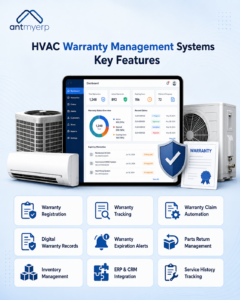
Warranty Registration
Stores all equipment and warranty details digitally.
Warranty Tracking
Tracks warranty expiry dates automatically.
Warranty Claim Automation
Automates claim creation and processing.
Digital Warranty Records
Centralized storage for all warranty documents.
Warranty Expiration Alerts
Sends alerts before warranty expiry.
Parts Return Management
Tracks defective parts and replacements.
Inventory Management
Monitors spare parts usage and availability.
ERP & CRM Integration
Connects warranty data with business systems.
Service History Tracking
Maintains complete maintenance and repair history.
HVAC Spare Parts Warranty Tracking Methods
Tracking spare parts is critical in HVAC warranty operations.
Common methods:
- QR code and barcode tracking
- RMA (Return Merchandise Authorization) process
- Vendor-based warranty tracking
- Digital return logs
Benefits:
- Better traceability of parts
- Reduced financial losses
- Faster replacement cycles
- Improved inventory accuracy
Asset Lifecycle & Warranty Tracking Integration
HVAC equipment goes through multiple stages such as installation, maintenance, repair, and replacement.
Warranty Management Systems become more powerful when integrated with asset lifecycle tracking.
How integration works:
- Each HVAC asset is registered during installation
- Warranty data is linked to the asset
- Service and maintenance history is continuously updated
- Warranty status is tracked throughout lifecycle
- Alerts are generated for expiry and maintenance
Key benefits:
- Full visibility of HVAC assets
- Accurate warranty tracking across lifecycle
- Reduced missed warranty claims
- Better preventive maintenance planning
- Faster repair decisions
- Strong coordination between teams
Why it matters:
Without lifecycle integration, warranty and service data become disconnected, leading to missed claims and higher operational costs.
Benefits of Warranty Management Systems for HVAC Companies
Faster Warranty Claims
Speeds up approval and processing.
Better Asset Tracking
Improves visibility of HVAC equipment.
Reduced Warranty Leakage
Prevents missed or expired claims.
Improved Technician Efficiency
Mobile access to warranty data.
Better Inventory Control
Reduces unnecessary spare part purchases.
Complete Lifecycle Management
Tracks assets from installation to replacement.
Higher Customer Satisfaction
Faster service improves trust.
What Should You Check Before Purchasing HVAC Equipment?
Warranty Coverage
Check what is included and excluded.
Lead Time
Understand delivery and replacement timelines.
After-Sales Support
Ensure reliable service availability.
Local Service Network
Check nearby support centers.
Spare Parts Availability
Ensure easy access to components.
Warranty Period
Confirm duration and extension options.
Vendor Support
Evaluate response quality.
Preventive Maintenance Support
Check AMC and service offerings.
Why Choose AntMyERP for Warranty Management Systems?’
AntMyERP’s Warranty Management Systems provides a complete HVAC-focused field service and warranty management solution designed to simplify operations.
Key capabilities:
- Warranty tracking and registration
- HVAC service management
- AMC and preventive maintenance
- Inventory and spare parts tracking
- Field technician management
- Service reporting and analytics
Business benefits:
- Reduced manual workload
- Faster warranty claim processing
- Better equipment visibility
- Improved operational efficiency