
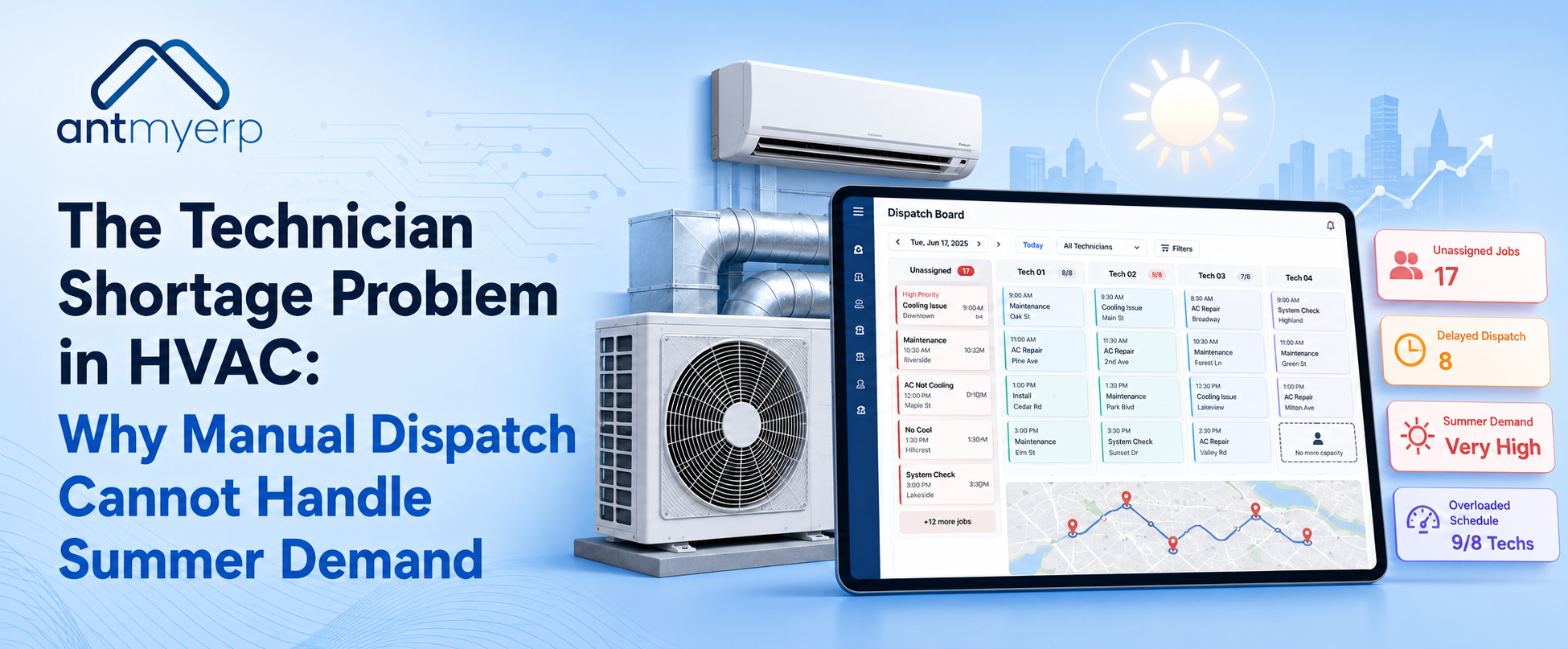
The Technician Shortage Problem in HVAC: Why Manual Dispatch Cannot Handle Summer Demand
2026-07-13
The HVAC technician shortage has become a major challenge for HVAC businesses, especially during the busy summer season. As AC service requests, installations, and maintenance jobs increase, many companies struggle to assign enough skilled technicians. Manual dispatch methods like phone calls, spreadsheets, and WhatsApp make the problem even worse. HVAC businesses can overcome the HVAC technician shortage by using digital dispatch and field service management software to improve scheduling, technician productivity, and customer service.
How the HVAC Technician Shortage Impacts Summer Service Demand
Every year, summer brings a big increase in demand for HVAC services.As temperatures rise, people depend on air conditioners to stay comfortable at home, in offices, hospitals, hotels, shopping malls, schools, and factories. Even a small AC problem can quickly become an emergency.
As per EIA, AC usage increases significantly during summer months in residential and commercial buildings.
For HVAC businesses, this means:
- More AC installations
- More repair requests
- More preventive maintenance visits
- More warranty service calls
- More Annual Maintenance Contract (AMC) visits
- More emergency breakdowns
While business opportunities grow, one major problem remains the same: there are not enough skilled HVAC technicians to handle the workload.
Hiring experienced technicians has become difficult in many regions. Even when companies want to expand their service teams, finding trained professionals takes time. During peak summer months, existing technicians often work longer hours and travel to more customer locations each day.This is why many HVAC companies are asking an important question:
How can we complete more service jobs without increasing our workforce?
The answer is not always hiring more people. Sometimes, it is about using the available technicians more efficiently. Unfortunately, many businesses still rely on manual dispatch methods that slow everything down.
Why Manual Dispatch Breaks Down During Peak HVAC Season
Many HVAC companies still manage daily service operations using familiar tools like:
- Excel spreadsheets
- Whiteboards
- Phone calls
- WhatsApp groups
- Paper job cards
- Sticky notes
These methods may work when there are only a few service requests each day. But during summer, the number of customer calls can double or even triple.When dispatchers manually assign dozens of jobs, small mistakes become common.
For example:
A dispatcher accidentally assigns two technicians to the same customer.Another customer is forgotten until the evening. An emergency repair request is delayed because nobody knows which technician is closest.
One technician spends two hours driving across the city while another technician is available nearby.These problems waste valuable time. Instead of completing service jobs, technicians spend more time waiting for instructions, travelling between locations, or calling the office for updates.
Customers notice these delays too. Late arrivals, missed appointments, and poor communication can quickly affect customer trust and future business.Manual dispatch is not the problem because people lack experience. It becomes difficult because today’s service operations move much faster than paper-based processes can handle.
In the next section, we’ll look at the warning signs that show your business has outgrown manual dispatch.
8 Signs the HVAC Technician Shortage Is Affecting Your Business
As your business grows, managing service calls becomes more difficult. What worked for five technicians may no longer work for twenty.
If you notice the following problems during peak season, it may be time to move beyond manual dispatch.
1. Dispatchers Spend Too Much Time Assigning Jobs
Every service request needs to reach the right technician quickly. With manual dispatch, office staff often spend hours making phone calls, checking technician availability, updating Excel sheets, and changing schedules. When emergency jobs come in, the entire plan has to be rearranged again.Instead of focusing on customers, dispatchers spend most of their day managing schedules.
2. Technicians Keep Calling the Office
Imagine a technician driving to the next job. Instead of starting the repair, they call the office to ask:
- Where is the customer located?
- What is the complaint?
- Is the unit under warranty?
- Are spare parts needed?
- Who is the contact person?
These back-and-forth calls waste valuable time.If technicians can access job details on their phones, they can start work faster and reduce unnecessary communication.
3. Customers Keep Asking, “When Will the Technician Arrive?”
One of the most common questions customers ask is:
“Can you tell me when your technician will arrive?”
Without real-time visibility, dispatchers often have to call the technician first before giving an update. This delays communication and creates uncertainty for customers.Over time, poor communication can affect customer satisfaction, even if the repair is completed successfully.
4. Emergency Service Requests Disrupt the Entire Schedule
Summer brings many urgent AC breakdowns.When emergency calls arrive, dispatchers must quickly decide which technician should take the new job. Without knowing each technician’s current location or workload, these decisions become difficult.
As a result:
- Existing appointments may be delayed.
- Technicians travel longer distances.
- Customers wait longer for service.
5. Technicians Spend More Time Travelling Than Repairing
A technician may finish one job in the north of the city and then receive the next assignment in the south.Meanwhile, another technician is already working close to the customer’s location.
Poor route planning increases travel time, fuel costs, and technician fatigue.The more time technicians spend on the road, the fewer service calls they can complete each day.
6. Service Reports Are Delayed
Many businesses still use paper service reports.Technicians return to the office at the end of the day to submit completed job cards.
This creates delays in:
- Updating customer records
- Closing service tickets
- Creating invoices
- Reviewing technician performance
Managers don’t get real-time visibility into completed work.
7. Managers Have Limited Visibility
When schedules are managed through calls and spreadsheets, managers often don’t know:
- Which jobs are completed
- Which technicians are available
- Which customers are waiting
- Which tickets are delayed
Without accurate information, making quick business decisions becomes difficult.
8. Customer Complaints Increase During Peak Season
When service demand is high, even small delays become noticeable.Customers may experience:
- Late technician arrivals
- Missed appointments
- No ETA updates
- Longer repair times
- Delayed follow-up visits
These issues can lead to negative reviews and lost business, especially when customers have multiple service providers to choose from.
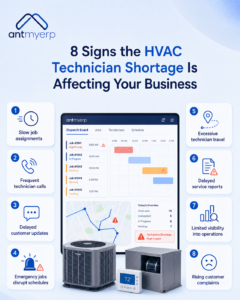
A Technician Mobile App Helps Manage the HVAC workforce shortage
Managing technician shortages is not just about hiring more people. It is also about helping your existing team work more efficiently.
Instead of relying on phone calls and paper job cards, many HVAC businesses now use a Technician Mobile Application that keeps field engineers connected wherever they are.
With the Technician Mobile Application, technicians can receive assigned jobs directly on their mobile devices. They no longer have to wait for calls from the office or visit the branch to collect paperwork.
Before reaching the customer, technicians can view important job details such as:
- Customer name and address
- Service request details
- Equipment history
- Previous repair records
- Warranty information
- Required spare parts
This helps technicians arrive better prepared and reduces the chances of repeat visits.Once the work begins, they can update the job status in real time. They can also upload photos, add service notes, capture customer signatures, and close the work order from the mobile app itself.
Because updates are shared instantly, dispatchers and managers always know the progress of every service call without making multiple phone calls.During the busy summer season, this saves valuable time and helps technicians complete more jobs each day.
Live Engineer Tracking Helps Dispatchers Make Faster Decisions
During peak summer months, every minute matters.Imagine a customer calling your office and saying, “My AC has completely stopped working. Can someone come today?”
The dispatcher now has an important decision to make.
Which technician should take this job?
If the dispatcher doesn’t know where technicians are or which jobs they are working on, they have to make several phone calls before assigning the request. This wastes valuable time for both the customer and the technician.
With Field Service Engineer Tracking Software, dispatchers can see the live status and location of field engineers on a single dashboard.
Instead of guessing, they can quickly identify:
- Which technician is available
- Who is closest to the customer
- Which jobs are already completed
- Which technicians are delayed
- Who can handle an emergency service request
This helps businesses respond faster without disrupting the entire day’s schedule.For HVAC companies handling dozens of service requests every day, better visibility leads to better decisions.
With Field Service Engineer Tracking Software, dispatchers can monitor field activities in real time, assign jobs more efficiently, and keep customers informed with more accurate arrival estimates.
Smart Field Service Management Helps You Do More with the Same Team
Hiring more technicians is not always possible, especially during the busiest months of the year.Instead of increasing your workforce, many successful HVAC businesses focus on improving how work is planned, assigned, and completed.
This is where HVAC Field Service Management Software makes a real difference. Rather than managing every task separately, it brings your service operations into one centralized system.
Assign the Right Technician to the Right Job
Not every technician has the same skills.Some specialize in commercial HVAC systems, while others handle residential installations or preventive maintenance.
A digital dispatch system helps managers assign jobs based on:
- Technician skills
- Availability
- Current workload
- Service location
- Job priority
This improves the chances of fixing the problem on the first visit and reduces unnecessary repeat calls.
Manage Work Orders Digitally
Paper job cards can easily be misplaced or delayed.Digital work orders allow dispatchers to create, assign, track, and close service requests from one platform.
Everyone stays updated throughout the service process, reducing manual paperwork and improving communication between the office and field teams.
Schedule Preventive Maintenance Automatically
Many HVAC companies manage hundreds of Annual Maintenance Contracts (AMCs).Keeping track of every service date manually can be difficult.
A field service management system can schedule preventive maintenance visits automatically, helping businesses deliver services on time and reduce unexpected equipment failures.This also helps build stronger customer relationships and creates repeat business.
Keep Customer Information in One Place
Before visiting a customer, technicians often need to know:
- Which equipment is installed?
- Has it been repaired before?
- Is it still under warranty?
- Were any parts recently replaced?
If this information is stored in different files or notebooks, technicians spend extra time searching for answers. A centralized system keeps customer records, service history, warranty details, and equipment information in one place, making every service visit more efficient.
Monitor Service Performance in Real Time
Managers don’t have to wait until the end of the day to understand what is happening.
With real-time dashboards, they can monitor:
- Open service tickets
- Completed jobs
- Pending requests
- Technician productivity
- Response times
- Service trends
This visibility helps managers make faster decisions and improve overall service performance.
With Field Service Management Software, HVAC businesses can manage service requests, technician scheduling, preventive maintenance, work orders, customer history, inventory, and reporting from one integrated platform.
Why the HVAC Technician Shortage Continues After Installation
For many HVAC businesses, the job doesn’t end once a new air conditioner is installed. Customers continue to expect reliable support throughout the equipment’s lifecycle.
This includes:
- Warranty services
- Preventive maintenance
- Annual Maintenance Contracts (AMCs)
- Emergency repairs
- Spare parts replacement
- Customer complaint resolution
As the customer base grows, managing these after-sales activities manually becomes increasingly challenging. Without a structured system, service requests can be delayed, warranty information may be difficult to find, and preventive maintenance visits may be missed.
These issues not only increase the workload on technicians but can also impact customer satisfaction and repeat business.
Instead of switching between spreadsheets, paper files, and phone calls, businesses can manage complaints, warranties, service history, technician assignments, and customer communication through a single platform.
With After Sales Service Management Software, HVAC companies can streamline after-sales operations, improve response times, and deliver a more consistent service experience throughout the customer journey.\
Why HVAC Companies Need Industry-Specific Software
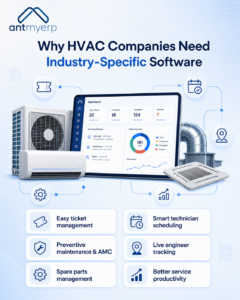
Many businesses start by using general tools like spreadsheets, email, or basic CRM software to manage service operations. While these tools can help with simple tasks, they are not built for the day-to-day needs of an HVAC business.
HVAC service teams handle much more than customer information. They manage installations, breakdown repairs, preventive maintenance, warranty claims, spare parts, technician schedules, and Annual Maintenance Contracts (AMCs). Trying to manage all these activities with separate tools often creates confusion and slows down operations.
Industry-specific software is designed to support these workflows from one platform.
For example, an HVAC business should be able to:
- Create and assign service tickets quickly
- Schedule technicians based on availability and skills
- Track engineers in the field
- View complete equipment and service history
- Manage preventive maintenance visits
- Handle warranty and AMC services
- Monitor spare parts inventory
- Generate service reports instantly
Instead of switching between multiple systems, everything is managed from one place. This improves team coordination, reduces manual work, and helps businesses deliver faster customer service.
Our HVAC Service Software is designed to support these day-to-day service operations, helping businesses stay organized during both regular and peak service seasons.
Why Digital Dispatch Outperforms Manual Scheduling During Peak HVAC Season
As service requests increase during the busy summer season, manual dispatch often struggles to keep up. Digital dispatch helps HVAC businesses stay organized, respond faster, and make better use of their technicians.
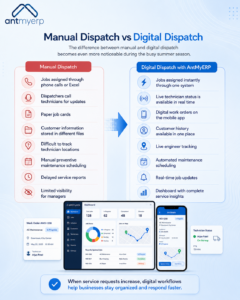
Manual Dispatch
- Jobs are assigned through phone calls, WhatsApp, or Excel sheets.
- Dispatchers spend time calling technicians for updates.
- Paper job cards increase paperwork and delays.
- Customer information is stored across multiple files.
- Technician locations are difficult to track.
- Preventive maintenance schedules are managed manually.
- Service reports are submitted at the end of the day.
- Managers have limited visibility into field operations.
- Emergency service requests can disrupt the entire schedule.
- Higher chances of missed jobs, scheduling errors, and delayed responses.
Digital Dispatch with AntMyERP
- Jobs are assigned instantly from a centralized platform.
- Live technician status is available in real time.
- Digital work orders are sent directly to the technician mobile app.
- Customer history, equipment details, and warranty information are available in one place.
- Live engineer tracking helps assign the nearest available technician.
- Preventive maintenance visits can be scheduled automatically.
- Service reports are updated instantly from the field.
- Real-time dashboards provide complete visibility into service operations.
- Emergency requests can be assigned quickly without affecting other schedules.
- Better technician productivity, faster response times, and improved customer satisfaction.
As demand grows during the summer, digital dispatch enables HVAC businesses to complete more service calls with the same team while delivering a faster and more reliable customer experience.
Benefits of Managing the HVAC Technician Shortage with AntMyERP
Replacing manual dispatch with a digital service management platform offers benefits across the entire business.
With AntMyERP, HVAC companies can:
- Assign jobs to the right technician faster.
- Reduce technician travel time with better scheduling.
- Track field engineers in real time.
- Improve communication between office staff and technicians.
- Manage work orders digitally.
- Schedule preventive maintenance visits automatically.
- Keep customer, equipment, and warranty records in one place.
- Monitor technician productivity through dashboards and reports.
- Improve response times for emergency service requests.
- Deliver a better customer experience during peak seasons.
Instead of spending time managing paperwork and phone calls, your team can focus on completing more service jobs and providing better support to customers.
Conclusion
Technician shortages may continue to challenge the HVAC industry, especially during the busy summer months. However, manual dispatch does not have to slow your business down.
By replacing phone calls, spreadsheets, and paper-based processes with digital workflows, HVAC businesses can make better use of their existing workforce, respond to customer requests more quickly, and improve service quality.
With features such as technician scheduling, a mobile app for field engineers, live engineer tracking, digital work orders, preventive maintenance management, and after-sales service management, We help HVAC businesses stay organized and productive throughout the year.
Whether your goal is to complete more service calls, improve technician productivity, or deliver a better customer experience, having the right field service management platform can make all the difference.