
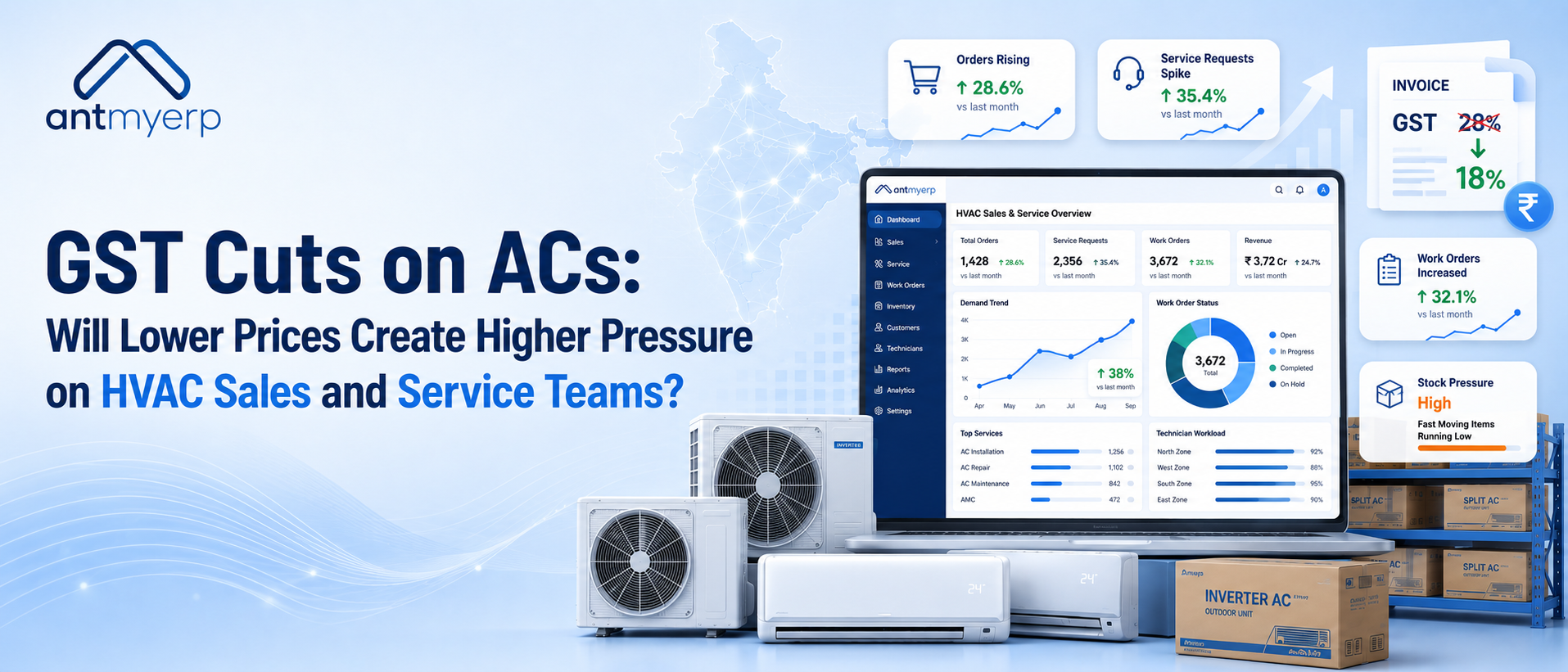
GST Cuts on ACs: Will Lower Prices Create Higher Pressure on HVAC Sales and Service Teams?
2026-07-11
The GST reduction on air conditioners can increase AC demand, creating more installation jobs, preventive maintenance contracts, warranty claims, spare parts movement, and customer service requests. As workloads grow, HVAC businesses need better technician scheduling, inventory management, rental tracking, and customer management. An integrated HVAC Field Service Management Software helps teams stay organized, complete jobs faster, and deliver a better customer experience.
GST Cuts on ACs and Market Context
Air conditioners are now a basic need in most buildings like homes, offices, hospitals, schools, hotels, and factories. Every year, demand rises sharply during hot seasons. Now, with the GST reduction on air conditioners, prices have become more affordable for customers. This encourages more people and businesses to buy new ACs or replace older systems.
According to the Voltas official GST rate cut update on AC prices, the reduction in GST from 28% to 18% has directly lowered AC prices and made cooling solutions more affordable for customers across India.
According to updates from the GST Council Official Updates, changes in GST rates on consumer products often impact pricing and demand trends.
For HVAC companies, this is a strong growth opportunity. More sales usually mean more installations, service requests, AMC contracts, warranty claims, and spare parts usage.
But growth also brings challenges.If companies are not prepared, it can lead to delays, missed jobs, and unhappy customers.
Businesses that plan early and use the right systems will be able to manage this demand smoothly and grow faster.
How GST Cuts on ACs Are Increasing HVAC Demand
The GST Cuts on ACs are directly reducing prices, which is increasing demand across industries. Lower GST makes air conditioners cheaper for customers. This naturally increases buying interest.
More customers now consider:
- Buying new ACs for homes
- Installing ACs in offices and shops
- Replacing old and inefficient systems
- Upgrading to energy-efficient models
This leads to higher demand in both residential and commercial markets.
As sales increase, HVAC companies also get more service responsibilities like:
- Installation jobs
- After-sales service
- Preventive maintenance contracts
- Emergency repairs
Every new AC installation also creates a long-term customer relationship. Over time, these customers need regular servicing, spare parts, and support.
So, as the customer base grows, HVAC companies must be ready to manage both sales and service operations efficiently.
Challenge 1: Managing More Installation Requests
With GST Cuts on ACs, installation requests are rising quickly, creating pressure on HVAC teams. When demand increases, installation work increases quickly.Without proper planning, HVAC companies may face:
- Delayed installations
- Missed customer appointments
- Overloaded technicians
- Poor service experience
- Higher operational pressure
Many companies still manage scheduling using phone calls or spreadsheets. This works for small teams but becomes difficult during peak demand. An HVAC Field Service Management Software helps solve this problem.
It allows managers to:
- Assign jobs based on technician location and skills
- Track job progress in real time
- Handle urgent requests easily
- Reduce manual scheduling errors
Technicians also get clear job details on time, which helps them complete more installations in a day.
Challenge 2 : Keeping Spare Parts Ready
More installations and repairs also increase the need for spare parts.Technicians often need:
- Air filters
- Capacitors
- Compressors
- Fan motors
- Thermostats
- Refrigerant gas
- Electrical components
If any of these parts are missing, service gets delayed. Customers get frustrated, and repeat visits increase.At the same time, keeping too much stock increases storage cost and blocks working capital.
This makes inventory management very important during high demand periods. Inventory Management Software helps HVAC businesses:
- Track stock in real time
- Manage warehouse and van inventory
- Get alerts for low stock items
- Plan purchases in advance
This ensures technicians always have the right parts at the right time, helping them complete jobs on the first visit.
Challenge 3: More Installations Mean More Maintenance Contracts
Installing an AC is not a one-time job. It is the start of a long service journey.Once customers install air conditioners, they need regular servicing. This includes cleaning, checking gas levels, and making sure the system runs smoothly. Without maintenance, ACs use more power and break down faster.
So, when AC sales increase, HVAC companies also get more requests for:
- Annual Maintenance Contracts (AMCs)
- Preventive maintenance visits
- Seasonal servicing
At first, this sounds like good news. More customers mean more recurring business.But managing all these service visits manually becomes very difficult.
Companies often face problems like:
- Missing scheduled service dates
- Forgetting customer reminders
- Double-booking technicians
- No clear service history
When this happens, customers feel ignored and may switch to other service providers. A Preventive Maintenance Software helps HVAC teams:
- Automatically schedule repeat visits
- Send service reminders to customers
- Track complete service history
- Avoid missed or duplicate appointments
This keeps customers happy and creates steady, long-term income for HVAC businesses. A detailed HVAC preventive maintenance checklist helps teams standardize service quality
Challenge 4: Warranty and RMA Requests Can Also Increase
With more ACs being sold, warranty claims also rise.
Customers expect quick support when something goes wrong during the warranty period. Even a small delay can lead to complaints and negative feedback.
But warranty handling is not simple.
Without a proper system, HVAC businesses struggle with:
- Checking warranty validity
- Tracking replaced parts
- Managing return requests
- Coordinating with suppliers
- Closing claims on time
These small delays can create a lot of confusion inside the team.Warranty work also increases paperwork and follow-ups, which slows down service teams. To solve this, businesses use Warranty Management Software
It helps teams:
- Store all warranty details in one place
- Track claim status easily
- Reduce confusion in approvals
- Speed up response time
Sometimes faulty parts must be returned to suppliers or manufacturers. This is where RMA Software (Return Merchandise Authorization) becomes useful.
It helps HVAC companies:
- Record returned parts
- Track approval status
- Follow replacement progress
- Avoid lost or missing components
Together, warranty and RMA systems reduce stress for teams and improve customer trust.
Challenge 5: Temporary Cooling Equipment May See Higher Demand
Not every customer wants to buy a new AC immediately. Some businesses only need cooling for a short time. This is very common in industries like:
- Construction sites
- Factories
- Hospitals
- Event venues
- Commercial spaces during repair work
In these cases, companies prefer to rent cooling equipment like portable ACs or chillers.As AC demand increases, rental demand also increases.But rental operations can quickly become messy if managed manually. Businesses often lose track of:
- Which equipment is available
- Which unit is already rented
- Return dates
- Maintenance schedules
- Asset condition
This can lead to confusion, delays, and even equipment loss. A Rental Management Software helps HVAC businesses:
- Track all rental equipment in real time
- Manage bookings and schedules
- Monitor returns and availability
- Plan maintenance before re-renting assets
This improves equipment usage and ensures no asset is left idle or misplaced during peak demand.Now that installations, maintenance, warranty, and rentals are increasing, the next big challenge is handling daily service execution smoothly. This is where work orders and customer communication become very important.
Challenge 6: Managing More Work Orders Efficiently
Every HVAC job starts with a work order. It can be an installation, repair, inspection, or maintenance visit. When demand increases, the number of work orders also increases quickly. If these are not managed properly, things can easily go out of control.
Many HVAC companies face problems like:
- Delayed job assignments
- Missing job details
- Duplicate work orders
- Poor coordination between office staff and technicians
- No real-time job tracking
When this happens, technicians get confused and customers have to wait longer for service. A Field Service Management Software helps solve this problem.
It allows HVAC teams to:
- Create work orders in one place
- Assign jobs instantly to technicians
- Track job progress in real time
- Update job status from mobile devices
- Upload photos and customer signatures
- Close jobs without returning to the office
This makes the entire service process faster, cleaner, and more organized. Technicians can focus on their work instead of paperwork, and managers get full visibility of every job.
Challenge 7: Better Customer Service Becomes More Important
When the number of customers increases, communication becomes just as important as technical work. Customers today expect quick updates about:
- Installation schedules
- Technician arrival time
- Service progress
- Warranty status
- Job completion
If they do not get clear updates, they may feel ignored or unhappy.This is why customer service needs to be strong and fast. A CRM Software helps HVAC companies manage customer communication better.
It stores:
- Customer details
- Equipment history
- Past service records
- Communication history
So when a customer calls, the support team can quickly see their full history and respond faster.This improves trust and builds long-term relationships. Good communication also leads to:
- Higher customer satisfaction
- More repeat business
- Better brand reputation
AMC tracking software improves customer retention and service transparency
Why Integrated HVAC Service Management Software Makes a Difference
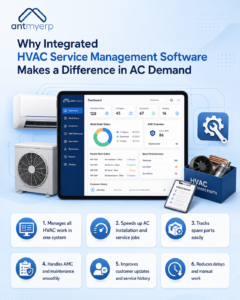
As HVAC companies grow, using separate tools for each task becomes confusing.
For example:
- One system for inventory
- Another for customer records
- Spreadsheets for scheduling
- Paper forms for work orders
This creates duplication, missing data, and slow operations. An integrated HVAC software system solves this problem by connecting everything in one platform.
Businesses can manage:
- Customers
- Technician scheduling
- Work orders
- Preventive maintenance
- Inventory
- Rentals
- Warranty and RMA
- Reports and dashboards
With everything connected, teams work faster and make fewer mistakes. Managers also get clear visibility of daily operations, which helps them make better decisions.
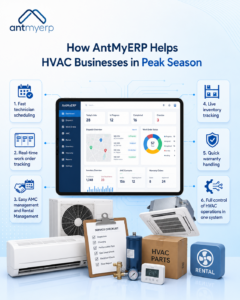
How AntMyERP Helps HVAC Businesses
Whether demand increases due to GST cuts, seasonal heatwaves, or business growth, HVAC companies need systems that can scale with them. AntMyERP’ HVAC Field Service Software brings all HVAC operations into one platform.
With Us, businesses can:
- Schedule and dispatch technicians easily
- Create and track work orders
- Manage preventive maintenance contracts
- Monitor inventory in real time
- Track rental equipment
- Handle warranty and RMA processes
- Maintain complete customer history
- Generate reports for better planning
By combining field service, inventory, CRM, rentals, and maintenance in one system, HVAC companies can reduce manual work and improve efficiency.This helps teams handle more jobs without losing service quality.
Conclusion
Overall, the GST Cuts on ACs are creating strong growth opportunities for HVAC companies.
This brings new growth opportunities, but also increases pressure on installation teams, service technicians, inventory systems, warranty processes, and customer support teams. Without proper systems, businesses may face delays, confusion, and customer dissatisfaction.
But with the right HVAC Service Management Software, HVAC companies can turn this demand into a big advantage.