
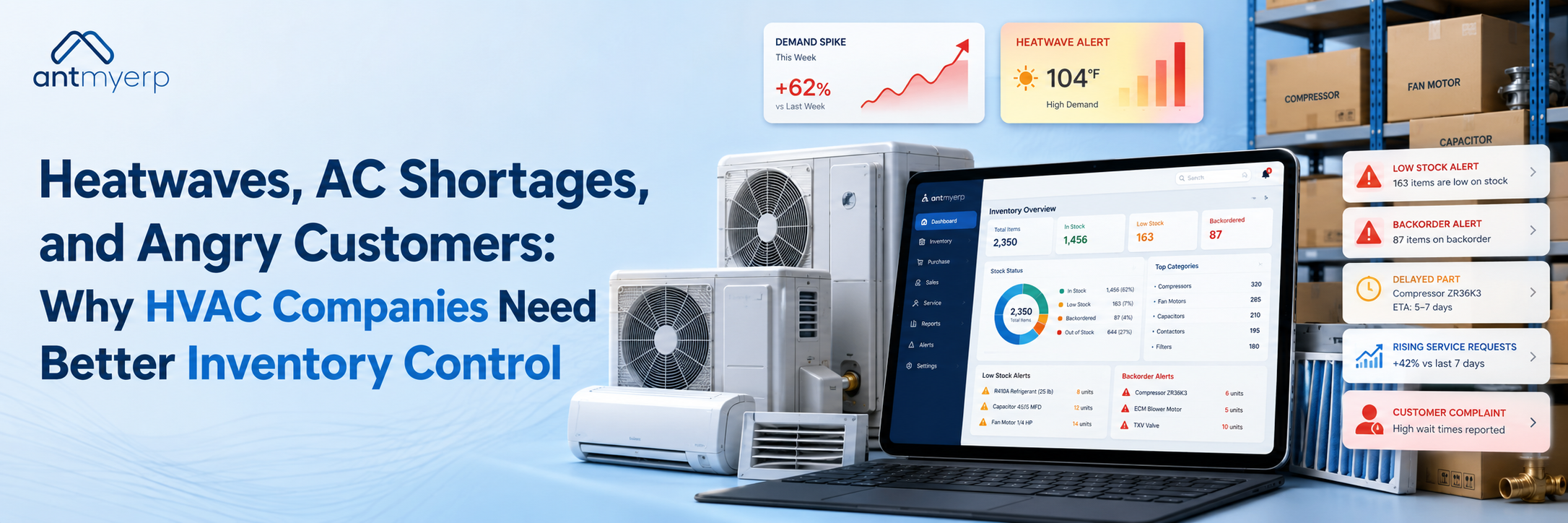
Heatwaves, AC Shortages, and Angry Customers: Why HVAC Companies Need Better Inventory Control
2026-07-08
I Heatwaves increase HVAC service requests, making stock shortages, rental equipment, and warranty returns harder to manage. HVAC Inventory Management Software helps businesses maintain real-time inventory visibility, prevent stockouts, streamline rentals, simplify RMA claims, and deliver faster customer service.
Summer is the busiest season for HVAC companies, with rising demand for AC installations, emergency repairs, and preventive maintenance. Without the right parts in stock, service delays, frustrated customers, and higher costs become common. HVAC Inventory Management Software provides real-time inventory visibility, automates stock tracking, and ensures technicians have the right parts to deliver faster, more reliable service during peak demand.
Why Heatwaves Create Inventory Challenges for HVAC Companies
Heatwaves don’t just increase temperatures, they put immense pressure on HVAC operations. A sudden spike in service requests can quickly expose weaknesses in inventory planning and warehouse management.
Some of the biggest challenges include:
- A sharp increase in emergency AC repair requests.
- Fast-moving spare parts selling out within days.
- Delayed deliveries from suppliers due to increased demand.
- Warehouse staff struggling to update stock manually.
- Technicians leaving for jobs without the required components.
- Multiple branches ordering the same parts because inventory isn’t visible across locations.
Without a centralized HVAC inventory system, businesses often discover stock shortages only after a technician reaches the customer. This delays repairs, increases travel costs, and affects customer satisfaction. Maintaining adequate spare parts and supporting effective maintenance planning are key to reliable HVAC operations, a principle also highlighted by ASHRAE in its guidance on HVAC system operation and maintenance.
Common Inventory Problems HVAC Companies Face
Many HVAC companies experience recurring inventory issues, especially during the summer season. These challenges not only reduce efficiency but also impact revenue and customer trust.
1. Frequent Stockouts
Running out of high-demand components such as compressors, contactors, thermostats, and fan motors can stop service operations. Without real-time HVAC stock tracking, businesses cannot identify low inventory until it is too late.
2. Overstocking Slow-Moving Inventory
To avoid shortages, some companies purchase excess inventory. While this reduces the risk of stockouts, it also increases storage costs and ties up valuable working capital. An effective HVAC inventory management strategy helps maintain the right balance between demand and stock levels.
3. Poor Warehouse Visibility
Many businesses operate multiple warehouses or service locations. If inventory is tracked manually, employees may not know where a particular part is available. This lack of visibility leads to unnecessary purchases and delays in fulfilling service requests.
4. Manual Inventory Errors
Using spreadsheets or paper-based records increases the risk of incorrect inventory counts, duplicate entries, and missing stock updates. Even a small mistake can disrupt multiple work orders during peak season.
5. Inefficient Technician Van Inventory
Technicians often carry commonly used spare parts in their service vehicles. Without proper technician van inventory tracking, parts may be consumed without being recorded. This creates discrepancies between actual and recorded inventory, making it difficult to replenish stock accurately.
6. Delayed Purchase Planning
When businesses cannot forecast demand, they place purchase orders too late. Suppliers may also experience stock shortages during heatwaves, making it difficult to source critical components quickly. Better HVAC purchase planning helps ensure essential parts are available before demand peaks.
Why Inventory Alone Isn’t Enough During Peak Summer
Inventory management is essential, but it is only one piece of the puzzle. During the busiest months, HVAC companies also need to manage rental equipment and warranty returns efficiently.
For example:
- A customer may need a temporary cooling unit while waiting for a replacement system.
- A failed compressor may still be covered under the manufacturer’s warranty.
- Portable air conditioners, chillers, or generators may already be rented out, but their availability isn’t visible to the service team.
When inventory, rentals, and warranty processes operate in separate systems, teams waste valuable time searching for equipment, checking warranty status, or coordinating returns.
An integrated platform helps businesses manage all these operations from one place, reducing delays and improving service.
How HVAC Inventory Management Software Solves These Challenges
HVAC Inventory Management Software goes beyond simple stock tracking. It provides complete visibility into inventory, warehouse operations, technician stock, and procurement activities.
Instead of manually updating spreadsheets, businesses can automate inventory processes and make faster decisions based on real-time information.
A centralized inventory system helps HVAC companies:
- Track inventory across multiple warehouses in real time.
- Monitor stock movement from purchase to installation.
- Receive automatic low-stock alerts.
- Maintain accurate inventory records.
- Reduce manual data entry and human errors.
- Improve inventory visibility across all service locations.
- Plan purchases using historical demand data.
- Ensure technicians have the right spare parts before leaving for service calls.
- Improve first-time fix rates and customer satisfaction.
By replacing manual inventory tracking with automation, HVAC companies can reduce operational costs, improve warehouse efficiency, and respond faster to emergency service requests during heatwaves.
Equipment Rental Challenges During Heatwaves
During peak summer, many HVAC companies do more than install and repair air conditioning systems. They also rent portable air conditioners, chillers, generators, air handlers, and cooling units to customers who need immediate relief while waiting for permanent repairs or new installations.
Managing rental equipment manually can quickly become difficult when demand is high.
Some common rental challenges include:
- Equipment availability is not updated in real time.
- The same unit is accidentally booked for multiple customers.
- Returned equipment is not inspected before the next rental.
- Maintenance schedules are missed.
- Rental assets are misplaced between warehouses or job sites.
- Teams cannot identify which units are available, rented, or under maintenance.
These problems reduce equipment utilization, delay customer service, and increase operational costs. By integrating HVAC Inventory Management Software with equipment rental management, businesses can track both spare parts and rental assets from a single platform.
How Equipment Rental Software Improves HVAC Operations
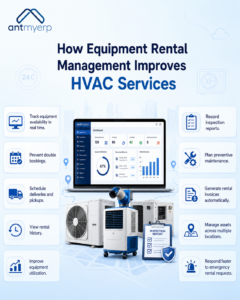
An integrated equipment rental solution helps HVAC businesses manage rental assets throughout their lifecycle.
Instead of maintaining separate spreadsheets, teams can monitor every rental unit from booking to return.
Key benefits include:
- Track real-time availability of rental equipment.
- Prevent double bookings.
- Schedule equipment deliveries and pickups.
- Monitor rental history and utilization.
- Record inspections before and after each rental.
- Plan preventive maintenance based on usage.
- Generate rental invoices automatically.
- Improve asset utilization across multiple branches.
For example, during a heatwave, a commercial customer may need temporary cooling while waiting for a replacement chiller. With an integrated rental system, the service team can instantly check available units, reserve the equipment, and schedule delivery without manually contacting multiple warehouses.
This improves response time and enhances the customer experience.
Managing Warranty Returns with RMA Software
Heatwaves place additional stress on HVAC equipment, increasing the likelihood of component failures. Compressors, capacitors, motors, thermostats, and control boards are replaced more frequently during peak demand.
Many of these parts are still covered under the manufacturer’s warranty.However, warranty management often becomes a challenge because businesses rely on emails, spreadsheets, or paper records to process returns.
As a result, companies experience:
- Delayed warranty claims.
- Lost or misplaced returned parts.
- Missing warranty documents.
- Poor visibility into claim status.
- Increased replacement costs due to rejected claims.
Without a structured Return Merchandise Authorization (RMA) process, valuable time and money are lost.
How RMA Software Supports Better Inventory Management
An integrated RMA Software simplifies the entire warranty return process.Instead of manually tracking returned parts, businesses can record every return, monitor warranty status, and follow the progress of each claim from one system.
An effective RMA solution helps HVAC companies:
- Create and manage Return Merchandise Authorizations (RMAs)
- Track defective parts from technicians to the warehouse.
- Store warranty information digitally.
- Monitor claim approvals from manufacturers.
- Record return reasons for future analysis.
- Reduce warranty leakage.
- Speed up reimbursements.
- Improve inventory accuracy by updating stock automatically after returns.
For example, if a technician replaces a faulty compressor under warranty, the returned unit can be tracked through the RMA process while inventory is updated automatically. This eliminates manual paperwork and ensures accurate stock records.
Key Features to Look for in HVAC Inventory Management Software
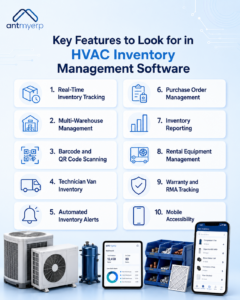
Choosing the right software can significantly improve daily operations. A modern solution should support inventory, warehouse management, rentals, and service teams from a single platform.
Look for features such as:
Real-Time Inventory Tracking
Monitor stock levels instantly across warehouses, service centers, and technician vehicles.
Multi-Warehouse Management
Track inventory across multiple locations while maintaining complete visibility.
Barcode and QR Code Scanning
Reduce manual data entry and improve inventory accuracy with barcode-enabled stock movements.
Technician Van Inventory
Monitor spare parts carried by technicians and automatically update stock after every service call.
Automated Inventory Alerts
Receive notifications when inventory reaches predefined minimum stock levels.
Purchase Order Management
Generate purchase requests based on inventory consumption and seasonal demand.
Inventory Reporting
Analyze stock movement, fast-moving items, slow-moving inventory, and purchasing trends through detailed reports.
Rental Equipment Management
Track rental assets, monitor availability, schedule bookings, and manage returns.
Warranty and RMA Tracking
Record warranty claims, manage returned parts, and monitor manufacturer approvals from one dashboard.
Mobile Accessibility
Allow technicians and warehouse staff to update inventory using smartphones or tablets while working in the field.
Benefits of an Integrated HVAC Operations Platform
Managing inventory, rental equipment, warranty claims, and field service from separate systems creates unnecessary complexity. An integrated platform helps HVAC companies streamline operations and improve decision-making.
Some of the biggest benefits include:
- Prevent AC shortages during peak summer demand.
- Improve inventory visibility across all warehouses.
- Increase first-time fix rates by ensuring technicians have the right spare parts.
- Reduce emergency purchases through better demand forecasting.
- Improve technician productivity with real-time inventory access.
- Minimize inventory carrying costs.
- Increase rental equipment utilization.
- Simplify warranty return management.
- Reduce warranty claim processing time.
- Improve warehouse operations and inventory accuracy.
- Deliver faster customer service.
- Lower operational costs through automation.
- Make data-driven purchasing decisions.
- Improve overall business efficiency.
By integrating inventory management, rental operations, and RMA processes into one platform, HVAC companies can respond more effectively to seasonal demand while providing a better customer experience.
Best Practices for HVAC Inventory Management
Managing inventory effectively requires more than simply tracking stock levels. HVAC companies should adopt proactive strategies that improve inventory accuracy, reduce waste, and ensure the right parts are available when customers need them.
Here are some best practices to follow:
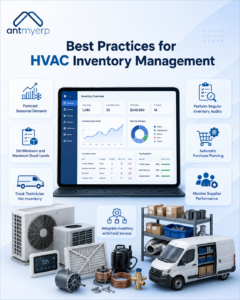
Forecast Seasonal Demand
Analyze historical service data to identify fast-moving parts during summer. Accurate HVAC demand forecasting helps businesses prepare for peak demand without overstocking.
Set Minimum and Maximum Stock Levels
Define reorder points for critical spare parts such as compressors, capacitors, motors, thermostats, and contactors. Automated HVAC inventory alerts ensure replenishment happens before stock runs out.
Track Technician Van Inventory
Technicians often carry commonly used spare parts in their service vehicles. Monitoring technician van inventory ensures parts used during service calls are automatically deducted from inventory, maintaining accurate stock records.
Perform Regular Inventory Audits
Schedule periodic inventory audits to identify discrepancies between physical stock and system records. Regular audits improve inventory accuracy and reduce losses.
Automate Purchase Planning
Use historical consumption trends and current inventory levels to automate procurement decisions. Smart purchase planning reduces emergency purchases and helps maintain healthy stock levels.
Monitor Supplier Performance
Evaluate suppliers based on delivery time, product quality, and order accuracy. Reliable suppliers help prevent delays during high-demand seasons.
Integrate Inventory with Field Service
Connecting inventory with field service management ensures technicians know which parts are available before visiting customer sites. This improves first-time fix rates and reduces repeat visits.SMRP recommends standardized maintenance and inventory processes to improve equipment reliability and operational performance.
Why Choose AntMyERP for HVAC Inventory Management?
Managing HVAC operations requires more than just inventory tracking. Businesses also need better control over equipment rentals, warranty returns, work orders, and field technicians.
AntMyERP’s HVAC Inventory Management brings all these processes together in one integrated platform, helping HVAC companies improve efficiency and customer satisfaction.
Inventory Management
Track spare parts across multiple warehouses with complete inventory visibility. Real-time stock updates, automated replenishment, and inventory reporting help businesses avoid stock shortages during peak demand.
Equipment Rental Management
Manage rental assets such as portable air conditioners, chillers, generators, and temporary cooling units from a centralized dashboard. Check equipment availability, schedule rentals, track returns, and monitor maintenance to maximize asset utilization.
RMA and Warranty Management
Manage returned parts using Return Merchandise Authorization (RMA) software, store warranty documents, and track claim status in one place. This reduces warranty leakage and improves reimbursement turnaround time.
Field Service Management
Assign work orders to technicians, track service history, manage preventive maintenance schedules, and ensure technicians have access to the required spare parts before arriving on-site.
Procurement and Supplier Management
Automate purchase requests based on inventory levels, manage supplier information, and monitor procurement activities to ensure stock availability throughout the year.
AntMyERP combines inventory management, equipment rental, warranty tracking, and field service in one platform. It helps HVAC companies respond faster, lower costs, and provide better customer service.
Key Take Away
- Heatwaves increase HVAC demand but also expose gaps in inventory, rental equipment, and warranty management.
- Poor inventory control can lead to stockouts of critical spare parts, delayed repairs, and reduced customer satisfaction.
- HVAC Inventory Management Software improves real-time visibility, streamlines warehouse operations, and helps increase first-visit job completion rates.
- When combined with equipment rental management, RMA software, HVAC Field Service Management Software, and procurement tools, businesses gain complete control over their operations from a single platform.
- AntMyERP helps HVAC businesses stay prepared during peak seasons, reduce costs, and improve service reliability under high-demand conditions.
Ready to Prepare for Peak Summer Demand?
Heatwaves don’t have to result in stock shortages, delayed service, or unhappy customers. With AntMyERP, you can manage inventory, rental equipment, warranty returns, and field service from a single platform.