
Top Reasons to Invest in HVAC Field Service Management Software
2026-06-05
HVAC field service management software helps HVAC businesses manage technician scheduling, work orders, preventive maintenance, maintenance contracts, inventory, asset tracking, customer service, and billing from a centralized platform. By automating daily operations, HVAC companies can improve technician productivity, reduce operational costs, increase first-time fix rates, and deliver better customer experiences.
What Is HVAC Field Service Management Software?
HVAC field service management software is basically a platform that HVAC, refrigeration, and maintenance companies use to manage field operations from one place.
It usually covers things like work orders, technician scheduling, dispatching, preventive maintenance, asset tracking, inventory, customer management, billing, all the main daily operations.
Earlier most of this work was scattered. Spreadsheets, phone calls, paperwork, different systems not really talking to each other. Now it’s more connected in one platform.
Because of that, companies get a clearer view of what’s happening in the field. Technicians, equipment history, maintenance schedules, customer requests, everything becomes easier to track and manage.
Why HVAC Businesses Need Field Service Management Software
As HVAC businesses grow, things start getting a bit harder to manage. Technicians, customer requests, maintenance contracts, equipment records, service schedules, everything starts piling up together.
Many companies end up facing issues like missed appointments, delayed technician dispatch, manual work orders, lost service records, missed contract renewals, inventory shortages, billing delays, and sometimes customer complaints also.
All of this slowly affects day-to-day work. Operations don’t run as smoothly, and it also impacts customer satisfaction and overall profitability over time.
Common HVAC Service Challenges
Many HVAC businesses struggle with:
- Missed service visits
- Delayed technician dispatch
- Lost service records
- Contract renewal misses
- Inventory shortages
- Billing delays
- Customer complaints
HVAC field service management software helps solve these challenges through automated scheduling, GPS technician tracking, digital service records, automated contract reminders, real-time inventory visibility, automated invoicing, and customer notifications.
As per Grand View Research, the HVAC maintenance services market is growing steadily. This is mainly because companies are focusing more on better energy usage and preventive maintenance instead of waiting for breakdowns. The report also mentions that AMC models and digital service systems are becoming more common in HVAC businesses.
Top 10 Reasons to Invest in HVAC Field Service Management Software
1. Improve Overall Operational Efficiency
Managing HVAC service operations involves coordinating multiple activities simultaneously, including technician scheduling, work order management, preventive maintenance, billing, customer communication, and inventory tracking.
HVAC field service software centralizes these activities into one platform, helping teams streamline workflows and improve productivity.
Benefits include:
- Faster service delivery
- Reduced administrative workload
- Improved technician productivity
- Better visibility into operations
- Fewer scheduling conflicts
2. Real-Time Technician Tracking
Real-time technician tracking allows dispatchers to monitor technician locations and assign jobs more effectively.
With GPS-enabled tracking, managers can quickly identify the nearest available technician and dispatch them to emergency service requests.
Benefits include:
- Faster response times
- Reduced travel costs
- Better route optimization
- Improved technician accountability
- Enhanced customer satisfaction
3. Automated Work Order Management
Manual work order handling often creates delays and communication issues between office staff and field technicians.
HVAC software automates the entire work order process, from service request creation to job completion.
Technicians can:
- Access work orders instantly
- View customer history
- Upload photos and videos
- Record customer signatures
- Update job status in real time
Having complete service information available on mobile devices helps technicians arrive prepared and complete jobs more efficiently.
4. Better Preventive Maintenance Management
Preventive maintenance is one of the most important revenue streams for HVAC businesses. Regular maintenance helps reduce equipment failures, improve system efficiency, and increase customer retention.
HVAC software automates:
- Maintenance schedules
- Recurring inspections
- Service reminders
- Compliance tracking
- Technician assignments
Preventive Maintenance vs Reactive Maintenance
Preventive maintenance is basically planned checks and servicing done before anything actually breaks. It helps reduce repair costs, keeps downtime low, extends equipment life, and overall customers stay more satisfied because things don’t fail suddenly.
Reactive maintenance is the opposite. It comes after something has already broken down. In most cases it leads to emergency repairs, higher costs, more downtime, and often customer complaints because the service gets delayed and urgent.
5. HVAC Asset Management and Service Tracking
HVAC companies manage a wide range of equipment, including air conditioning systems, chillers, compressors, heat pumps, ventilation systems, air handling units, and thermostats.
HVAC field service software helps businesses maintain complete records for:
- Asset history
- Repair records
- Maintenance schedules
- Equipment performance
- Warranty information
- Lifecycle costs
This information helps technicians diagnose issues faster and supports better maintenance planning.
6. Maintenance Contract Management
Annual Maintenance Contracts (AMCs) are a major source of recurring revenue for HVAC businesses.
HVAC software helps businesses manage:
- Contract renewals
- Scheduled maintenance visits
- SLA compliance
- Customer obligations
- Contract profitability
Automated reminders ensure contracts are renewed on time while helping businesses maintain consistent customer relationships.
7. Spare Parts and Inventory Management
Inventory visibility plays a major role in improving first-time fix rates.
HVAC software helps manage:
- Spare parts inventory
- Warehouse stock
- Technician van inventory
- Purchase requests
- Reorder levels
This ensures technicians have access to the right parts when needed and helps reduce inventory shortages.
8. Improved Customer Service
Customer expectations continue to rise in the HVAC industry.
HVAC service management software improves communication through:
- Appointment reminders
- Technician arrival notifications
- Service status updates
- Digital service reports
- Automated follow-ups
These features help create a better customer experience while building trust and long-term loyalty.
9. Better Technician Productivity
Technicians are more productive when they have immediate access to the information they need.
With a mobile field service application, technicians can access:
- Work orders
- Customer history
- Asset records
- Maintenance checklists
- Inventory information
This reduces paperwork and allows technicians to complete more jobs each day.
10. Increased Profitability
Improved efficiency directly contributes to profitability.
HVAC businesses can increase profits by:
- Reducing operational costs
- Increasing technician utilization
- Improving first-time fix rates
- Reducing administrative overhead
- Improving contract renewals
Example
A company with 20 technicians that just manages to complete one extra service call per technician per day can actually see a noticeable jump in yearly revenue. No need to hire more staff, just better utilization of time and scheduling.
How Air Conditioning Service Management Software Helps HVAC Businesses
Air conditioning service management software is mainly built to handle AC installation, maintenance, and repair work in a more organized way from one system.
Benefits include:
- Faster dispatching
- Better service scheduling
- Equipment history tracking
- Warranty tracking
- Customer communication
- Preventive maintenance planning
This is especially valuable for businesses managing large volumes of residential and commercial AC units.
Best HVAC Field Service Management Software Features
When evaluating HVAC software, look for features such as:
- Work order management for faster service delivery
- Technician scheduling for better resource utilization
- GPS tracking for faster dispatching
- Preventive maintenance scheduling to reduce breakdowns
- Inventory management to improve first-time fix rates
- Mobile apps for real-time field updates
- Asset tracking for equipment visibility
- CRM integration for customer management
- Billing and invoicing automation
- Reporting and analytics for business insights
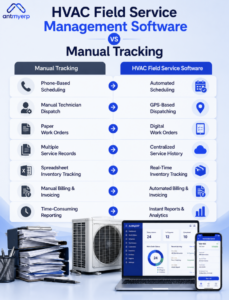
HVAC Field Service Management Software vs Manual Tracking
Traditional manual processes often rely on phone calls, spreadsheets, paper forms, and disconnected systems.
With HVAC field service software:
- Scheduling becomes automated instead of relying on phone calls.
- Dispatching uses GPS-based technician assignment instead of manual coordination.
- Work orders become digital instead of paper-based.
- Service history is centralized rather than stored in multiple files.
- Inventory is tracked in real time instead of spreadsheets.
- Billing is automated rather than manually generated.
- Reports can be generated instantly instead of requiring hours of manual work.
HVAC Inventory and Procurement Management
Inventory and procurement directly impact service profitability.
HVAC businesses must manage spare parts, vendor relationships, purchase orders, stock levels, and material costs.
Integrated HVAC software helps reduce inventory shortages while improving procurement planning and cost control.
Why Inventory Visibility Matters
When technicians know exactly which parts are available and where they are located, they can resolve issues faster and avoid repeat visits.
Good inventory visibility helps:
- Improve first-time fix rates
- Reduce stock shortages
- Lower inventory carrying costs
- Improve customer satisfaction
How Commercial HVAC Companies Use Field Service Software
Imagine a commercial HVAC company managing 50 technicians, hundreds of buildings, and thousands of maintenance visits each year.
Without software, coordinating schedules, contracts, inventory, and customer communication becomes extremely difficult.
HVAC software helps automate and centralize these operations.
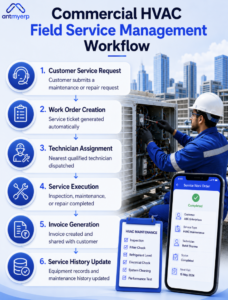
Real-World HVAC Workflow
Step 1: Customer Creates Service Request
The customer submits a maintenance or repair request.
Step 2: Work Order Creation
The system automatically creates a work order.
Step 3: Technician Assignment
The dispatcher assigns the nearest qualified technician.
Step 4: Service Execution
The technician completes the work and updates job details.
Step 5: Invoice Generation
The system automatically generates invoices.
Step 6: Service History Update
Equipment and customer records are updated for future reference.
How to Choose the Best HVAC Field Service Management Software
HVAC Software Evaluation Checklist
Look for software that includes:
- Work Order Management
- Preventive Maintenance Scheduling
- Technician Mobile App
- GPS Tracking
- Asset Management
- AMC Management
- Inventory Management
- Customer Portal
- Billing & Invoicing
- CRM Integration
- Reporting & Analytics
- Multi-location Support
Why Choose AntMyERP for HVAC Service Management?
AntMyERP’ HVAC FSM Software helps HVAC businesses manage their complete service lifecycle from a single platform.
Key capabilities include:
- Work Order Management
- Preventive Maintenance
- AMC Management
- Asset Tracking
- Inventory Management
- Technician Tracking
- Customer Management
- Billing & Invoicing
By centralizing service operations, HVAC companies can improve productivity, reduce operational costs, and deliver better customer experiences.
Key Takeaways
- HVAC field service management software centralizes service operations.
- It improves scheduling, dispatching, maintenance, inventory, and billing.
- Preventive maintenance reduces equipment failures.
- Asset tracking improves equipment reliability.
- Inventory visibility improves first-time fix rates.
- Automated workflows increase technician productivity.
- Better service delivery improves customer satisfaction and profitability.