
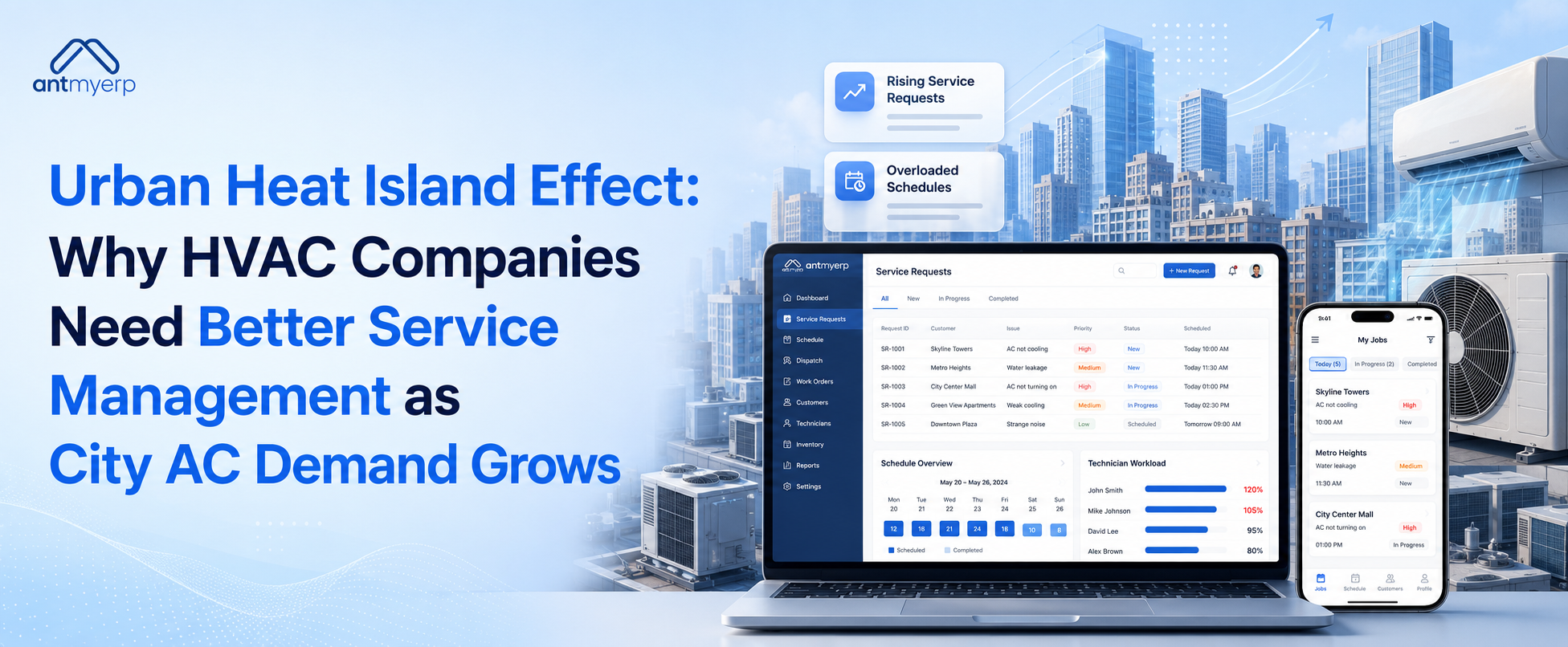
Urban Heat Island Effect: Why HVAC Companies Need Better Service Management as City AC Demand Grows
2026-07-27
The Urban Heat Island Effect is making cities hotter than ever, leading to a sharp increase in air conditioner installations, emergency repairs, and preventive maintenance needs. While this creates new business opportunities for HVAC companies, it also puts pressure on technicians, scheduling, inventory, and customer service. HVAC Service Management Software helps businesses automate service operations, improve response times, and manage growing demand efficiently.
Urban Heat Island Effect: Why HVAC Companies Need Better Service Management as City AC Demand Grows
Urban areas across India are experiencing longer and more intense summers. Buildings, roads, parking lots, and other infrastructure absorb and retain heat throughout the day, making cities significantly warmer than nearby rural areas. This phenomenon is known as the Urban Heat Island Effect.
As temperatures continue to rise, households, offices, hospitals, retail stores, hotels, and industrial facilities rely more heavily on air conditioning systems. This has resulted in increased installation requests, higher maintenance demand, and more emergency breakdown calls for HVAC service providers.
While the growing demand presents new business opportunities, it also creates operational challenges. Companies that continue to rely on manual scheduling, spreadsheets, and paper-based service processes may struggle to keep up. This is where HVAC Service Management Software becomes essential.
What Is the Urban Heat Island Effect?
The Urban Heat Island (UHI) Effect occurs when urban areas become warmer than surrounding rural regions because concrete, asphalt, and buildings absorb and store heat. Limited vegetation, dense construction, vehicle emissions, and human activities further contribute to rising temperatures.
As cities expand and climate patterns change, cooling systems are operating for longer hours and under greater stress. This directly impacts the workload of HVAC installation and service companies.
According to the U.S. Environmental Protection Agency (EPA), urban areas can experience higher temperatures than surrounding rural areas because buildings, roads, and other infrastructure absorb and re-emit heat. This increase in temperature can directly impact cooling demand and energy consumption.
How the Urban Heat Island Effect Is Increasing AC Demand
The growing demand for air conditioning is driven by several factors:
- Higher average temperatures in cities
- More frequent and prolonged heatwaves
- Rapid urbanization and commercial development
- Increased construction of residential apartments and office spaces
- Growing awareness of indoor air comfort
- Expansion of data centers, healthcare facilities, and retail infrastructure
For HVAC companies, this means handling a larger volume of installations, preventive maintenance visits, and emergency repair requests throughout the year.The demand for cooling is expected to grow significantly in the coming years. According to the International Energy Agency (IEA), space cooling demand is one of the fastest-growing sources of electricity consumption globally, driven by rising temperatures, urbanization, and increasing access to air conditioning.
The increase in enquiries during peak summer also creates bottlenecks before a technician even reaches the site. Learn how HVAC companies lose customers between the first enquiry and final installation in our guide on From Enquiry to Installation: Where HVAC Companies Lose Customers During High-Demand Months.
Challenges HVAC Companies Face During Peak Cooling Seasons
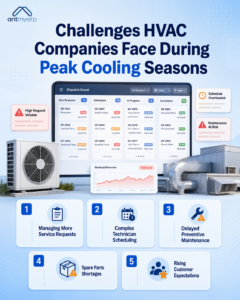
1. Managing More Service Requests
During summer months, service calls can increase significantly. Customers expect quick response times, but manually assigning jobs often leads to delays, scheduling conflicts, and missed appointments.
Using Field Service Management Software helps HVAC businesses automate job assignment, track service requests, and improve technician response time.
2. Technician Scheduling Becomes More Complex
Coordinating multiple technicians across different city locations is difficult without a centralized system.
Managers need answers to questions like:
- Which technician is available?
- Who is closest to the customer?
- Who has experience with the required equipment?
- Which jobs should be prioritized?
Without real-time visibility, dispatching becomes inefficient.
3. Preventive Maintenance Often Gets Delayed
Many HVAC businesses prioritize emergency repairs during peak season, causing preventive maintenance contracts to be postponed.
Delayed maintenance increases equipment failures, customer complaints, and expensive repair work.
With Preventive Maintenance Software, HVAC companies can schedule recurring maintenance activities, track service history, and reduce unexpected breakdowns.
4. Spare Parts Availability Becomes Critical
High demand for compressors, filters, motors, capacitors, refrigerants, and electrical components can quickly deplete inventory. Without proper inventory tracking, technicians may need multiple visits to complete a repair, increasing operational costs and reducing customer satisfaction.
Spare Parts Management Software enables HVAC companies to monitor inventory levels, manage spare availability, and improve first-time fix rates.
5. Customers Expect Faster Service
Today’s customers expect:
- Quick appointment scheduling
- Technician arrival updates
- Digital service reports
- Transparent communication
- Faster issue resolution
Meeting these expectations becomes challenging when service operations are managed manually.
Why HVAC Service Management Software Is Becoming Essential
As service demand grows, HVAC businesses need digital tools that simplify daily operations instead of adding more manual work.
HVAC Field Service Management Software connects scheduling, dispatch, preventive maintenance, inventory management, customer information, and reporting into one centralized platform.
Instead of switching between spreadsheets, phone calls, and paperwork, service teams can manage everything from a single system.
Key Features Every HVAC Business Should Look For
Smart Technician Scheduling
Automatically assign service requests based on technician availability, skills, location, and workload to reduce travel time and improve response rates.
Real-Time Dispatch Management
Track technicians in real time, monitor job progress, and quickly reassign urgent service requests when needed.
Preventive Maintenance Planning
Schedule recurring maintenance visits automatically to reduce unexpected equipment failures and extend the life of HVAC systems.
Digital Work Orders
Allow field technicians to receive service requests on their mobile devices, upload photos, update job status, collect customer signatures, and close jobs digitally.
Spare Parts Inventory Management
Track inventory across warehouses and service vehicles to ensure technicians have the right parts before visiting customer locations.
AMC Management
Manage Annual Maintenance Contracts with automated reminders, scheduled visits, SLA tracking, and renewal notifications.
Reporting and Analytics
Monitor technician productivity, service turnaround time, repeat visits, maintenance compliance, and customer satisfaction through real-time dashboards.
How AntMyERP Helps HVAC Companies Manage Rising Service Demand
As the Urban Heat Island Effect continues to increase cooling demand, HVAC businesses need more than manual coordination to stay competitive. AntMyERP HVAC Service Management Software helps HVAC companies manage their entire service lifecycle from a single platform.
With AntMyERP, you can:
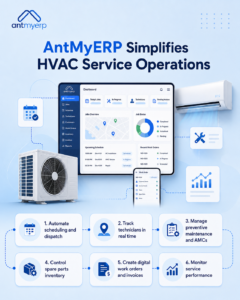
- Automate technician scheduling and dispatch
- Track field technicians in real time
- Manage preventive maintenance schedules
- Handle Annual Maintenance Contracts (AMCs)
- Monitor spare parts inventory
- Generate digital work orders and service reports
- Capture customer approvals electronically
- Maintain complete service history for every asset
- Generate invoices faster
- Improve first-time fix rates
- Monitor service performance through centralized dashboards
Whether your business provides residential AC servicing, commercial HVAC maintenance, refrigeration services, or industrial cooling solutions, AntMyERP helps streamline operations while delivering a better customer experience.
Why Digital Service Management Is the Future of HVAC
Rising urban temperatures are not a seasonal trend—they are becoming a long-term operational reality. As cities continue to grow and cooling demand increases, HVAC businesses must be prepared to manage higher service volumes without compromising quality.
Companies that invest in digital service management today will be better positioned to reduce delays, improve technician productivity, optimize inventory, and deliver faster customer support.
Key Takeaways
- The Urban Heat Island Effect is increasing cooling demand across urban areas.
- Higher AC usage means more installations, maintenance visits, and emergency repairs for HVAC companies.
- Manual scheduling and inventory tracking make it difficult to handle growing workloads efficiently.
- HVAC Service Management Software helps automate dispatch, preventive maintenance, inventory management, and customer communication.
- AntMyERP enables HVAC businesses to improve operational efficiency, reduce response times, and scale service operations with confidence.
As cooling demand continues to rise, HVAC businesses need smarter tools to stay efficient and competitive.
Our HVAC Service Management Software helps you automate scheduling, dispatch, preventive maintenance, inventory management, AMC tracking, and field service operations all from one integrated platform.
Book a demo today to see how AntMyERP can help your HVAC business deliver faster service, improve technician productivity, and keep customers satisfied even during peak cooling seasons.