

Medical Equipment Maintenance Software: Complete Guide
2026-11-23
Medical Equipment Maintenance Software helps hospitals, healthcare organizations, and service businesses keep track of equipment, maintenance schedules, service requests, repairs, technicians, spare parts, and service history in one place. It makes day-to-day maintenance easier to manage and helps teams avoid missed service activities.
Medical equipment needs regular maintenance to stay safe, reliable, and ready to use. But when a business is managing hundreds of machines, service requests, maintenance dates, and repair records, keeping everything updated manually can quickly become difficult.
Medical Equipment Maintenance Software gives teams one place to manage this work. They can keep equipment records updated, schedule preventive maintenance, assign service jobs to technicians, track repairs, and check previous service history when needed.
Teams can keep their maintenance information together, making it easier to see what needs attention and what has already been completed.
What Is Medical Equipment Maintenance Software?
Medical Equipment Maintenance Software helps teams keep track of the maintenance work needed for their medical and healthcare equipment.
It brings important details such as equipment records, maintenance schedules, service requests, repairs, technician assignments, spare parts, warranties, and service history together in one place.
For example, a hospital may have diagnostic machines, patient monitoring devices, imaging equipment, and many other devices across different departments. With so many assets to look after, the maintenance team needs an easy way to check where a piece of equipment is, when it was last serviced, when the next maintenance is due, and whether any repair or service is still pending.
A Medical Equipment Management System keeps these details organized and makes it easier for maintenance and service teams to find the right information when they need it.
For businesses that also manage customer equipment and field service operations, Medical Equipment Service Software can help connect equipment records, service requests, preventive maintenance, technicians, and service activities.
Why Is Medical Equipment Maintenance Important?
Medical equipment is often used regularly and can be critical to day-to-day healthcare operations. Delayed maintenance or missed service activities can lead to unexpected breakdowns and equipment downtime.
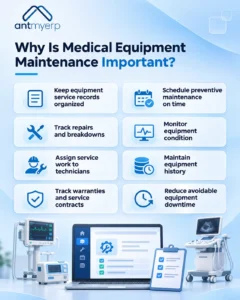
A structured maintenance process helps teams:
- Keep equipment service records organized
- Schedule preventive maintenance on time
- Track repairs and breakdowns
- Monitor equipment condition
- Assign service work to technicians
- Maintain equipment history
- Track warranties and service contracts
- Reduce avoidable equipment downtime
For service businesses, it also becomes easier to manage multiple customers, equipment locations, technicians, and service requests from one place.
Key Features of Medical Equipment Maintenance Software
1. Medical Equipment Asset Management
Keeping track of every piece of equipment becomes difficult as the number of assets grows. Medical Equipment Asset Management Software helps teams maintain important equipment information such as:
- Equipment name and type
- Serial number
- Asset ID
- Location
- Customer or department
- Installation date
- Warranty details
- Service history
- Current status
This helps service teams keep track of each asset and its service history over time. For a broader view of equipment and asset records, businesses can also use Asset Management Software.
2. Preventive Maintenance Scheduling
Preventive maintenance helps teams service equipment before a small issue becomes a major breakdown. With maintenance software, teams can create recurring maintenance schedules based on equipment requirements, service intervals, or contract terms.
The system can help teams keep track of:
- Upcoming maintenance
- Maintenance frequency
- Inspection tasks
- Service due dates
- Completed maintenance
- Pending maintenance
This makes it easier to avoid missed maintenance activities. Teams looking to manage scheduled maintenance can also use Preventive Maintenance Management to understand how preventive maintenance activities can be organized.
3. Medical Equipment Service Management
Maintenance is only one part of the service process. Medical equipment businesses also need to manage complaints, service requests, technician visits, repairs, and follow-ups.
Medical Equipment Service Software can bring these activities together.
A typical service process can look like this:
- Service Request
- Work Order
- Technician Assignment
- Equipment Service
- Service Report
- Closure
This gives managers better visibility into the status of each service request. For broader service operations, Service Management Software can help businesses manage service scheduling, preventive maintenance, technician activities, spare parts, and service reporting.
4. Medical Equipment Service Scheduling
When technicians are handling service calls across different customer locations, scheduling can quickly become complicated. Medical Equipment Service Scheduling Software helps teams organize service visits based on technician availability, location, workload, and job requirements.
Managers can use it to plan:
- Preventive maintenance visits
- Breakdown repairs
- Installation visits
- Inspection visits
- Follow-up service
- Customer service calls
This can help reduce scheduling conflicts and improve technician coordination. Service teams can also explore Field Service Management Software for managing technician schedules and service activities.
5. Repair and Breakdown Management
Medical equipment can sometimes require corrective maintenance when an issue or breakdown occurs. Medical Device Maintenance Software can help service teams record the problem, assign the repair task, track the work performed, and update the equipment’s service history.
This creates a useful record of what happened and what action was taken.
For teams handling repair jobs along with service requests and technician assignments, Service and Repair Management Software can support the overall repair workflow.
6. Biomedical Equipment Management
Biomedical equipment requires regular inspection, maintenance, and service tracking. Biomedical Equipment Management Software can help teams maintain records for biomedical assets and monitor their maintenance activities from one system.
Instead of searching through separate files for individual equipment records, technicians and managers can access the relevant service information when needed.
Service teams can also use Service Ticket Management to manage service requests, equipment details, service reports, and related service activities.
7. Service History and Equipment Records
Knowing an equipment’s previous service history can help technicians understand recurring issues and make better maintenance decisions.
A centralized system can maintain records of:
- Previous service visits
- Repairs
- Parts replaced
- Maintenance dates
- Technician details
- Service remarks
- Equipment status
This gives teams a complete view of the equipment’s maintenance history.
8. Spare Parts and Inventory Management
Maintenance work often depends on having the right spare parts available at the right time.
Medical equipment service teams can connect maintenance activities with spare parts management to keep track of parts used during repairs and service visits.
This can help teams monitor stock levels and avoid unnecessary delays caused by unavailable parts.
For broader service operations, Service Management Software also covers spare parts management along with service and maintenance activities.
Benefits of Medical Equipment Maintenance Software
Better Equipment Visibility
Teams can access equipment details, locations, service records, and maintenance schedules from a centralized system.
Fewer Missed Maintenance Activities
Scheduled maintenance and reminders can help teams stay aware of upcoming service requirements.
Faster Service Coordination
Managers can assign service work and track technician activities without depending entirely on manual communication.
Complete Service History
Every service visit, repair, and maintenance activity can be recorded against the relevant equipment.
Better Equipment Utilization
Understanding equipment status and service history can help businesses make better decisions about maintenance, replacement, and future asset planning.
Improved Maintenance Planning
Historical service information can help teams identify recurring issues and plan future maintenance activities more effectively.
Hospital Equipment Management Software
Hospitals often manage a large number of assets across different departments and locations.
Hospital Equipment Management Software can help biomedical and maintenance teams organize equipment information, preventive maintenance, service requests, repairs, and service history.
For example, if a hospital has equipment spread across multiple departments, the maintenance team can use centralized records to identify where an asset is located, when it was last serviced, and when its next maintenance activity is due.
Healthcare Maintenance Software can also help healthcare organizations manage preventive maintenance, service requests, equipment records, inspections, and repair activities from a centralized system.
This becomes particularly useful as the number of assets and service requests increases.
For organizations managing equipment along with service contracts, warranties, spare parts, and preventive maintenance, AMC Management Software can also be relevant.
Medical Equipment Maintenance Software for Service Businesses
Medical equipment service companies have a different challenge. They may manage equipment belonging to multiple customers while coordinating field technicians, service contracts, spare parts, and customer requests.
Medical equipment maintenance software can help service businesses manage:
- Customer equipment
- Service requests
- Preventive maintenance
- AMC contracts
- Technician assignments
- Repair jobs
- Spare parts
- Service history
- Customer communication
This gives service managers a central view of their ongoing maintenance operations.
For businesses managing AMC-based service operations, AMC Management Software can help connect service contracts with preventive maintenance, service tickets, spare parts, and asset information.
Medical Equipment Maintenance Software vs Manual Tracking
Manual tracking may work when the number of assets and service requests is small. As operations grow, maintaining accurate records becomes more difficult.
Manual Maintenance Tracking
- Spreadsheet-based equipment records
- Manual maintenance reminders
- Separate service records
- Difficult technician coordination
- Limited visibility into service status
- Higher dependency on individual employees
Medical Equipment Maintenance Software
- Centralized equipment records
- Scheduled preventive maintenance
- Organized service requests
- Technician assignment and scheduling
- Complete service history
- Better maintenance visibility
The goal is not simply to replace a spreadsheet. It is to create a more organized maintenance process that connects equipment, people, service activities, and records.
How to Choose Medical Equipment Maintenance Software
Before choosing a solution, consider the actual requirements of your maintenance and service team.
Look for software that supports:
- Equipment and asset management
- Preventive maintenance
- Service request management
- Technician scheduling
- Repair tracking
- Service history
- Spare parts management
- Warranty tracking
- AMC management
- Mobile access
- Reports and analytics
It is also important to consider how easily the software can fit into your existing workflow and whether technicians can use it without unnecessary complexity.
If technicians need to update service activities from customer locations, mobile access is especially useful. You can learn more about Technician Mobile Apps as part of a field service workflow.
How AntMyERP Helps Manage Medical Equipment Maintenance
AntMyERP helps businesses manage service and maintenance operations from a centralized system.
For medical equipment businesses, teams can manage equipment records, preventive maintenance, service requests, technician activities, repairs, spare parts, and service history in one place.
Its service capabilities include preventive maintenance, service scheduling, technician mobile applications, spare parts management, warranty management, and service and repair management.
For example, when a medical equipment service request is received, the team can record the request, create a service task, assign it to the appropriate technician, update the service status, and maintain the service history for future reference.
This helps connect maintenance and service activities instead of managing them as separate processes.
You can learn more about Medical Equipment Service Software and how it supports medical equipment service and maintenance operations.
Final Thoughts
Managing medical equipment requires more than knowing where an asset is. Maintenance teams also need to know when equipment needs servicing, what work has already been completed, which technician handled the job, and whether any repairs or parts replacements are pending.
Medical Equipment Maintenance Software brings these activities together and gives teams a more organized way to manage equipment maintenance and service operations.
Whether you manage equipment for a hospital, healthcare facility, medical equipment company, or field service business, the right software can help you maintain accurate records, plan preventive maintenance, coordinate service work, and improve visibility across your maintenance operations.