
Top 5 features of audio visual rental software
2026-08-19
Audio visual rental software helps AV companies manage equipment, inventory, quotes, customers, rentals, billing, and reports from one platform. When comparing software, businesses should look for flexible quoting, AV inventory management, rental equipment tracking, CRM, reporting, and accounting integration.
The audio visual rental industry manages many types of equipment, such as projectors, cameras, speakers, microphones, LED screens, lights, and cables. As customers and rental orders increase, managing everything in spreadsheets can become difficult. Teams need to know which equipment is available, what is booked, where it is, when it must be returned, and if it needs maintenance.
Audio visual rental software keeps equipment, customers, quotes, rental orders, inventory, billing, and reports in one place. It helps AV companies reduce manual work and manage daily operations more easily.
But what should AV companies compare before choosing an operations system?
What Is Audio Visual Rental Software?
Audio visual rental software is a business system designed to help AV rental companies manage their daily rental operations. It can bring activities such as equipment management, quotations, customer management, rental scheduling, inventory tracking, invoicing, and reporting into one platform.
For example, an AV company may receive a request for projectors, speakers, microphones, and LED screens for a three-day event. The team needs to check availability, prepare a quote, confirm the order, prepare the equipment, track the rental, and record the return.
Instead of managing each step separately, AV rental software can connect these activities. This makes it easier to track rental equipment and keep customer and inventory information organized.
AV businesses also need to follow good practices when managing audiovisual equipment and systems. AVIXA’s standards and guidelines provide industry resources that can help AV professionals understand recommended practices and performance requirements.
What Features Should AV Companies Compare When Choosing Operations Software?
AV companies should compare software based on how well it supports their complete rental workflow. The most useful features include flexible quoting, inventory management, customer management, reporting, and financial integration.
Here are five key features to consider.
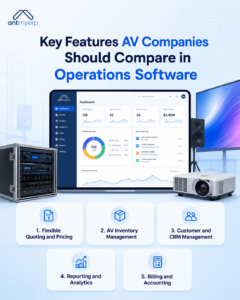
1. Flexible Quoting and Pricing
Creating accurate quotes is an important part of an AV rental business. Rental prices may depend on equipment type, quantity, rental duration, availability, delivery, discounts, and additional services.
Good audio visual equipment rental software should make it easier to create and manage quotes based on these requirements.
Look for features such as:
- Custom rental pricing
- Equipment-based pricing
- Discounts and additional charges
- Rental duration calculations
- Quote creation and tracking
- Quote-to-order conversion
- Customer-specific pricing
For example, a customer may need 10 speakers, four microphones, two projectors, and an LED screen for an event. The software can help the sales team create a structured quote without calculating every item manually.
This can reduce pricing errors and help sales teams respond to customers faster.
2. AV Inventory Management and Equipment Tracking
Inventory is at the center of every AV rental business. Companies may manage hundreds of items, including projectors, cameras, speakers, microphones, lighting equipment, screens, mixers, cables, and accessories. Effective AV inventory management gives teams a clear view of what is available and what is already committed to another rental.
When comparing AV equipment rental software, check whether it supports:
- Equipment availability tracking
- Asset-wise records
- Rental and return tracking
- Equipment condition tracking
- Barcode or QR code scanning
- Stock movement tracking
- Equipment location tracking
- Maintenance history
This supports better rental equipment tracking. Teams can quickly check whether an item is available, rented out, under maintenance, or ready for another order. Better audio visual equipment management can also help reduce double bookings and improve equipment utilization.
3. Customer and CRM Management
AV rental companies often work with corporate clients, event planners, production houses, wedding planners, and other businesses.Managing customer information separately from rental records can make follow-ups difficult. A rental system with CRM capabilities can connect customer information with rental activities.
Teams can manage:
- Customer contact details
- Rental history
- Previous quotes
- Communication records
- Customer preferences
- Follow-up activities
- Payment information
For example, when a repeat customer requests equipment for another event, the sales team can review previous rental information before preparing a new quote. This gives the team more context and can improve customer service.
A CRM can also help sales teams manage leads and follow-ups instead of relying on separate spreadsheets or manual reminders. Businesses looking for broader customer management can also explore CRM and sales management capabilities.
4. Reporting and Analytics
Data can help AV businesses understand which equipment generates revenue and where operational improvements are needed.
A good AV rental management system should provide reports that help managers monitor rental performance.
Useful reports can include:
- Equipment utilization
- Rental revenue
- Most-rented equipment
- Equipment availability
- Customer rental history
- Pending orders
- Outstanding payments
- Quote conversion
- Rental performance
For example, a projector that is rented frequently may be a better investment than equipment that remains unused for long periods.
Reports can help managers identify these patterns and make better purchasing decisions. They can also provide visibility into revenue, customer activity, equipment utilization, and outstanding payments.
5. Billing and Accounting Integration
Rental operations are closely connected to billing and payments.
Once a rental order is confirmed, the business may need to generate an invoice, record payments, track outstanding amounts, and maintain financial records.
Managing this information manually can create duplicate work and increase the risk of errors.
Useful capabilities include:
- Invoice generation
- Payment tracking
- Outstanding payment management
- Rental billing
- Transaction records
- Financial reporting
- Accounting integration
Connected systems can help businesses reduce repeated data entry and maintain more consistent financial records.
Improving Daily Operations with Audio Visual Rental Software
AV service business handles several activities for every order. A typical process may include receiving an inquiry, preparing a quote, checking equipment availability, confirming the rental, preparing equipment, delivering it, tracking the rental period, receiving the equipment back, and completing billing. When these activities are managed through separate spreadsheets and tools, information can become difficult to track. An integrated system can connect these processes.
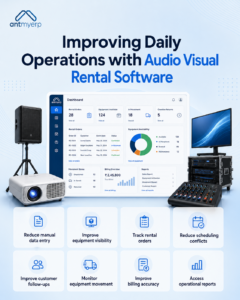
This can help businesses:
- Reduce manual data entry
- Improve equipment visibility
- Track rental orders
- Reduce scheduling conflicts
- Improve customer follow-ups
- Monitor equipment movement
- Improve billing accuracy
- Access operational reports
This approach makes AV equipment rental management more organized as the business grows.
How Can AV Rental Software Reduce Manual Work?
Manual rental management often requires teams to update multiple spreadsheets, send follow-up emails, check equipment availability, and enter the same information into different systems. This can consume time and increase the possibility of errors. Audiovisual rental software can centralize key information and automate routine activities.
For example, teams can use one system to manage equipment records, customer details, rental orders, quotes, and invoices. This reduces the need to switch between different tools. It also gives managers a clearer view of daily operations.
Why Is Rental Equipment Tracking Important for AV Companies?
AV equipment is valuable and often moves between warehouses, offices, event venues, and customers.
Without proper rental equipment tracking, businesses may struggle to identify where an item is or whether it is available for another booking.
Tracking can help teams monitor:
- Equipment location
- Rental status
- Return dates
- Equipment condition
- Maintenance requirements
- Customer assignment
This can improve asset visibility and help businesses make better use of their equipment. Equipment tracking is also useful for managing warranties and service coverage. AV companies can keep warranty details, service dates, and equipment records together to avoid missed claims and unexpected repair costs. Learn more about audio-video equipment warranty management software and how it can help manage equipment after purchase.
What Should You Check Before Choosing Rental Business Software?
The right rental business software should match your current operations and support future growth.
Before choosing a system, compare the following:
- Equipment and inventory management
- Rental scheduling
- Quotation and pricing tools
- Customer and CRM management
- Equipment tracking
- Reporting and analytics
- Billing and payment management
- Accounting integration
- Barcode or QR code support
- Scalability
- Ease of use
Do not choose software based only on the number of features. Consider whether your employees can use the system easily and whether it can connect the different parts of your rental workflow.
Audio Visual Rental Software vs. Spreadsheets
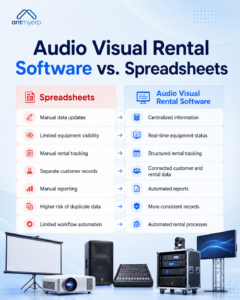
Spreadsheets may work for small rental businesses, but they can become hard to manage as the business grows. Audio visual rental software keeps equipment, customers, rentals, and reports in one place. It reduces manual work, improves accuracy, and makes daily rental operations easier.
As rental operations become more complex, a centralized equipment rental management system can provide better control.
How to Choose the Right AV Rental Management System
Start by mapping your current rental process. Identify where your team spends the most time and where errors usually occur. These areas can help you determine which software features matter most. For example, if equipment availability is difficult to track, prioritize inventory and asset tracking.
If sales teams spend too much time preparing quotes, focus on quotation and pricing features.If managers lack visibility into business performance, look for strong reporting and analytics.
You should also check whether the system can scale as your inventory, customers, and rental orders increase.
Manage AV Rental Operations with AntMyERP
The right software should do more than record equipment. It should connect AV equipment rental management, customer management, rental operations, inventory, service activities, and financial processes.
AV service Business software provides service capabilities that can help AV businesses manage customers, inventory, equipment, service activities, AMC operations, and other business processes from a centralized platform.
With the right audio visual rental software, AV companies can reduce manual work, improve equipment visibility, manage rental operations more efficiently, and make better decisions using accurate business data.