
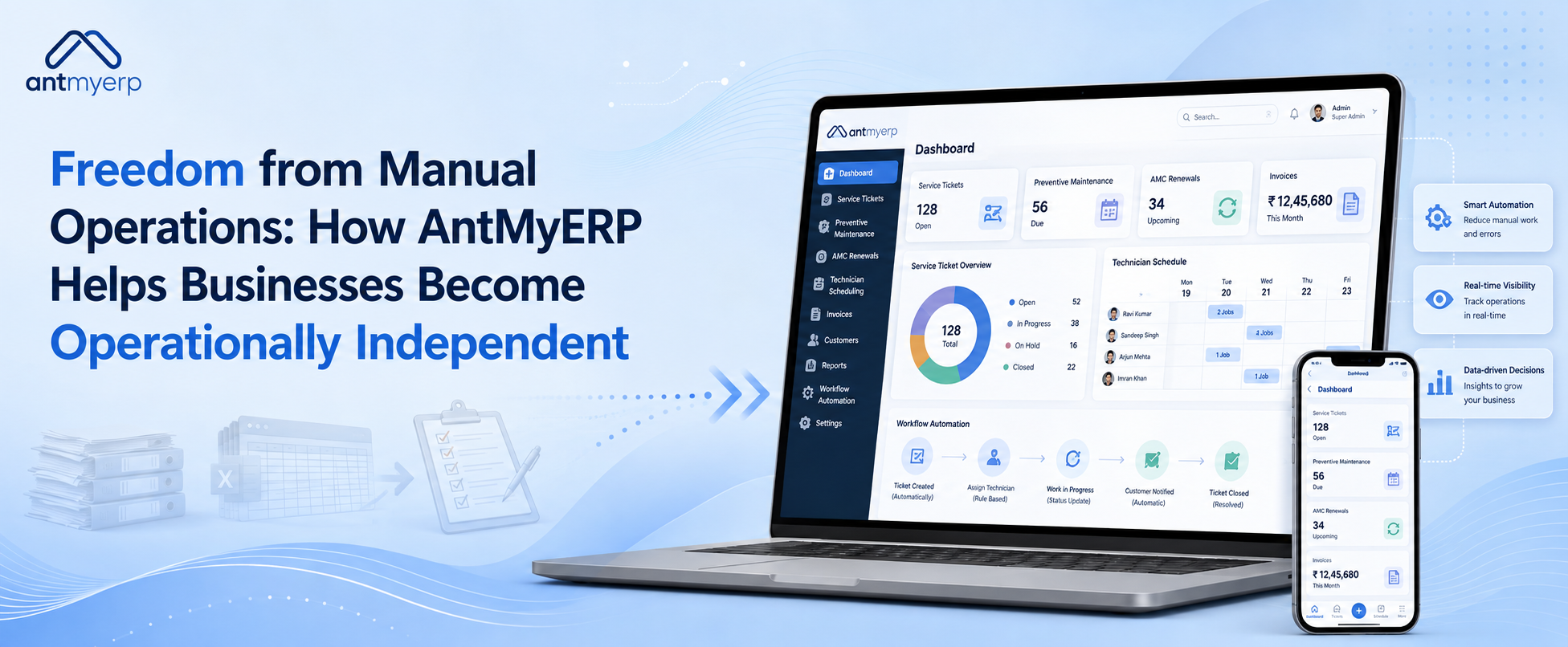
Freedom from Manual Operations: How AntMyERP Helps Businesses Become Operationally Independent
2026-08-14
Manual service operations can create delays, errors, and unnecessary dependency on employees. Field service automation helps businesses streamline service workflows, automate repetitive tasks, improve technician productivity, and gain better operational visibility. AntMyERP connects service tickets, technician scheduling, AMC management, preventive maintenance, spare parts, SLA management, and service reporting to help businesses operate with less manual intervention.
What Does Operational Independence Mean?
As India celebrates Independence Day on 15 August, the idea of freedom goes beyond national independence. For businesses, freedom can also mean having the right systems and processes to operate with greater control and less dependency.
Operational independence does not mean running a business without people. It means freeing people from repetitive manual tasks so they can focus on work that creates greater value.
In many service businesses, important activities still depend on spreadsheets, phone calls, emails, paper records, and individual employee knowledge. A manager may have to assign technicians manually. Another employee may track AMC renewals in a spreadsheet. Someone else may prepare service reports or follow up on pending tickets.
This approach may work when operations are small. But as the number of customers, technicians, assets, and service requests increases, manual processes become difficult to control.This is where field service automation can help.
By connecting service workflows and automating repetitive activities, businesses can reduce manual dependency, improve operational visibility, and give employees more freedom to focus on customers and service delivery.
Businesses can think beyond freedom from manual work as it can be about building operations that are more independent, connected, and ready to grow.
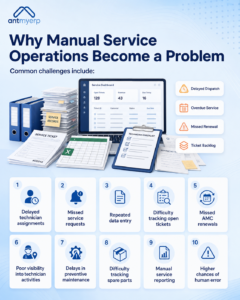
Why Manual Service Operations Become a Problem
Manual processes create more than extra administrative work. They can affect the entire service lifecycle.
Common challenges include:
- Delayed technician assignments
- Missed service requests
- Repeated data entry
- Difficulty tracking open tickets
- Missed AMC renewals
- Poor visibility into technician activities
- Delays in preventive maintenance
- Difficulty tracking spare parts
- Manual service reporting
- Higher chances of human error
When information is spread across different systems, managers spend more time collecting information than managing operations. A service management software solution brings these processes into a centralized workflow, helping businesses manage service activities with greater visibility and control.
How Field Service Automation Reduces Manual Work
Field service automation connects different stages of the service process so employees do not have to manually coordinate every step.
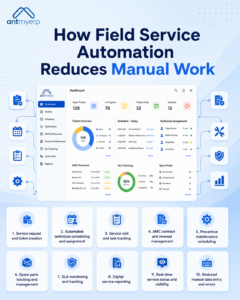
For example, a service request can move through a structured workflow:
- Service request received
- Service ticket created
- Technician assigned
- Service visit scheduled
- Required parts issued or used
- Service report completed
- Service request resolved
Instead of updating multiple spreadsheets and communicating through different channels, teams can manage the process through a connected system.
AntMyERP Field Service Management Software helps businesses manage service operations through connected workflows covering field service, AMC, preventive maintenance, spare parts, SLA-related activities, and reporting.
The result is a more organized service process with fewer manual dependencies.
1. Automate Technician Scheduling and Assignment
Technician management is one of the most important parts of field service operations.When assignments are handled manually, managers may spend considerable time checking technician availability, location, workload, skills, and existing appointments.
Technician scheduling and automated assignment can simplify this process.
A structured field service workflow helps businesses assign service requests to the appropriate technicians and keep teams updated about their assigned jobs.
AntMyERP also provides a dedicated Technician Mobile App that helps field technicians access job information and update service activities while working in the field.
This reduces unnecessary coordination and helps technicians work more independently.
2. Improve Service Ticket Management
Service tickets are the foundation of many field service operations.
Without a centralized system, tickets can become difficult to track. A customer may call multiple times for an update, while managers may have limited visibility into the current status of a complaint.
Field service automation helps businesses organize service requests from creation to resolution.
Teams can track:
- Open and closed tickets
- Assigned technicians
- Service status
- Customer details
- Service history
- Pending actions
- Resolution information
This gives managers better operational visibility and reduces the chances of tickets being forgotten or delayed.
3. Make AMC Management More Proactive
For businesses managing annual maintenance contracts, recurring service activities require continuous attention.Teams need to monitor contract periods, service schedules, renewal dates, and preventive maintenance requirements.Manual AMC management can lead to missed renewals or delayed service visits.
With AMC Management Software, businesses can centralize contract information, manage service schedules, and improve renewal tracking.This allows service teams to move from reactive service management toward a more proactive approach.
Instead of waiting for customers to remember a contract renewal or maintenance visit, businesses can plan upcoming activities in advance.
4. Simplify Preventive Maintenance
Preventive maintenance is about addressing service requirements before they become major problems.However, scheduling recurring maintenance manually can become difficult when a business manages hundreds or thousands of assets.
Preventive Maintenance Software helps businesses schedule and track maintenance activities through a centralized system.Technicians can receive assigned maintenance tasks, complete service activities, and update service records.
This creates a more structured maintenance process and helps businesses maintain consistent service schedules.
5. Connect Spare Parts With Service Operations
A technician cannot always complete a repair without the right part.When spare-parts information is maintained separately from service operations, technicians may arrive at a site without the required component. This can result in repeat visits and longer resolution times.
Spare Parts Management Software helps businesses track spare parts and maintain better visibility into inventory movements.
Connecting spare parts management with service workflows allows teams to understand which parts are required, issued, used, or returned during service activities.This helps connect inventory with actual field service requirements and supports faster service delivery.
6. Improve SLA Management
Service businesses often work with specific response and resolution commitments.Tracking these commitments manually can be difficult, particularly when the number of tickets increases.
SLA management helps businesses monitor service commitments and identify tickets that require attention.
With better visibility into response times, pending tickets, and resolution status, managers can take action before service commitments are missed.This can contribute to more consistent service delivery and improved customer satisfaction.
7. Reduce Manual Service Reporting
Service reporting is another area where teams can lose valuable time.
Technicians need to record completed work, service details, parts used, observations, and other information. When this information is collected manually, office teams may have to enter it again into another system.
Field Service Reporting Software helps businesses capture and organize field service information while improving visibility into technician activities.
Digital service reports can reduce duplicate data entry and create a consistent record of completed work.Over time, these records can also help managers understand service trends, workload, and technician performance.
From Employee Dependency to Operational Independence
The real value of automation is not simply doing tasks faster.It is creating a business process that does not depend on one person remembering every detail.
Consider a manual process:
- Customer complaint received
- Employee handles the request through a phone call
- Manager checks technician availability
- Technician is contacted manually
- Service details are updated in a spreadsheet
- Technician completes the service
- Service report is collected
Now compare it with an automated workflow:
- Automated Service Workflow
- Customer request received
- Service ticket created
- Technician assigned
- Field service activity completed
- Digital service report submitted
- Ticket updated and resolved
The second process is easier to track and manage.Employees still make important decisions, but the system handles much of the repetitive coordination. That is what operational independence looks like.
Why AntMyERP for Field Service Automation?
AntMyERP brings key service processes together so businesses can manage their operations through a centralized platform.
Its service capabilities cover areas such as field service management, AMC management, preventive maintenance, complaint management, spare parts management, SLA management, technician operations, and service reporting.
This connected approach can help businesses reduce manual work while improving visibility across the service lifecycle.Instead of managing every process separately, teams can work with connected service information and standardized workflows.
Final Thought
Manual operations can limit a service business as it grows.When technician scheduling, service tickets, AMC renewals, preventive maintenance, spare parts, SLA tracking, and reporting all depend on manual coordination, employees spend more time managing processes and less time improving service delivery.
Field service automation provides a practical way to change that.By automating repetitive tasks and connecting service workflows, businesses can reduce manual work, improve operational visibility, and create more consistent service processes.
AntMyERP helps businesses move toward this model by bringing essential service operations into one connected system.
The goal is simple: less manual dependency, better service control, and greater operational independence.