
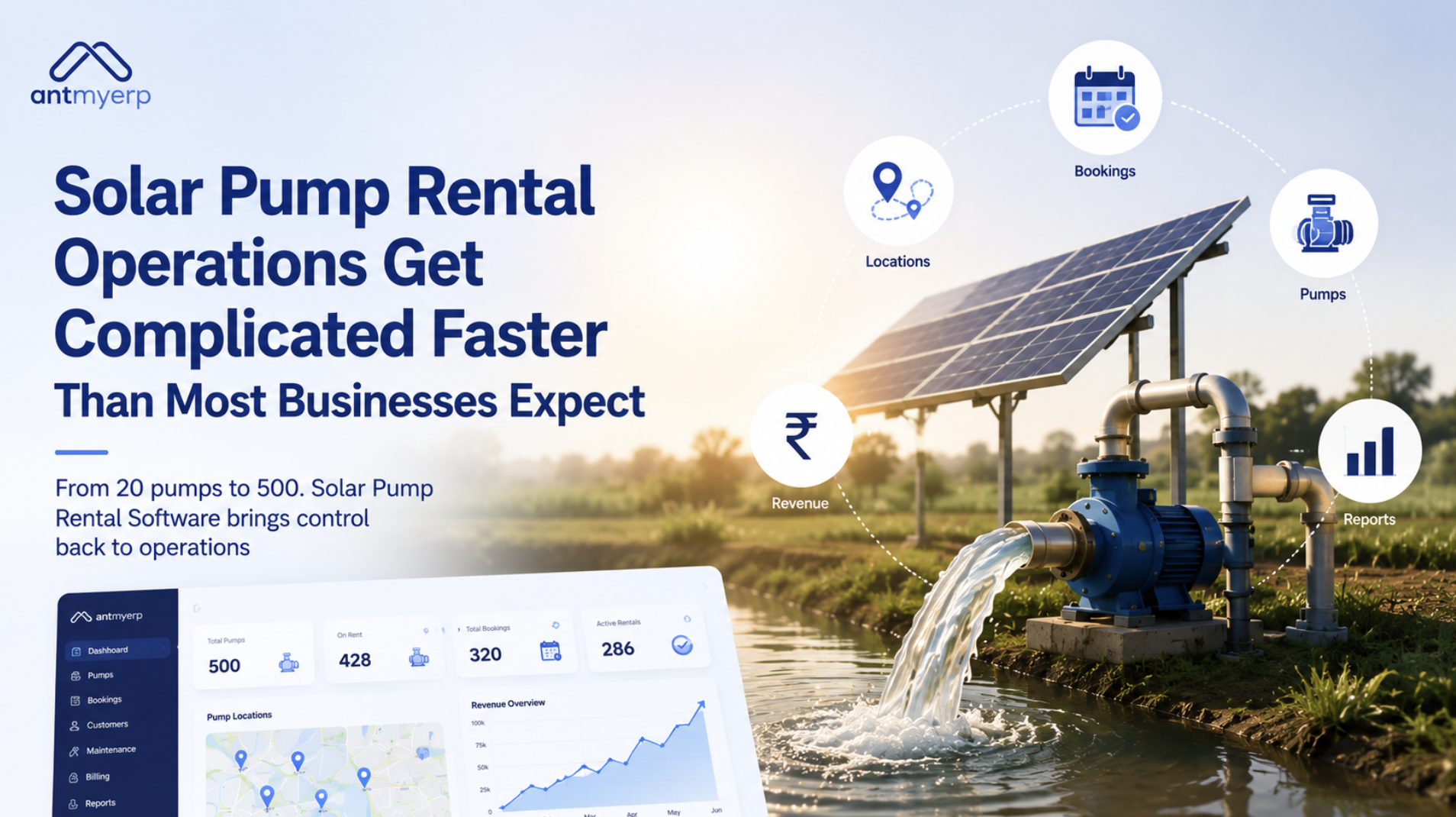
Solar Pump Rental Operations Get Complicated Faster Than Most Businesses Expect
2026-05-17
Every solar pump rental business starts with a spreadsheet and a WhatsApp group. Works fine in the beginning. But once your fleet grows to 300–500 pumps across multiple villages, that system starts breaking from all sides – missed AMCs, billing disputes, no service history, technicians going to wrong locations. This blog explains where it all goes wrong and how solar pump rental management software helps you get proper control over operations.
Managing 20 solar pumps feels simple.
You know every farmer.Your technician remembers every installation.
Billing happens in Excel.Service updates come through phone calls.
Nothing feels difficult. Then the business grows.
Suddenly:
- Pumps are spread across multiple villages
- Technicians are travelling all day
- AMC renewals start getting missed
- Billing disputes increase
- Spare parts disappear from inventory
- Farmers call before your team even knows a pump is down
This is the stage where most businesses realize they are no longer managing only pump rentals.They are managing field operations at scale. This is why many growing companies are moving toward solar pump rental management software to improve operational visibility, rental operations management, and service coordination across farms.
India’s Solar Pump Market Is Growing Rapidly
India’s solar irrigation sector is expanding quickly under the PM-KUSUM scheme. According to the Ministry of New and Renewable Energy (MNRE), the government aims to install lakhs of solar pumps across the country to support sustainable irrigation and reduce diesel dependency.
As more pumps are deployed across farms and villages, solar pump businesses are facing a new operational challenge: managing large-scale pump operations efficiently.
This growth is also increasing demand for:
- Solar pump tracking software
- Irrigation pump rental management software
- Solar equipment rental software
- Field service management software
Why Solar Pump Rental Management Becomes Difficult at Scale
The challenge is not installing pumps.The challenge is managing everything after installation.
A growing solar pump rental business handles:
- Rental contracts
- Preventive maintenance
- Technician assignments
- Service complaints
- Spare inventory
- Warranty tracking
- Meter reading collection
- AMC renewals
- Breakdown escalations
Now imagine doing all of this for 500+ pumps across farms.That’s where manual coordination starts slowing businesses down. This is also where businesses start searching for:
- Software for solar pump rental business
- Solar pump rental tracking system
- How to manage 500+ solar pumps
Why Spreadsheets Fail for Solar Pump Rental Management Operations
Spreadsheets can store information.But large solar pump operations need live coordination and rental workflow automation. For example: A farmer reports a controller issue.
Before assigning a technician, your team needs answers quickly:
- Which pump is installed at that farm?
- Is it under AMC?
- When was the last service visit?
- Which spare part was replaced earlier?
- Which engineer is closest to the location?
- Is the warranty still active?
When this information lives across:
- Excel sheets
- WhatsApp chats
- Notebooks
- Calls
operations become reactive instead of controlled.This is one of the biggest challenges in solar pump rental business operations today.
What Usually Breaks First in Large Pump Fleets
Every growing solar pump rental company experiences operational leakage somewhere.
1. AMC Renewals Start Slipping
At a small scale, reminders work. At 500+ pumps, they don’t. Teams miss renewal follow-ups because:
- Contracts are stored manually
- Expiry dates are difficult to track
- No centralized AMC renewal tracking system exists
The result: Recurring revenue quietly drops.This is one reason businesses invest in solar pump AMC management systems to automate renewal workflows.
2. Service History Gets Scattered
A technician repairs a pump. Three months later, another breakdown happens. But nobody knows:
- What was repaired earlier
- Which spare part was used
- Whether the issue was temporary or recurring
Without pump service history at the asset level, troubleshooting becomes slower every month.
3. Billing Disputes Increase
Many solar pump rental businesses still collect meter readings through:
- WhatsApp photos
- Calls
- Handwritten notes
Manual entries eventually create:
- Incorrect invoices
- Delayed billing
- Payment disputes
Especially during seasonal irrigation demand. This is why businesses increasingly adopt rental billing software integrated with field activity.
4. Engineers Spend Too Much Time Coordinating
This is one of the biggest hidden operational costs.Technicians often call the office for:
- Customer details
- Job updates
- Location clarification
- Previous service records
- Spare approvals
Instead of solving field issues, engineers spend time waiting for information.This creates a strong need for:
- Engineer dispatch management
- Technician scheduling software
- Service ticket tracking
Downtime During Irrigation Season Has a Bigger Business Impact
A solar pump breakdown during irrigation season affects more than equipment uptime.
For farmers, it can directly impact:
- Irrigation schedules
- Crop productivity
- Water availability
For rental businesses, repeated downtime can lead to:
- Customer dissatisfaction
- Delayed payments
- AMC non-renewals
- Service escalations
This is why preventive maintenance and faster service response are becoming important operational priorities for solar irrigation management businesses.
Businesses increasingly use pump preventive maintenance software to reduce downtime and improve equipment lifecycle management.
The Businesses Scaling Successfully Usually Have One Thing in Common
They stop treating operations as manual admin work.And start treating operations as a connected system. That usually includes:
- Centralized solar pump asset tracking
- Preventive maintenance workflows
- Technician mobile apps
- AMC automation
- Service ticket tracking
- Billing integration
- Spare inventory visibility
- Spare parts tracking software
This is why many businesses move toward solar pump and irrigation pump rental management software once fleets start growing.
What Changes When Solar Pump Operations Become System-Driven
The biggest improvement is visibility. Instead of depending on memory or spreadsheets, every team works from the same operational data.
Every Pump Gets Its Own Operational History
Each pump can be tracked with:
- serial number
- installation details
- farm location
- AMC status
- warranty timeline
- service history
- spare consumption
- rental contract information
This makes field service much faster and more accurate. This is where solar pump tracking software and solar pump inventory management systems become important for growing businesses.
Preventive Maintenance Stops Becoming Random
Without systems, maintenance usually happens only after complaints.
With preventive maintenance scheduling:
- inspections happen on time
- recurring issues get identified early
- downtime reduces during irrigation season
This is especially important during:
- Kharif
- Rabi
- seasonal peak usage periods
Technicians Update Jobs Directly From Farms
Modern field service workflows allow engineers to:
- receive job assignments
- upload photos
- update service notes
- close tickets
- submit meter readings
This removes delays between field teams and office teams. Many businesses now use field service management software to improve technician coordination and engineer dispatch management.
Billing Gets Connected to Real Field Activity
When meter readings are submitted with:
- timestamps
- photos
- engineer details
billing becomes more reliable. This helps reduce disputes and manual calculations.It also improves rental billing software accuracy for multi-location pump fleets.
Solar Pump Businesses Are Expanding Beyond Single-District Operations
Many solar pump businesses now operate across:
- multiple villages
- districts
- regional service zones
This creates new operational pressure on field teams.
Without centralized systems, managers often struggle with:
- Engineer visibility
- Service prioritization
- Ticket escalation
- Spare movement tracking
As operations spread geographically, businesses increasingly need real-time field coordination instead of phone-based management.This is why many companies search for how to track solar pumps across farms more efficiently.
The Real Shift Happens Around 300–500 Pumps
Below 100 pumps:manual systems feel manageable.
Between 100–300 pumps:businesses start noticing operational gaps.
Beyond 500 pumps: operations become difficult to control without software.
At that stage, the business is no longer just managing rentals. It is managing:
- Assets
- Technicians
- Service SLAs
- Maintenance schedules
- Customer expectations
- Recurring revenue
all at the same time. This is the point where many businesses start adopting software for solar pump rental business operations.
What Solar Pump Businesses Usually Look for in Management Software
Most growing solar pump rental companies eventually need:
- Solar pump asset tracking
- Rental lifecycle management
- Preventive maintenance scheduling
- AMC renewal workflows
- Technician mobile app
- Service ticket management
- Spare parts tracking software
- Meter reading billing
- Warranty tracking
- RMA management
- SLA monitoring
- Equipment lifecycle management
The goal is not only digitization.The goal is operational control across farms and locations.
How AntMyERP Supports Solar Pump Rental Businesses
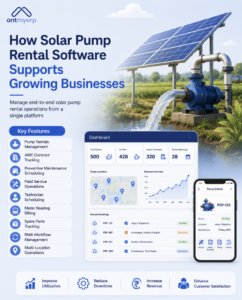
AntMyERP Solar Pump and Irrigation Business Management Software helps businesses manage:
- Pump rentals
- AMC contracts
- Preventive maintenance
- Field service operations
- Technician scheduling
- Meter reading billing
- Spare tracking
- RMA workflows
- Multi-location operations
through one centralized platform.The system is designed for businesses handling growing solar pump fleets across villages, districts, and service regions.
Conclusion
India’s solar pump ecosystem is growing rapidly, but operational complexity is growing just as fast.The challenge is no longer only about installing pumps.
It is about managing:
- technicians
- maintenance
- billing
- AMC renewals
- service response
- spare inventory
- field visibility
Across hundreds of farms and locations. Businesses that continue depending entirely on spreadsheets and manual coordination often struggle as operations scale.
This is why many companies are investing in centralized solar pump rental management software to improve operational visibility, automate rental workflow automation, manage preventive maintenance, and handle large solar pump fleets more efficiently.
As the solar irrigation industry continues expanding under programs like PM-KUSUM, operational efficiency may become just as important as installation growth for long-term business success.
To know more about cloud-based solar pump rental management software.