
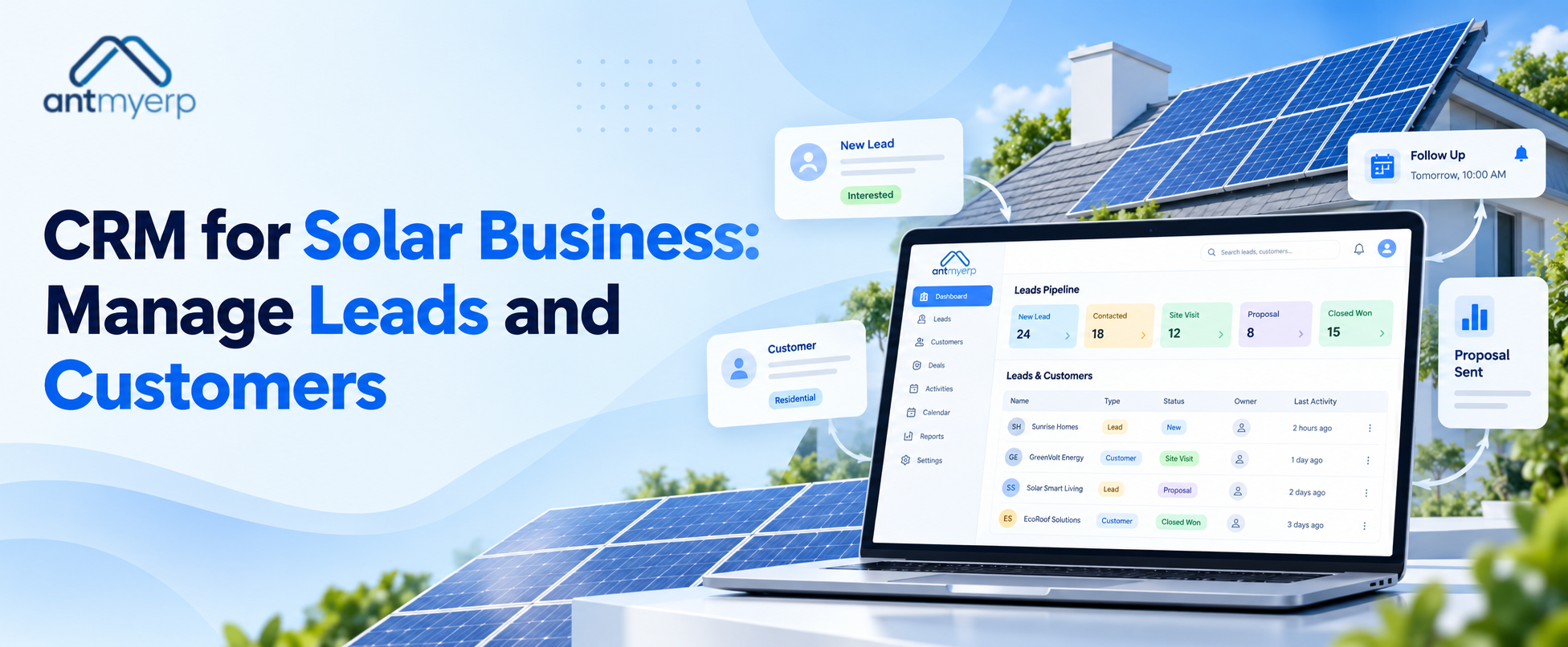
CRM for Solar Business: Manage Leads and Customers
2026-10-16
A CRM for solar business helps companies manage leads, follow up with customers, track sales, and plan installations. It also helps teams keep customer details organized and manage service requests and maintenance more easily.
A solar business involves more than selling solar panels. Teams also need to coordinate site visits, schedule installations, check equipment availability, and handle customer service after installation.
Managing these activities through spreadsheets, phone calls, and separate applications can become difficult as the business grows. A CRM for solar business helps organize customer information, track sales opportunities, and coordinate follow-ups. When connected with field service, inventory, and maintenance management, it can also help teams manage installations and after-sales support more efficiently.
What Happens Between a Solar Inquiry and a Completed Installation?
Consider a customer who contacts a solar company for a rooftop installation. The sales representative records the inquiry, discusses the customer’s requirements, arranges a site assessment, and prepares a quotation.
Once the customer approves the proposal, the business must coordinate the installation date, equipment, technicians, and any remaining requirements. After installation, the customer may need documentation, maintenance, warranty assistance, or technical support.
Each stage involves different people and information. If these details are not recorded properly, employees may need to contact one another repeatedly to understand the status of a job.
Solar CRM software helps organize the customer-facing part of this process. It allows teams to maintain lead records, track discussions, monitor opportunities, and keep important customer details accessible. Integrations with operational software can connect those records to installation and service activities.
The result is a more consistent way to manage the customer journey, from the first inquiry to ongoing support.
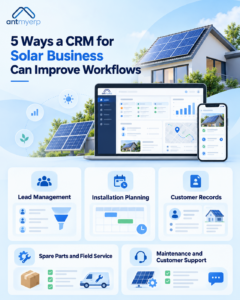
5 Ways a CRM for Solar Business Can Improve Workflows
1. Turn More Inquiries into Organized Sales Opportunities
Solar inquiries can come from website forms, marketing campaigns, referrals, and direct calls. The challenge is not simply collecting leads; it is knowing what should happen next with each one.
A solar sales CRM helps representatives maintain a record of each prospect, including contact details, system requirements, previous discussions, and the current sales stage.
For example, a representative can identify customers waiting for a quotation, prospects who need a follow-up call, and opportunities that are close to confirmation.
A defined sales process also helps managers understand where opportunities are getting delayed. Instead of depending on individual notes or memory, the team can review pending activities and prioritize follow-ups.
2. Connect Sales Commitments with Installation Planning
Closing a sale is only one part of delivering a solar project. The business must translate the agreed requirements into practical installation work.
This may involve arranging a site visit, confirming the installation schedule, checking material availability, and assigning the appropriate field team.
A CRM connected with project or field service management can help transfer relevant customer and job information to the employees responsible for the next stage. Teams can access details such as site location, customer requirements, planned work, and job status, depending on the system configuration.
This reduces the need to collect the same information repeatedly and helps office staff coordinate work across different locations.
Solar companies managing field teams can learn more about field engineer management for solar pump companies. Contractors working on government-supported solar pump projects can also explore this guide to managing solar pump projects under the PM-KUSUM scheme.
3. Keep Customer and Equipment Records Accessible
After installation, employees may need to refer to the customer’s address, installation date, equipment details, warranty information, or previous service requests.
When these records are scattered across emails, paper documents, and spreadsheets, finding the correct information can take time.
A CRM for solar companies helps maintain customer profiles and interaction histories in one place. When equipment and service records are linked appropriately, teams can get a clearer picture of the relationship and the work completed.
For instance, when a customer reports an inverter issue, the support team can review available installation and service records before assigning the request.
Accurate records also help new team members understand existing customer relationships without depending entirely on verbal handovers.
4. Coordinate Spare Parts and Field Service Requirements
Solar installations and repairs may require panels, inverters, batteries, cables, connectors, and other components. A technician arriving at a site without the required material can lead to another visit and additional coordination.
CRM alone does not replace inventory management. However, connecting customer and job information with inventory records can help teams plan material requirements more effectively.
With Spare Parts Management Software, businesses can maintain stock records, review material availability, and coordinate parts needed for service work.
Similarly, Field Service Management Software can help organize technician assignments, job schedules, and field updates.
Together, these capabilities can help solar businesses prepare for scheduled work and maintain better communication between office staff and field teams.
5. Manage Maintenance and Customer Support After Installation
Solar customers may contact the company for troubleshooting, equipment inspections, repairs, warranty assistance, or recurring maintenance.
Without a consistent process, service requests can remain pending, and employees may struggle to identify the next action. A CRM connected with service management helps businesses record complaints, assign responsibility, track request status, and maintain a history of customer interactions.
For businesses offering Annual Maintenance Contracts (AMCs), AMC Management Software can help manage contract details and plan maintenance activities. Solar pump contractors can also read this guide to solar pump AMC contract management for practical ways to track maintenance commitments and avoid missed renewals.
Is a Solar CRM Enough to Manage the Entire Business?
Not always. The right solution depends on the size of the business and the activities it needs to manage.
A business that mainly generates and follows up on sales leads may need a CRM with contact management, sales pipelines, quotation tracking, and reminders.
A company that also handles installations, field technicians, spare parts, and recurring maintenance may need additional operational capabilities.
Before selecting a solution, consider the following requirements:
- Sales management: Lead capture, contact records, quotation tracking, and follow-up reminders.
- Installation coordination: Site visits, job scheduling, team assignments, and progress updates.
- Inventory visibility: Stock records, material availability, and spare parts coordination.
- Service management: Complaint tracking, repair requests, service history, and maintenance planning.
- Reporting: Sales pipeline visibility, pending activities, and operational reports.
- Mobile access: Relevant customer and job information for employees working outside the office.
For businesses that need these functions together, solar business management software with connected CRM, inventory, and field service capabilities may be more suitable than a standalone sales tool.
The important point is to choose software according to the actual workflow rather than selecting a product based on the number of features it advertises.
How to Choose the Right CRM for Your Solar Company
Before investing in solar CRM software, map the way your business currently works. Identify where information gets lost, which activities require repeated manual updates, and where customers experience delays.
Use these questions to evaluate potential solutions:
Can it manage your sales process?
Check whether the system supports your lead sources, sales stages, quotations, and follow-up requirements.
Can your team coordinate installations?
If you manage installation projects, determine whether the solution supports job scheduling, assignments, status updates, and integration with project or field service tools.
Can it support after-sales service?
Check how the system records complaints, customer history, warranty details, maintenance activities, and recurring service requirements.
Can it connect customer records with inventory?
If your business maintains spare parts, confirm whether the solution provides inventory features or integrates with your existing inventory system.
Can employees use it easily?
Sales representatives, managers, and technicians have different requirements. Evaluate the interface, mobile access, reporting, and ease of updating records.
Can it grow with your business?
Consider whether the system can accommodate more customers, employees, service locations, and operational processes as the business expands.
A suitable CRM should solve current problems while giving the business room to improve its processes over time.
How AntMyERP Can Support Solar Business Operations
AntMyERP’s CRM software helps businesses manage customer information, track sales opportunities, and organize follow-ups. Solar companies that also handle installations and after-sales service may need additional capabilities to coordinate field teams, spare parts, and maintenance activities.
Learn more about how AntMyERP supports solar businesses with service operations.
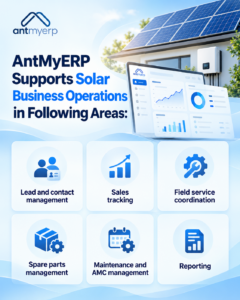
Solar companies can explore relevant functions such as:
- Lead and contact management: Organize customer inquiries and follow-ups.
- Sales tracking: Monitor sales opportunities and quotation progress.
- Field service coordination: Manage service jobs and technician activities.
- Spare parts management: Track inventory and plan material requirements.
- Maintenance and AMC management: Manage recurring maintenance commitments and service contracts.
- Reporting: Review sales performance and operational activities.
The right setup depends on the company’s workflow and the modules it needs. Businesses should check which functions fit their solar installation, customer management, and service requirements.Manage Your Solar Business with Better Coordination
Growing a solar business requires more than generating leads. Sales teams need to follow up consistently, installation teams need accurate job information, and service staff need access to customer and equipment records.
A suitable CRM helps organize customer relationships, while connected field service, inventory, and maintenance capabilities can support the work that happens after a sale.
Ready to improve how your team manages customers, installations, and service activities?