
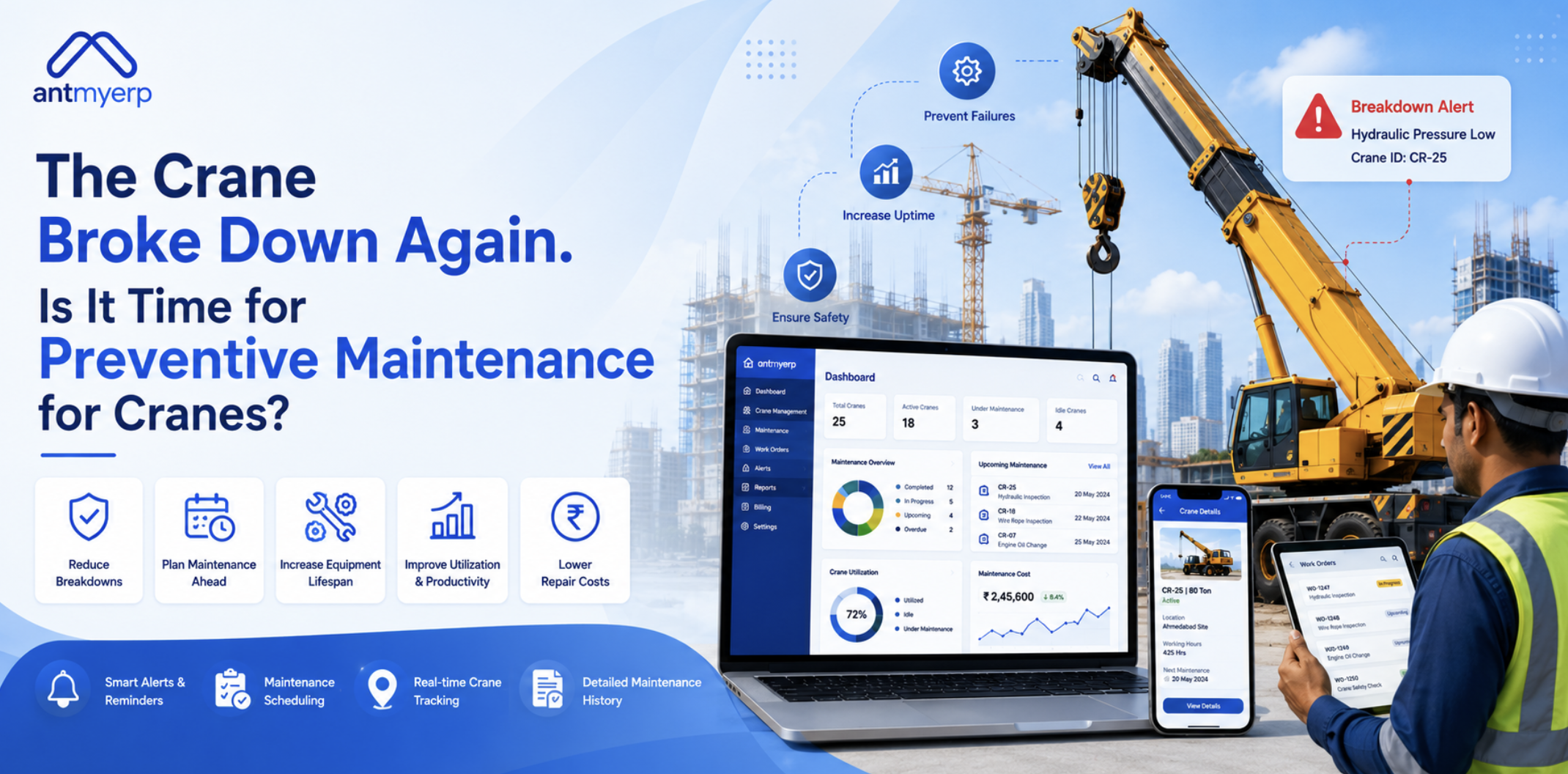
The Crane Broke Down Again. Is It Time for Preventive Maintenance for Cranes?
2026-06-08
Cranes usually don’t fail suddenly. Most breakdowns happen because small issues like leaks, worn ropes, or missed inspections build up over time.Preventive maintenance helps fix these problems early through regular checks, servicing, and planning. It reduces unexpected breakdowns, lowers repair costs, and keeps cranes available for rental work.
Using maintenance software makes it easier to track inspections, schedule work, and manage spare parts so operations run smoothly without surprises.
Why Do Cranes Keep Breaking Down?
Most crane breakdowns don’t happen out of nowhere. They slowly develop over time when small maintenance issues are missed or ignored. Cranes work under heavy load, constant vibration, and changing weather conditions. Because of this, parts naturally wear out.
The problem starts when:
- small leaks are ignored
- inspections are delayed
- lubrication is skipped
- worn parts are not replaced on time
Over time, these small gaps turn into major failures that stop operations completely.
Common Causes of Crane Breakdowns
Hydraulic System Leaks
Hydraulic systems power many critical crane functions. Leaks reduce pressure, decrease lifting performance, and can eventually cause complete system failure.
Wire Rope Wear
Wire ropes are exposed to friction, bending, and heavy loads every day. Over time they can develop broken strands, corrosion, or deformation that increases failure risk.
Why Do Cranes Keep Breaking Down?
Most crane breakdowns don’t happen out of nowhere. They slowly develop over time when small maintenance issues are missed or ignored. Cranes work under heavy load, constant vibration, and changing weather conditions. Because of this, parts naturally wear out.
The problem starts when:
- small leaks are ignored
- inspections are delayed
- lubrication is skipped
- worn parts are not replaced on time
Over time, these small gaps turn into major failures that stop operations completely.
Common Causes of Crane Breakdowns
Hydraulic System Leaks
Hydraulic systems power many critical crane functions. Leaks reduce pressure, decrease lifting performance, and can eventually cause complete system failure.
Wire Rope Wear
Wire ropes are exposed to friction, bending, and heavy loads every day. Over time they can develop broken strands, corrosion, or deformation that increases failure risk.
Brake Failures
Crane brakes are essential for load control and operator safety. Worn brake pads or damaged components can create serious operational hazards.
Electrical Faults
Damaged wiring, loose connections, faulty sensors, and control system failures can cause unexpected shutdowns and operational issues.
Poor Lubrication
Insufficient lubrication increases friction and accelerates wear on gears, bearings, sheaves, and moving components.
Delayed Inspections
Skipping scheduled inspections allows minor issues to remain undetected until they develop into costly repairs or equipment failures.
What Is Preventive Maintenance for Cranes?
Preventive maintenance means taking care of cranes on a regular schedule instead of waiting for something to break. It includes simple activities like inspections, lubrication, testing, and replacing parts before they fail.
In real operations, this means the crane is checked at fixed intervals—based on usage, running hours, or manufacturer guidelines so small issues are fixed early and don’t turn into costly breakdowns later.
Why Preventive Maintenance for Cranes Costs Less Than Reactive Repairs
Many crane rental companies still prefer reactive maintenance because it looks cheaper at first. Nothing is spent until something breaks. But the real cost shows up later.
When a crane fails suddenly, everything becomes urgent; repair teams, spare parts, and transportation all need to be arranged quickly. This not only increases cost but also delays projects and affects rental income.
In most cases, fixing a breakdown ends up costing much more than maintaining the crane regularly.
Crane Maintenance Cost Breakdown
Understanding where costs increase helps crane rental companies make better maintenance decisions. Below is a simple breakdown of how different maintenance approaches impact overall expenses.
- Emergency repair cost: High (urgent labor, fast shipping, breakdown response)
- Planned maintenance cost: Low (scheduled servicing and predictable parts replacement)
- Downtime cost: Very high impact (lost rental income and project delays)
- Replacement part cost: Higher in reactive maintenance due to sudden failure damage
- Operational efficiency: Higher in preventive maintenance due to fewer disruptions
This is why most crane rental companies are shifting from reactive to preventive maintenance strategies.
How Preventive Maintenance for Cranes Protects Rental Revenue
Lost Rental Revenue
When a crane is unavailable due to maintenance issues, rental income stops immediately.
Emergency Repair Costs
Urgent repairs often involve higher labor costs, expedited shipping charges, and emergency service fees.
Customer Complaints
Equipment failures can damage customer trust and negatively affect future business opportunities.
Project Delays
A crane breakdown can delay construction projects, causing contractual issues and financial losses for customers.
Why Preventive Maintenance Is Better Than Reactive Maintenance for Cranes
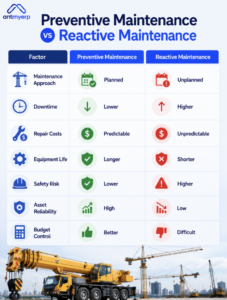
Warning Signs Your Crane Needs Preventive Maintenance
Certain indicators suggest a crane requires immediate maintenance attention.
Frequent Repairs
Repeated failures often indicate underlying maintenance problems.
Increasing Downtime
More downtime usually means equipment condition is deteriorating.
Rising Maintenance Costs
Growing repair expenses often signal that preventive maintenance is overdue.
Safety Concerns
Unusual noises, vibrations, load handling issues, or warning alarms should never be ignored.
Missed Inspection Schedules
Delayed inspections increase the likelihood of equipment failure.
Why Preventive Maintenance Matters for Crane Rental Companies
For crane rental businesses, uptime is everything. A crane only earns money when it is working and available for rent.Preventive maintenance helps keep equipment in good working condition so it is ready when customers need it. It also reduces unexpected breakdowns at job sites, which can otherwise delay entire projects and affect customer trust.
Regular inspections help identify small issues early, before they turn into safety risks or expensive repairs.
OSHA recommends regular crane inspections to help maintain safe operation, identify equipment issues early, and reduce the risk of unexpected failures.
How Preventive Maintenance for Cranes Works in Rental Operations
Step 1: Register and Track Assets
Every crane should have a complete asset record that includes specifications, maintenance history, inspection reports, and operational data.
Step 2: Create Maintenance Schedules
Schedules can be based on operating hours, usage patterns, manufacturer recommendations, or regulatory requirements.
Step 3: Perform Routine Inspections
Technicians inspect mechanical, hydraulic, structural, and electrical systems regularly.
Step 4: Generate Work Orders
Maintenance activities are documented through work orders that define tasks, priorities, technicians, and required parts.
Step 5: Manage Spare Parts
Critical spare parts should be tracked to avoid delays during maintenance activities.
Step 6: Complete Maintenance Activities
Technicians perform inspections, repairs, lubrication, adjustments, and component replacements as required.
Step 7: Analyze Maintenance Performance
Maintenance records help identify recurring failures, asset trends, and opportunities for improvement.
Many organizations use Crane Asset Management Software to improve asset visibility, maintenance compliance, and rental fleet management.
Preventive Maintenance for Cranes Checklist
Daily Checks
- Inspect wire ropes for visible damage
- Check hydraulic fluid levels
- Verify brake functionality
- Inspect hooks and safety latches
- Check warning indicators
- Look for leaks and unusual noises
- Verify controls are functioning properly
Weekly Checks
- Lubricate moving components
- Inspect sheaves and pulleys
- Check electrical connections
- Inspect hydraulic hoses
- Verify limit switch operation
Monthly Checks
- Conduct detailed structural inspection
- Check gearbox condition
- Inspect load-bearing components
- Test safety devices
- Review maintenance records
Annual Inspections
- Comprehensive crane inspection
- Load testing where required
- Structural integrity assessment
- Major component evaluation
- Regulatory compliance verification
Crane maintenance schedules may vary depending on usage, environment, and manufacturer recommendations. Inspection frequency should align with manufacturer recommendations and recognized industry standards such as those developed by ASME.
How Cranes Preventive Maintenance Cranes Improves Profitability
Reduced Downtime
Reliable equipment spends more time generating revenue and less time in repair workshops.
Lower Repair Costs
Early detection helps avoid expensive failures and emergency repairs.
Increased Equipment Lifespan
Proper maintenance slows component wear and extends asset life.
Better Customer Satisfaction
Reliable cranes improve customer confidence and repeat business.
Higher Fleet Utilization
More operational equipment means better rental performance and profitability.
What Happens When Crane Rental Companies Implement Preventive Maintenance?
“Didn’t we just repair this crane a few weeks ago?” It is a question many crane rental companies ask when the same equipment keeps breaking down and spending more time in the workshop than on rent.
Real-Life Example
A crane rental company with around 50 cranes was facing frequent breakdowns. Many machines were spending more time in repair than on rental jobs. To fix this, they introduced a preventive maintenance system and started tracking inspections and work orders using software.
After a few months, breakdowns reduced, maintenance became more predictable, and crane availability improved. Customers also started receiving more reliable service, which helped the business retain more contracts.
Best Practices for Building a Crane Preventive Maintenance Program
- Follow manufacturer maintenance guidelines
- Create standardized inspection procedures
- Schedule maintenance based on usage data
- Maintain complete service records
- Train technicians regularly
- Monitor recurring failure patterns
- Track maintenance KPIs
- Conduct regular safety audits
- Keep critical spare parts available
- Use maintenance software for automation
Preventive Maintenance for Cranes: KPIs to Track
Tracking maintenance KPIs helps crane rental companies improve reliability and reduce downtime.
Common metrics include:
- Mean Time Between Failures (MTBF)
- Mean Time To Repair (MTTR)
- Fleet Availability
- Preventive Maintenance Compliance
- Maintenance Cost Per Crane
- Equipment Utilization
Monitoring these KPIs helps maintenance teams identify trends, improve planning, and optimize fleet performance.
Maintenance Scheduling Best Practices
Maintenance schedules should balance equipment availability with reliability.
Best practices include:
- Schedule maintenance during low-demand periods
- Use automated maintenance reminders
- Track operating hours accurately
- Prioritize high-utilization cranes
- Review schedules regularly
- Adjust intervals based on equipment condition
Why Spare Parts Management Supports Preventive Maintenance for Cranes
Effective spare parts management supports successful preventive maintenance.
Without necessary parts, maintenance tasks may be delayed, increasing downtime risk.
Companies should maintain inventory visibility for critical components such as:
- Wire ropes
- Hydraulic hoses
- Filters
- Bearings
- Brake components
- Electrical parts
- Lubricants
Accurate inventory tracking helps prevent shortages and unnecessary stock accumulation.
How Maintenance Software Supports Crane Operations
Modern maintenance software helps organizations manage crane maintenance more efficiently.
Typical capabilities include:
- Asset management
- Preventive maintenance scheduling
- Work order management
- Mobile technician access
- Inspection management
- Inventory control
- Service history tracking
- Maintenance reporting
- Compliance documentation
- Fleet performance monitoring
These capabilities help maintenance teams stay organized and proactive. Crane Rental Software manages crane scheduling, maintenance, asset tracking, and rental operations in a single platform.
Spare Parts Management Software helps crane rental companies manage spare parts inventory, track usage in real time, and ensure critical components are always available for preventive maintenance activities.
How to Choose Crane Preventive Maintenance Software
Selecting the right software requires evaluating operational requirements, maintenance processes, and business goals.
Organizations should focus on solutions that support scalability, ease of use, and integration with existing workflows.
Consider software that can manage both maintenance operations and rental activities within a single platform. FSM Software helps streamline asset tracking, preventive maintenance, and service operations in one system.
Crane Maintenance Software Essential Features Checklist
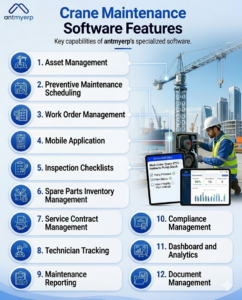
A crane maintenance software solution should include:
- Asset management
- Preventive maintenance scheduling
- Work order management
- Mobile application
- Inspection checklists
- Spare parts inventory management
- Service contract management
- Technician tracking
- Maintenance reporting
- Compliance management
- Dashboard and analytics
- Document management
Field service management systems provide these features in a single dashboard.
The Future of Preventive Maintenance for Cranes
The crane maintenance industry continues to evolve through digital transformation and connected technologies.
Organizations are increasingly adopting data-driven maintenance strategies that improve asset reliability and reduce operating costs.
Emerging technologies are helping maintenance teams move beyond traditional scheduled maintenance approaches.
Should You Use Predictive Maintenance or Preventive Maintenance for Cranes?
Preventive maintenance follows predefined schedules regardless of actual equipment condition.
Predictive maintenance uses real-time equipment data to determine when maintenance should be performed.
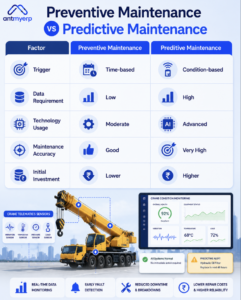
Many crane operators combine both strategies to maximize reliability and efficiency.Most crane companies use a hybrid model combining both approaches.
How IoT Improves Preventive Maintenance for Cranes
IoT sensors and telematics systems provide real-time visibility into crane performance.
These technologies can monitor:
- Operating hours
- Load cycles
- Hydraulic pressure
- Engine performance
- Fuel consumption
- Temperature
- Equipment location
Maintenance teams can use this information to identify issues early and optimize service schedules. As technology adoption increases, predictive maintenance is expected to become more common in crane rental operations.
Industry research on predictive maintenance using IoT sensors shows that real-time equipment monitoring can help organizations detect issues earlier and reduce unplanned downtime.
Why Choose AntMyERP’s Preventive Maintenance Software for Crane Maintenance Management?
Preventive Maintenance Software helps crane rental companies manage maintenance activities through a centralized platform.
Key capabilities include:
- Asset lifecycle management
- Preventive maintenance scheduling
- Work order management
- Technician management
- Inventory management
- AMC and contract management
- Mobile application support
- Service history tracking
- Inspection management
- Maintenance analytics and reporting
By bringing maintenance, assets, technicians, and inventory together, companies can improve operational visibility and reduce equipment downtime.
Key Takeaways
Most crane breakdowns can be avoided with regular maintenance.
when companies follow a preventive approach:
- cranes don’t break down as often
- repair costs become more predictable
- more equipment stays available for rental jobs
- safety issues are caught earlier
Simple planning and regular checks make a big difference in overall performance and profitability.
If you’re trying to reduce crane breakdowns and keep your fleet running, having the right system in place makes a big difference. You can explore how preventive maintenance, spare parts tracking, and work orders can all be managed in one place.
Crane brakes are essential for load control and operator safety. Worn brake pads or damaged components can create serious operational hazards.