
The Best SLA Management Software for Heavy Equipment Dealers
2026-02-23
SLA Management Software is a tool that enables heavy equipment dealers to effectively manage their service commitments by automating SLA tracking and monitoring, thereby reducing equipment downtime and offering timely services.
The heavy equipment sector is of utmost importance to the development of infrastructure, construction, logistics, and transport.
In this sector, even a slight delay in service would cause a major impact on both operations and finances. Managing service commitments manually becomes increasingly complex as fleets and customers grow. One delayed service call can shut down an entire construction site
This is where SLA Management Software becomes essential. It helps heavy equipment dealers automate service agreements, track response timelines and ensure consistent service delivery.
What Is SLA Management Software for Heavy Equipment Services?
A Service Level Agreement is an agreement that specifies the expected service response and resolution times between the dealers and customers. In the case of heavy equipment servicing, SLAs bring about accountability, transparency and very little downtime.
Key aspects of SLA management include:
- Defining service response and resolution timelines
- Automating service commitments using service agreement software
- Tracking SLA compliance across machines and locations
- Performance is measured by the use of KPIs linked to the SLA
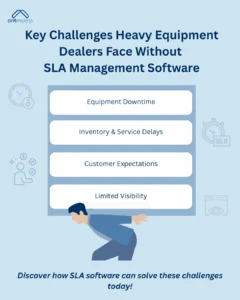
Key Challenges Heavy Equipment Dealers Face Without SLA Tracking Software
1] Equipment Downtime Without SLA Tracking Software:
Unsystematic tracking of SLAs results in a slower response, missing the deadline, and thus the machine is inoperable for a longer time.
2] Inventory and Service Delays:
Service and spare parts availability are separated by poor coordination which leads to longer turnaround time and higher operational costs.
3] Customer Expectations and Satisfaction:
Not keeping SLA commitments leads to loss of customer trust and eventually affects the customer base negatively.
4] Limited Visibility Without SLA Monitoring Software:
Manual tracking prevents real time SLA visibility thus resulting in reactive maintenance and poor performance insights.
According to industry research from maintenance and engineering, heavy equipment operators are projected to lose £50–60 billion in downtime costs across the EU in 2025 due to unplanned breakdowns and poor maintenance visibility thus highlighting how structured SLA tracking is essential.
How SLA Management Software Works in Real-World Service Scenarios
Imagine this
At the construction site, an important machine fails early in the morning. The service request gets reported, and there is, however, no precise response timeline.
The technician is appointed late, spare parts are not thoroughly checked beforehand, and updates are conveyed through numerous calls. The machine is inactive for hours, the project is postponed, and the client is annoyed.
Now, let SLA Management Software in.
The response and resolution time are automatically determined according to the service agreement as soon as the service request is recorded.
The service manager gets visibility, the nearest technician gets the job on their mobile, and the availability of spare parts is checked right away.
The timers for SLA run in the background, alerts stop delays, and the client is kept updated until the problem is solved.
Before vs After Using SLA Management Software
Before SLA Software:
- No clear response or resolution timelines
- Manual technician assignment
- Spare parts checked after reaching the site
- Delays noticed only after customer follow-up
- High equipment downtime and customer frustration
After SLA Software:
- Automated response and resolution timelines
- Instant technician notification
- Spare part availability checked in advance
- Real-time SLA tracking with alerts
- Faster resolution and improved customer satisfaction
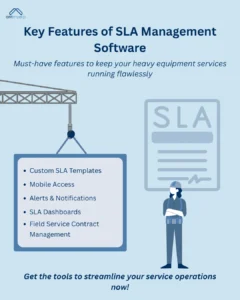
Key Features to Look for in an SLA Tracking & Monitoring Software
Choosing the right solution ensures scalability and long-term efficiency.
Essential features include:
- Customizable SLA templates for different contracts
- Automated alerts and escalations using SLA automation software
- Real-time SLA dashboards
- Mobile access for field technicians
- Built-in reporting and analytics
- Support for field service contract management
- A user-friendly interface is equally important to ensure quick adoption across service teams.
Why Cloud-Based SLA Software Works Best for Equipment Dealers
Modern dealerships need flexible systems that can scale with business growth. This makes cloud based contract management software an ideal choice.
Key benefits include:
- Centralized access to service data
- Seamless collaboration between teams
- Faster deployment and updates
- Reduced IT infrastructure costs
- Cloud-based systems also ensure service data is accessible anytime, anywhere.
How AntMyERP Helps Heavy Equipment Dealers Manage SLAs
AntMyERP is designed specifically to handle complex service operations in asset-heavy industries.
With AntMyERP, dealers can:
- Automate SLA creation and tracking
- Monitor SLA compliance in real time
- Receive instant alerts for SLA breaches
- Integrate SLA data with ERP and CRM systems
- Manage AMCs using structured field service contract management
- Scale service operations without losing control
- This enables faster service resolution and improved customer satisfaction.
Read our customer’s testimonials to know how we help manage SLAs
How to Choose the Right Service Agreement Software for Your Business
Selecting an appropriate solution is a difficult task but it is necessary for a long-term value and thus it requires careful evaluation.
Consider the following factors:
- Ease of use for technicians and managers
- Strong SLA tracking software and reporting capabilities
- Integration with existing ERP, CRM and inventory systems
- Reliable customer support
- Cost effectiveness and scalability
- Choosing the right software helps avoid future operational delays.
Industries That Benefit from SLA Management Software
Heavy equipment servicing isn’t limited to one sector. Automated SLA tracking and service agreement software supports uptime and reliability across multiple industries.
Industries that benefit include:
- Construction & Infrastructure
Maintains uninterrupted operation of cranes, excavators, and road machinery. - Mining & Quarrying
Critical equipment like haul trucks and drills need predictable servicing to avoid shutdowns. - Agriculture & Farm Equipment
Ensures tractors, harvesters, and tillage machines are always field-ready. - Oil & Gas & Energy Projects
Field equipment in remote locations needs precise monitoring and preventive alerts. - Fleet & Logistics Operators
Manages SLAs for trailers, forklifts, and maintenance fleets spread across sites. - Manufacturing & Industrial Plants
Reduces downtime of heavy assembly-line machines and robots.
A structured SLA system ensures every industry receives fast service, timely parts, and consistent uptime, regardless of scale or location.
Best Practices for Implementing SLA Management Software
Successful implementation requires a structured approach.
Best practices include:
- Defining clear SLA goals and metrics
- Customizing SLA templates based on service type
- Training teams thoroughly
- Reviewing SLA performance regularly using reports
- Regular feedback and optimization help improve service quality over time.
Performance Analytics & Future Trends in SLA Automation
The next wave of SLA improvement is being driven by data.
Key trends shaping SLA technology include:
- Predictive Maintenance Using IoT
Machine sensors will trigger service tickets automatically before breakdowns happen. - AI-Based SLA Analytics
Systems will highlight patterns in delays, costs, and technician efficiency. - Automated Escalation Rules
Missed deadlines will instantly alert managers to prevent contract breaches. - Mobile-First Field Service Execution
Technicians receive repairs, checklists, and parts info without returning to base. - Unified Cloud Platforms
Dealers will manage SLA tracking, AMC contracts, workflows, and billing in a single place. - Deeper ERP and Inventory Integrations
Future tools will connect parts forecasting with SLA timelines to eliminate stock delays.
As automation expands, dealers using SLA management software will gain a competitive edge through reduced downtime, faster decisions, and higher customer loyalty.
Conclusion
Making service commitments is an essential part of heavy equipment dealers’ operations that keeps their customers happy and the machines running.
Properly choosing and integrating SLA Management Software into your business operations makes it possible for your company to automatically handle service contracts, lessen downtimes, and monitor service performance with full transparency.
With features like automated tracking, real-time monitoring and scalable architecture. AntMyERP enables heavy equipment dealers to manage SLAs efficiently and deliver consistent, high-quality service while supporting long term business growth.
Boost your uptime and stay ahead, explore AntMyERP’s SLA solutions today!