
CRM software features for machinery and equipment industry
2026-01-03
CRM features help machinery and equipment businesses manage long sales cycles, service operations and customer relationships efficiently. A well structured CRM improves visibility across sales, service, inventory and customer support.
The sector of machinery and equipment has a high value and is very intensive regarding services and in this situation, accuracy, uptime and customer satisfaction are the main factors.
Companies deal with long sales cycles, intricate equipment data, regular maintenance and after-sales service obligations. If all these are handled manually or by separate systems, they will most likely result in delays, misunderstandings and lost opportunities.
CRM features play a vital role in machinery and equipment businesses by centralizing customer data, simplifying sales and service workflows and improving long-term customer relationships.
According to Fortune Business Insights, the global CRM market was valued at USD 101.41 billion in 2024 and is expected to reach USD 262.74 billion by 2032, showing strong and growing demand for CRM solutions.
What Is a CRM System in the Machinery and Equipment Industry?
A CRM system is not just a sales tool for equipment businesses. It acts as a centralized platform to manage customers, assets, service requests and communication across departments.
How a CRM supports equipment businesses:
- Centralizes customer, dealer and partner data
- Acts as a contact relationship management system for long term engagement
- Maintains equipment purchase and service history
- Improves coordination between sales, service and operations
How CRM Software Works for Equipment-Based Businesses
Imagine a mid-sized equipment supplier receiving a service call from a long time customer whose machine has suddenly broken down. Without a CRM system, the team spends hours searching emails, old invoices and service registers just to understand the machine’s history.
With CRM software in place, the moment the call comes in the service team can instantly view the customer profile, previous purchases, warranty status and past service records.
The issue is logged, the nearest technician is assigned and the customer receives an update without delay. This is how CRM turns scattered information into fast and coordinated action across teams.
In practice, CRM software works by:
- Capturing and organizing leads and customer inquiries in one place
- Converting prospects into customers through structured sales pipelines
- Managing service tickets, maintenance schedules and followups
- Using integrated CRM applications to connect sales, service and inventory data seamlessly
Core Customer Relationship Management Software Features
These are they CRM key features that you need to know:
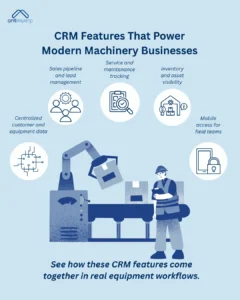
1] Customer Data Management
Customer data is the foundation of effective CRM usage. Using customer relationship management software features and businesses can maintain detailed customer profiles.
- Contact details, purchase history and service records
- Communication preferences and interaction logs
- Personalized engagement and improved customer retention
2] Sales Pipeline and Lead Management
Equipment sales involve high value deals and longer decision cycles. The best CRM software helps manage this complexity efficiently.
- Visual sales pipelines
- Lead scoring and opportunity tracking
- Sales forecasting for better planning
3] Service Management and Field Operations
After-sales service is critical in this industry. CRM supports crm for customer service and support by enabling faster and more accurate service delivery.
- Access to customer profiles and service history
- Better coordination for field technicians
- Reduced equipment downtime and faster issue resolution
4] Inventory, Asset and Equipment Tracking
CRM systems help track machinery, spare parts, rentals, and leases efficiently.
- Real time inventory visibility
- Maintenance planning and service scheduling
- Improved resource utilization
5] Mobile Accessibility for On-the-Go Teams
Sales and service teams often work in the field, making mobile CRM access essential.
- Real time updates via smartphones
- Faster communication and collaboration
- Increased productivity for field teams
Benefits of CRM for the Machinery and Equipment Industry
The right CRM system turns operational complexity into a competitive advantage by improving visibility and decision making.
Key benefits are –
- Improved customer experience and satisfaction
- Faster service response times
- Higher sales efficiency and conversion rates
- Data driven insights using CRM key features
- Performance benchmarks aligned with top 10 CRM software
On average, businesses can expect a return on investment (ROI) of $8.71 for every $1 spent on sales CRM software, reflecting a significant return on investment.
CRM Integration with ERP and Business Systems
For machinery and equipment businesses, disconnected systems often lead to data inconsistencies and operational delays.
CRM integration with ERP systems ensures that customer facing activities are aligned with back-office operations thus creating a single source of truth across the organization.
Integrated CRM capabilities help businesses:
- Sync customer, sales and service data with inventory and finance systems
- Eliminate duplicate data entry and manual errors.
- Improve coordination between sales, service, operations and accounting
- Gain end-to-end visibility into business performance using CRM applications
Why AntMyERP CRM Is Ideal for Machinery and Equipment Businesses
Generic CRM platforms often fail to address the operational complexity of equipment based industries. AntMyERP is designed specifically to support machinery and equipment businesses by combining customer management with service workflows and ERP functionality in a single platform.
AntMyERP supports businesses by:
- Offering unified CRM, service management and ERP capabilities
- Providing industry specific workflows tailored for equipment sales and after-sales service
- Enabling better customer engagement through structured contact relationship management system features
- Supporting scalability while maintaining performance comparable to top CRM software solutions.
Conclusion
In the machinery and equipment industry the success depends on more than just product quality. Efficient customer management, service reliability and operational visibility are equally important. Implementing the right CRM features helps businesses simplify sales, improve service delivery and build lasting customer relationships.
With its industry focused design and integrated approach, AntMyERP empowers equipment businesses to manage complexity with confidence and drive long term growth.
Ready to simplify customer management and service operations in your machinery business?