
Why RMA & Service Tracking Is the Biggest Blind Spot in Construction Equipment Rental Operations
2026-01-12
RMA and service tracking is a blind spot in construction equipment rentals due to manual processes, causing downtime and revenue loss. RMA and service tracking software fixes this by automating returns, repairs, and uptime management.
Poor visibility into returns and service workflows silently drains revenue in rental businesses. RMA and service tracking software brings structure, automation and clarity to equipment returns and service operations.
Construction equipment rental businesses run on one core principle: maximum uptime. When machines are out for repair or stuck in return loops, revenue stalls. However, one of the least considered aspects of rental operations is tracking of RMAs and service activities.
A lot of companies still depend on e-mails, phone calls and spreadsheets for the management of returns and repairs. This situation creates some blind spots that eventually result in downtimes, customer irritations and disorganization in the operations.
What Is RMA & Service Tracking in Construction Equipment Rentals
RMA or Return Merchandise Authorization refers to the structured process of approving, tracking and resolving equipment or part returns for repair, replacement or rejection.
Service tracking ensures every maintenance and repair activity is documented and monitored throughout the equipment lifecycle. In rental operations, both processes work together to maintain asset health and availability.
Key elements include:
- Structured equipment RMA management for returns and repairs
- Centralized service history for each machine
- Clear visibility into equipment under maintenance
- Reliable construction machinery service tracking across teams
How RMA & Service Tracking Works with Service Management Software for Rentals
Imagine this scenario.
A mid-sized construction company hires an excavator for an important project. The machine, however, breaks down at the site half through the work.
The site supervisor contacts the rental company; the service team writes down everything in a spreadsheet and the operations team is notified via WhatsApp.
Days go by and the excavator is still being repaired. No one is completely sure if the problem is covered by warranty or when the machine will be operational again.
In the meantime, the customer becomes annoyed, and the rental company loses not only time but also its customer’s trust.
This is exactly where structured RMA and service tracking changes the game. Instead of scattered updates and guesswork the entire process follows a defined and trackable workflow that keeps everyone aligned.
In a simplified system, the RMA flow looks like this:
- RMA request is raised and approved with proper authorization
- Equipment or part is logged into the service process
- Repair or replacement activities are tracked in real time
- Warranty details are verified within the system
- Service is completed and RMA is formally closed
- Enabled by equipment maintenance automation to eliminate manual follow-ups
This structured flow ensures faster resolution and better coordination between service, inventory and operations teams.
Why RMA & Service Tracking Becomes a Blind Spot for Rental Businesses
Despite its importance, RMA and service tracking often receive low priority. Many rental businesses focus heavily on bookings and fleet availability while service operations run in isolation.
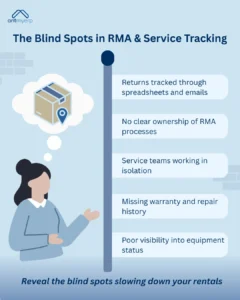
Common reasons for failure:
- Manual tracking using spreadsheets or emails
- No ownership of RMA workflows
- Poor communication between departments
- Missing service and warranty data
- Weak equipment RMA management processes
Over time, these gaps create operational inefficiencies that are hard to detect but costly to fix.
Impact of RMA & Service Gaps on Rental Fleet Efficiency
Lack of proper tracking directly impacts profitability and customer trust. When service operations lack transparency, the businesses react instead of planning proactively.
Negative outcomes include:
- Increased equipment downtime
- Lower fleet utilization
- Repeated service issues
- Delayed customer responses
- Ineffective construction machinery service tracking
What seems like a backend issue quickly turns into a revenue and reputation problem.
In fact, a report from Zipdo shows that maintenance issues are responsible for about 35% of equipment downtime, emphasizing how critical structured service processes are for rental fleet efficiency.
How RMA and Service Tracking Software Fixes the Problem
Dedicated software brings automation, accountability and real time visibility into RMA and service workflows. It replaces disconnected tools with a single source of truth.
Core capabilities:
- Centralized RMA creation and approvals
- Automated service workflows
- Live status updates for all stakeholders
- Linked service, warranty and inventory records
- Powered by equipment maintenance automation
This shift allows rental businesses to move from reactive firefighting to proactive service management.
Why Construction Equipment Rental Software Must Include RMA & Service Tracking
Standalone service tools often fail because they operate separately from rental operations. Integrated systems create stronger operational alignment.
Benefits of integration:
- Seamless connection between rentals and service
- Improved planning using rental fleet management software
- Faster turnaround with service management software for rentals
- Better decision-making using unified data
When service tracking is part of the core rental system, efficiency improves across the business.
How AntMyERP Brings End-to-End RMA & Service Visibility
AntMyERP offers a unified solution that connects rental operations, service management and RMA workflows. It ensures every return and repair is traceable from start to finish.
What AntMyERP enables:
- Centralized RMA and service tracking
- Faster resolution and reduced downtime
- Improved equipment RMA management
- Complete construction machinery service tracking across the fleet
Read Our Testimonials to See how rental companies manage RMAs better with AntMyERP
Conclusion
RMA and service tracking software are no longer optional in construction equipment rentals. Ignoring the problems creates hidden inefficiencies that directly impact uptime, revenue and customer satisfaction.
Using appropriate return merchandise authorization (RMA) and service monitoring software will allow rental companies to see everything clearly, make the whole maintenance process automated, and preserve the value of their assets.
AntMyERP empowers rental companies to turn service tracking from a blind spot into a strategic advantage.
Want to know how? Book a Demo to know more.