
What Happens When Emission Testing Equipment Isn’t Service Tracked? Compliance Risks Rental Businesses Can’t Ignore
2026-01-16
- Rental companies that invest in emission testing equipment service tracking avoid downtime, penalties, and unhappy customers.
- Without it, missed calibration, breakdowns and failed audits become costly business threats.
Automated tracking keeps every emission testing device compliant, calibrated, and rental ready. - Service tracking means logging assets, setting schedules, and sending reminders so technicians complete servicing on time with every job digitally recorded.
- AntMyERP handles the whole flow automatically, from alerts to job cards and audit-ready logs, so nothing depends on memory.
Emission testing devices are essential for proving that rented generators, machinery, and industrial assets meet environmental standards.
When servicing is skipped or forgotten, the machine becomes unusable not because it’s broken, but because it’s non-compliant.
In most cases, the real problem is not equipment quality, it’s lack of documentation, reminders and traceability.
What Is Emission Testing Equipment and Why It Must Be Tracked
Emission testing machines measure pollution levels and provide proof that equipment meets legal requirements. Tracking prevents avoidable downtime and compliance issues.
Here’s why tracking matters:
- Used widely across rental fleets, infra projects, etc.
- Accuracy depends on calibration and routine servicing.
- Overdue units become legally unusable.
- Customers expect compliant, ready-to-use equipment.
- Service history is critical during inspections.
Problems When Emission Testing Equipment Service Tracking Is Missing
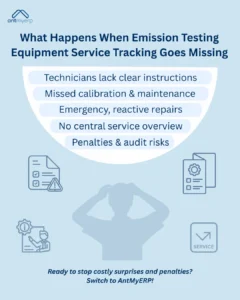
Even the best emission testing equipment can cause headaches if service and calibration aren’t tracked properly. Missed maintenance leads to hidden issues that quietly drain revenue, disrupt operations and put rental businesses at compliance risk.
Picture a rental depot where everyone assumes “someone else” remembered the calibration date. One slip can accelerate problems thus leaving the fleet unreliable on paper even if it runs perfectly.
A single missed service can delay a project, trigger penalties or create emergency repairs that cost more than planned.
Common problems include:
- No central view of due or completed services
- Teams relying on memory, calls, and scattered files
- Overdue calibration or skipped maintenance
- Technicians working without proper instructions
- Failures discovered only after deployment
- Increased customer complaints and refund requests
- Reactive workflows instead of predictable schedules
- Chaotic emission equipment breakdown management
- Regulatory penalties for emission testing failures
- No documented emission testing equipment service history
Research from Worldmetrics shows that most maintenance costs around 80% happen after equipment breaks down, and regular preventive maintenance can cut downtime by up to 30%. This shows how skipping proper tracking and servicing can be very costly.
Impact On Field Operations and Business Reputation
Customers judge reliability based on their experience, not your intentions.
Picture losing a major client simply because one machine wasn’t ready on time. They won’t think “it was a scheduling error”, they assume the company is unreliable.
Operational fallout looks like:
- Customer complaints and refund requests
- Idle equipment and delayed deliveries
- Emergency technician visits
- Confused staff chasing missing information
- Broken technician service visit tracking
- Poor visibility across multi location emission equipment management
Equipment Compliance Management: Why Rental Companies Can’t Delay It
Compliance pressure is no longer negotiable, one missed document can stop business.
Think of an inspection day: paperwork missing, no calibration proof, and the machine that should pass ends up sidelined. The contractor loses time, but the rental company loses trust.
Proper management supports:
- Regulatory approvals and renewals
- Tender eligibility for infra projects
- Customer trust in long rental cycles
- Stress-free, document-ready audits
How Testing Equipment Maintenance Tracking Works
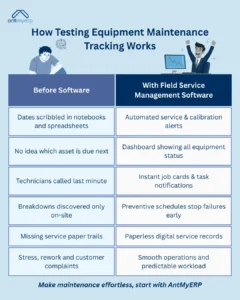
Maintenance tracking turns chaos into consistency.
Imagine a field coordinator juggling 40 rental assets across three cities. Before tracking was digitized, he scribbled dates in a notebook and prayed nothing slipped. Inevitably, it did and breakdowns followed.
Now, every asset automatically alerts him before a service is due. Technicians get job cards, customers stay informed, and the field coordinator sleeps better knowing he won’t get a midnight panic call.
A structured system typically includes:
- Service reminders before due dates
- Calibration alert cycles for accuracy
- Asset assignment and check-in/check-out
- Usage logs for high-volume equipment
- Technician notifications with job details
- Automatic creation of digital service records
Why Rental Businesses Need Testing Equipment Rental Software
When equipment moves between customers, keeping track manually becomes near impossible.
A rental owner in Hyderabad shared how missing one return inspection led to a false damage claim and a full deposit refund loss. With software logging check-in status, this risk disappears.
Here’s how rental software helps:
- Tracks location, allocation and return condition
- Ensures machines are rental-ready
- Syncs service due dates with rental duration
- Shows downtime vs working hours
- Prevents bill disputes through proof
- Avoids confusion across teams
Emission Equipment Field Service Management Software Advantages
Software removes manual dependency and builds consistency across locations.
A field service system enables:
- Central dashboards for all test units
- Automated service scheduling
- Predictive alerts before breakdown
- Spare parts and calibration kit tracking
- Technician route planning
- Quick reporting for customer documentation
How AntMyERP Eliminates Compliance Risk
AntMyERP tracks every service, calibration, and AMC automatically, keeping equipment audit-ready without extra admin.
Alerts, logs, and technician updates ensure rental fleets stay compliant, certified, and fully operational.
With AntMyERP you get:
- Central field service management system
- Calendar-based alerts & schedules
- Cloud service automation software
- Track technicians, spares and warranty
- Paperless digital service records
- Multi-branch maintenance visibility
- Audit-ready reports at any time
Find out how AntMyERP transformed service tracking for others. Read the customer testimonials and know more.
From Reactive Repairs to Equipment Preventive Maintenance
Fixing problems after they occur feels like a race you never win.
A preventive model is like servicing your bike before a road trip, it’s cheaper, safer, smoother.
Benefits include:
- Lower repair frequency
- Longer lifespan per device
- Steady billing without interruptions
- Reduced stress on field teams
- Higher uptime during peak seasons
Equipment AMC Management For Emission Testing Devices
AMCs sound simple until someone forgets a renewal date.
Many rental teams realize too late that an AMC expired, and suddenly every repair becomes fully paid and urgent. Digitizing AMCs eliminates that risk.
Strong AMC management supports:
- Renewal tracking with reminders
- Third-party vendor SLA monitoring
- Clearly defined service responsibility
- Central calibration certificate storage
- AMC cost vs repair cost comparison
Industries That Benefit from Proper Service Tracking
Structured service tracking supports every industry where emissions and accuracy matter.
Key industries include:
- Equipment rental companies
- Construction and infrastructure firms
- DG set and compressor rental providers
- Pollution monitoring & testing labs
- Automotive inspection centers
- Waste management plants
- Mining and exploration
- Industrial compliance advisors
Performance Analytics, Trends And Real-Time Insights
Data transforms guesswork into confident decisions.
Analytics reveal:
- Units with repeat failures or high repair costs
- Replacement planning using equipment lifecycle management
- Idle vs overworked devices
- Cost per service or per hour of use
- Location-wise utilization patterns
- Seasonal rental and maintenance demand
- Instant exports for compliance audit readiness
Conclusion
Skipping or delaying emission testing equipment service tracking sets rental businesses up for regulatory penalties, customer dissatisfaction, and costly breakdowns.
Staying on top of calibration and maintenance isn’t an extra task, it’s the shield that protects reputation, revenue and long-term customer trust.
With automated schedules, clean service logs and AMC reminders, AntMyERP ensures every piece of equipment stays compliant, rental-ready and profitable from day one.
Ready to Keep Your Emission Testing Equipment Compliant and Rental Ready?
Get started today and ensure every piece of equipment stays compliant, operational and profitable.